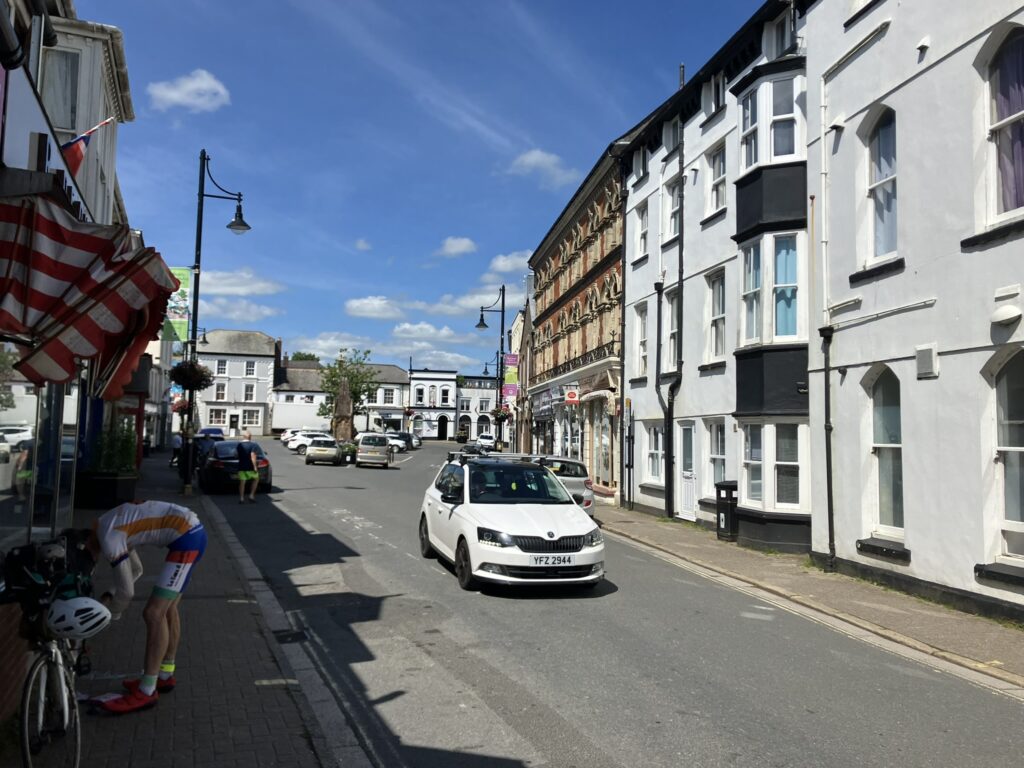
When I was ten, my mom and dad made a gut-wrenching decision and gave me up for adoption…
…to the English language.
The process began when I was six, as my parents thought it was wise to start me on a frequent flyer program by having me stay 6 months in Taiwan, where I was born, followed by 6 months in San Diego. During this period, I excelled at being bad at both languages in school. While Taiwan school officials willingly admitted me provided that a bribe was attached to the admissions forms, the school administrators at La Mesa Dale Elementary School actually looked out for my best interests and told my parents: “You need to make a decision regarding your son’s education.” So in the middle of my 4th grade year, English became my permanent adopted language.
I experienced a harsh upbringing.
For most of 5th and 6th grade, I walked home with Cs and Ds as I struggled with writing grammatically correct English. The prevailing educational theory classified me as having a “learning disability.” I was sent to a “special ed” instructor who tried to help me, along with other kids who spoke like Elmer Fudd or stuttered like King George VI.
At home my mom was in distress. She acquired rudimentary functional use of English to make sure I had a roof over my head, clothes on my back and rice in my bowl. She picked up the language in part by using my “Cat in the Hat Beginner Book Dictionary” by Dr Seuss. Still, she was helpless as I struggled. As a loving Chinese mom, she could only attribute my bad grades to one cause: I didn’t work hard enough. I got plenty a-yellin’ each time I brought home my report card during this dark period.
In between being labeled “disabled” at school and “lazy” at home, I distained English.
I started to decipher the riddle of English grammar with help from friends of family. With additional tutoring outside of school, I began to write properly. I finally turned the corner when I entered high school and skated through English classes with high marks up to the end of my sophomore year.
Then Mr. Landry became my English teacher in my junior year. He was well into middle-age with a beard and the stern countenance of a communist party cadre. He always wore a Panama hat and a pair of Birkenstocks, reminding us he had tenure and we couldn’t do anything about it. At the time, I had perfected my sob story about having to learn English later than the rest in class. He looked at me with a contrived look of care. By the end of the first semester, I received a B in his class.
I was pissed. I became defiant. I also became relaxed, since I wasn’t in the game of grade mongering anymore. I recovered and regained my pace in his class. A year and a half later at senior awards night, Mr. Landry walked to the podium and announced my name as the Recognized English Student for my graduating class. After graduation, Mr. Landry became Dave, a close friend and confidante. In 2011 he crewed on my RAAM team in my first foray into endurance cycling.
Ironically, I took no English literature classes in college. I found academic literary analysis about as useful as performing mime to the blind. Good stories were about how to appreciate them as the reader, not squeezed to death extracting some shred of “evidence” to prove a flimsy thesis.
It wasn’t until I started riding a bike in earnest that I began to flirt with English as artistic expression. Since I did not have the habit of listening to music while riding, I would occupy those solitary moments by conjuring up rhyming words: what rhymed with “languish?” How many words rhymed with “ate”? Or trying to string together a sentence in iamb or trochee. Perhaps I became more aware of meter as I could feel and hear the pounding of my heart when climbing up a hill.
I went so far as to apply for admission to Stanford University. On the strength and merit of my impeccable FICO score when my credit card payments were processed, I took a couple extension classes on poetry writing. Modern poets only wrote in free verse. I was ridiculed for rhyming and following meter. Since then, I have avoided all poetry classes.
Instead, most of what I’ve learned was when a gay British man took me under his wings: I read Stephen Fry’s “The Ode Less Travelled.” His wit developed and crafted over decades of being an accomplished comedic actor and author made the book very accessible in understanding the structures and techniques of various poetic forms. He also shared my affinity for rhyme. In a world which deprecated rhyming, Fry’s encouragements gave me hope.
At this time, I rode with a Bay Area group called the Fremont Freewheelers Bicycle Club (FFBC). Back in the day, club rides required printed cue sheets since electronic navigation was still in the distant future. In jest, I wrote down the turn-by-turns in the form of English heroic verse: iambic pentameter rhyming couplets. Someone in the club asked if I would take on the role as the club’s newsletter editor based on my perceived poetic prowess. I accepted, thinking that my works could finally be “published” under the self-dealing of my editorship.
I still earnestly worked to find content to fulfill my role. In 2007, I caught wind that Bill Brier, a club member, just came back from this epic ride called Paris-Brest-Paris. I reached out for an interview. He accepted the invitation. Afterward, I thought to myself: I don’t think I’ll ever take part in such a long crazy endeavor.
A memorable endeavor is like a pearl. A speck of sand is implanted inside the oyster. In resisting the agitation caused by that intrusion, the oyster starts to form layers around it as protection. The accumulation of these layers ultimately transforms that speck of sand into a beautiful pearl. The idea of taking part in PBP became implanted in my head. The initial agitation became curiosity, then finally discovery and entry into the beautiful world of randonneuring. Random thoughts during a brevet become a poem.
I want to deconstruct and share all the bike, gear and any other details about travel, storage, lodging, etc. I will wax in geek speak to help explain what and how I prepared. I hope my trials and tribulations will help you in your preparation and planning for this or any brevet or grand randonnee.
The Bike
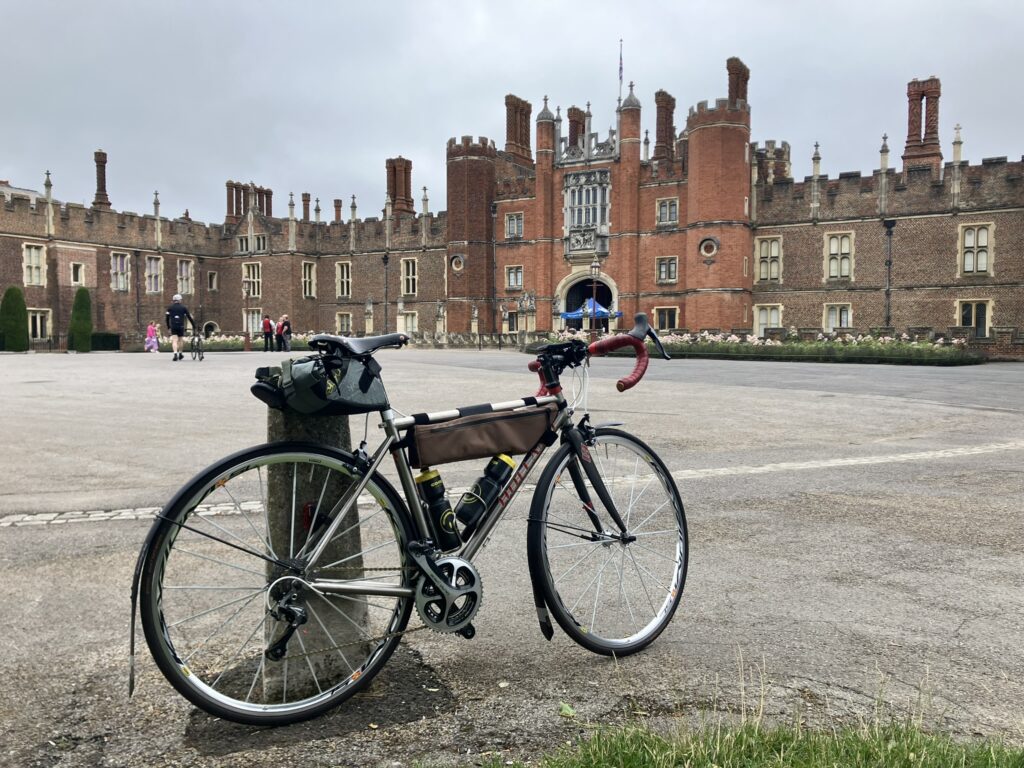
Hampton Court Palace dry run
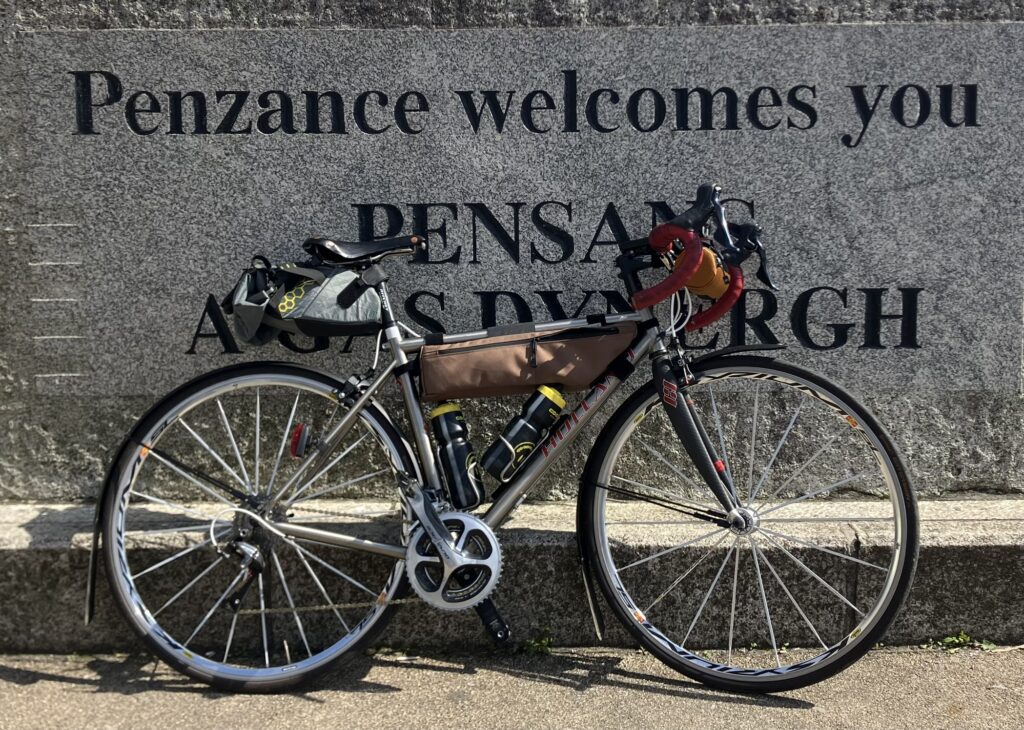
In late 2018 I took delivery of a Bill Holland custom titanium frame with the Richey breakaway in preparation for PBP 2019. It has been my go-to bike for all long distance events. At the time, disc brakes were still rather new on road bikes and I wasn’t familiar working with them, so I decided to stick with rim brakes.
Here are the deets:
Shimano Dura Ace 9100 11-sp shifters
Shimano Dura Ace 9000 52-38 11-sp crank
Shimano Dura Ace 9100 11-30 rear cassette
Shimano Ultegra R8000n 11-sp front derailleur
Shimano Ultegra 11-sp rear derailleur (the generation when the cable end pointed out)
Shimano Ultegra caliper brakes
Holland branded carbon fork
Brooks Swift saddle with titanium rails (style points with perhaps some weight saving)
Brooks leather bar tape – red, to match the bike. Had since 2019.
King Cage titanium bottle cage for downtube, side accessible
Unknown maker titanium bottle cage for seat tube (bought from Robert Abraham before he moved out of San Diego)
Mavic Ksyrium SSL wheel set (I struggled with putting tires with tubes on tubeless ready wheels, so I bought a “vintage” wheelset that could only take tubes)
Conti Gatorskin tires for 700Cx25
Because of the premature cable fraying in the shifters, I transitioned to a SRAM Red eTap shifters. As a rim brake bike, I had to find a set of used SRAM eTap shifters and derailleur for an 11-sp drive train with mechanical caliper brakes. There was an outfit called Elevate Cycling. I chose SRAM over Shimano because I like SRAM’s modular battery pack so I didn’t have to park the bike next to an outlet to recharge. I could bring an extra charged battery and bring along the charging cradle to plug into a battery. Just before the start of the Garden State series in 2025 the latch securing the front derailleur battery snapped off during assembly. During a shakedown ride I nearly lost the battery. I ended up using a zip tie to secure it and it worked out well beyond the 1000k.
I had to make trade-offs to get the other accessories to fit and could not install fatter tires which would have been ideal for UK infrastructure’s state of disrepair. I am considering a new titanium frame bike (N+1).
Fenders
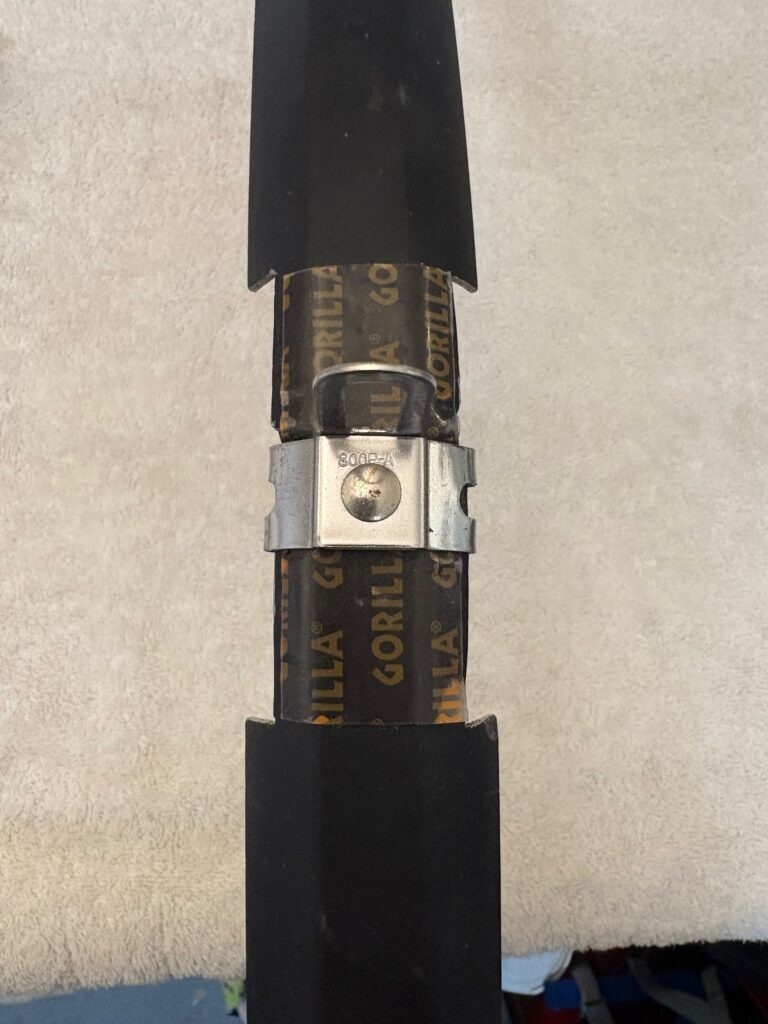
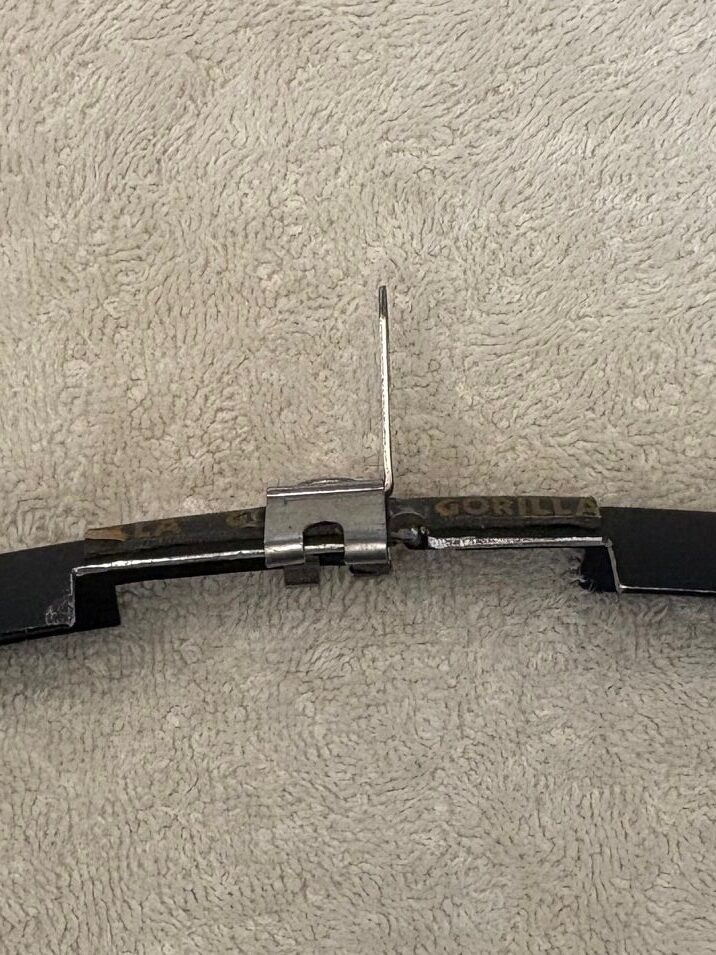
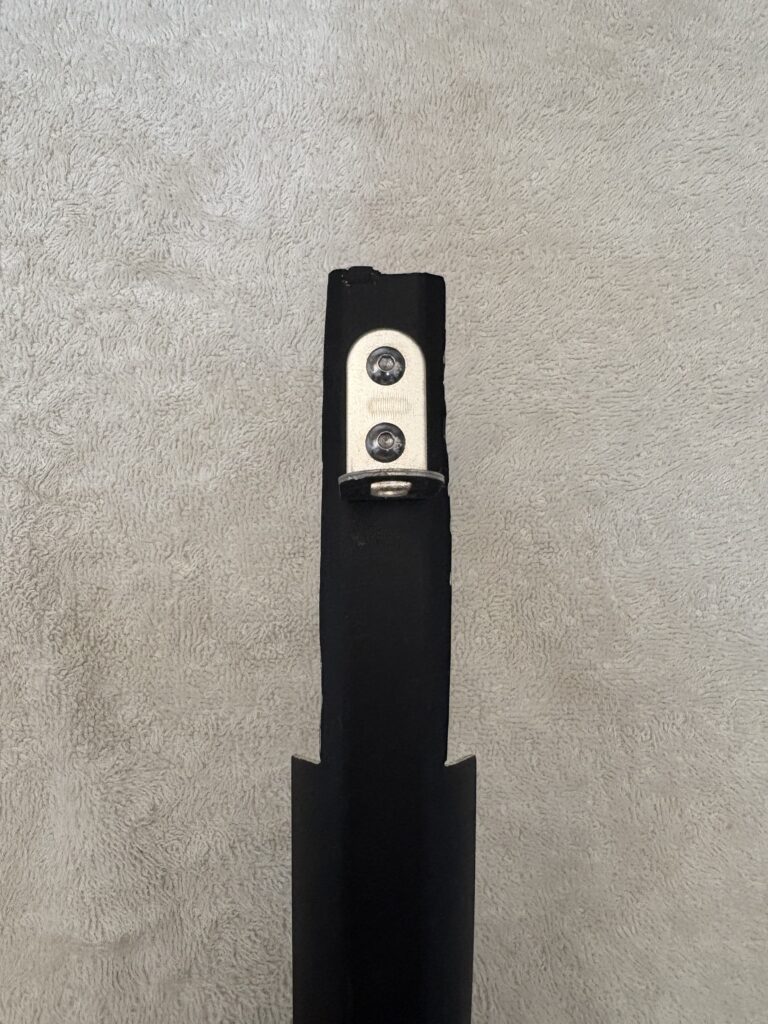
Portland Design Works full metal 700×30. Rain was my biggest concern. At LEL in 2017, a torrential down pour on Day 1 was the seed of my downfall. I previously installed a 28 but it wasn’t wide enough to minimize splash. When I tried to install the 30s, it didn’t have enough clearance in front and rear of the bike. I had to cut out 2-inch sections on both sides of each fender just enough to clear both fork and frame widths. The maximum tires I could put on were 700×25 to prevent any rubbing.
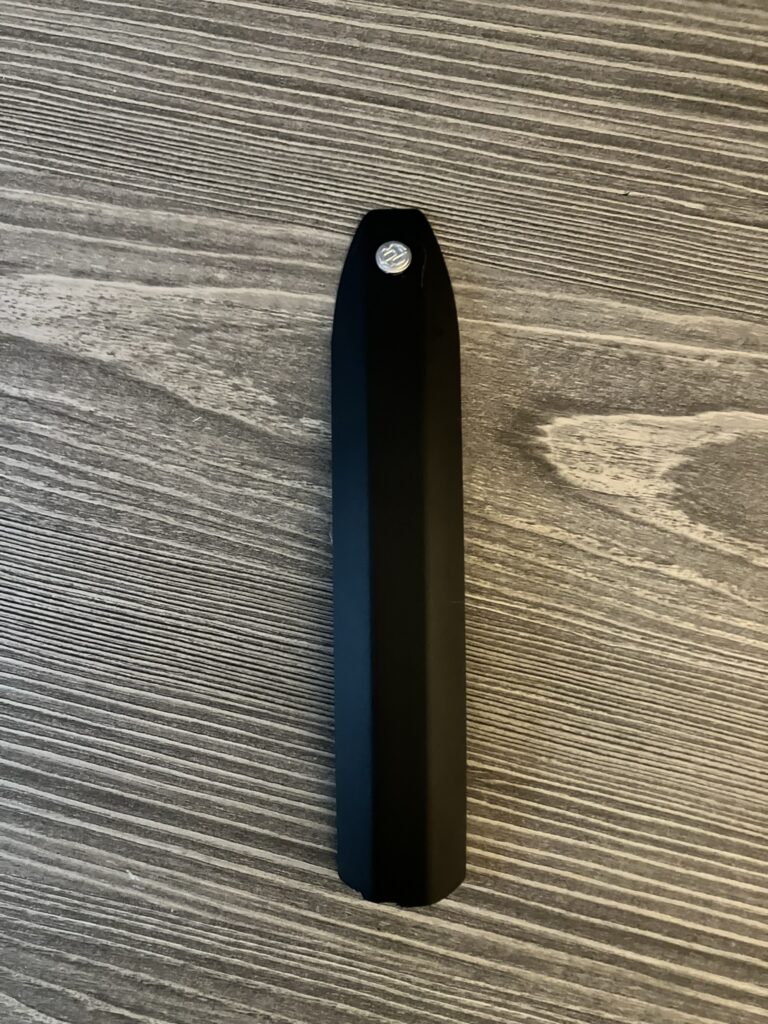
Rear fender -top viewRear fender-side view
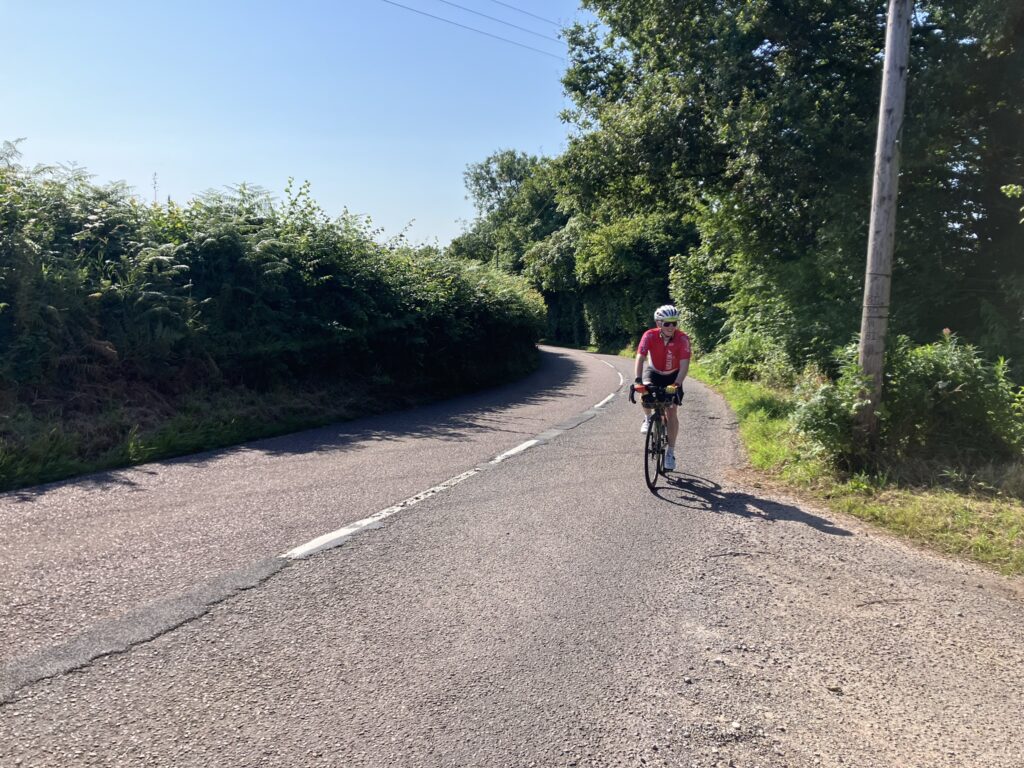
The road conditions in the UK were atrocious. Patches covering multiple excavations would have 50 shades of grey yet 60 different depths. When the Conservative government instituded austerity, they applied it liberally. Because of the cutouts, the front fender’s structural integrity was compromised. The shock and vibration was so incessant and violent at times that when I reached Wiveliscombe, the front “tongue” just simply fell off when I stopped at an intersection. I conjectured that the vibration from the bounces matched the harmonics of the molecular bond of the aluminum such that they separated.
In the end, it never rained from start to finish. The closest I came to feeling any moisture was then climbing Bretherdale Head in Cumbria. Another rando complained what a waste of time it was to install fenders. I thought they were the talisman that warded off the rain.
Coming home, I wanted to widen the clearances to allow both fenders and wider tires. I replaced the front fork with one made by Ritchey with cantilever brakes. To my dismay, I had no options for my rear. For the Garden State series, I kept the fork so at least I could keep the front fender intact and was very careful to cut out the rear fender. The only “issue” I had was nosy randos asking me why I had 2 different brake types and then shared their postulations.
Fiat Lux (Let There Be Light)
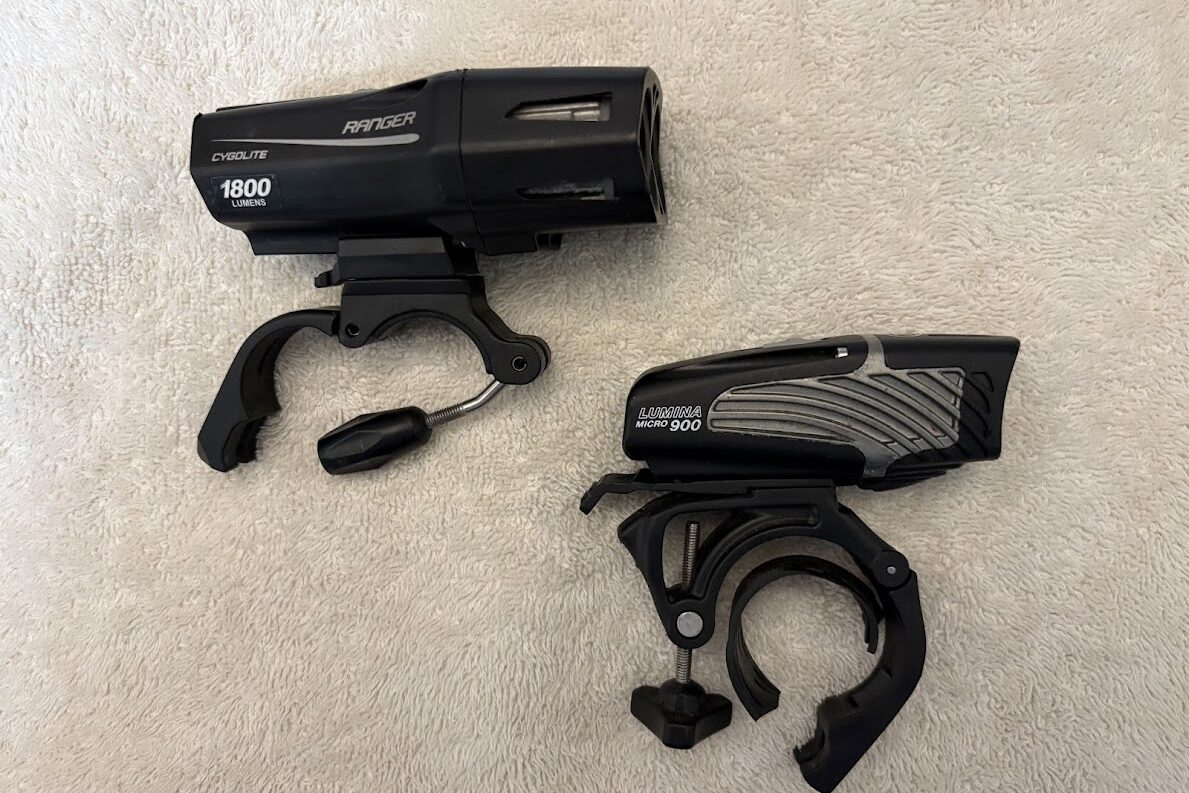
I knew I wasn’t going to ride through the night. Britain in the summer had extended daylight hours. Any riding in the dark wouldn’t be long. I brought a Cygolite 1800 as my primary headlight with a NiteRider 900 Micro as my backup. The Cygolite had the benefit of continuous operation when recharging while the NiteRider did not (at least not the one I have).
For my rear light, I used a AAA battery powered Planet Bike light. I didn’t want to deal with another device needing charging. Instead, I packed 2 spare batteries in my repair kit.
I Got the Power
Because I was foregoing a dynamo to power my light and Garmin with the Sinewave USB charger, I relied on one 5000 mAh battery in my frame bag for my phone and one 10,000 mAh battery in my handlebar bag to charge the Garmin and light. I performed a weight comparison between battery+Cyglolyte+front wheel combo and the wheel with SONS dynamo+Edelux II+USB charger combo. It ended up being almost the same weight. So I decided to go with the former to save the drag that the dynamo would cause. All in the margins in the end.
Rather than worrying about charging anything, I packed batteries in both drop bags so that I could just grab and go. While at the overnight controls, I would drain the current battery, knowing that I could swap out with fresh ones before I left.
Bike Cartage
Saddle Bag
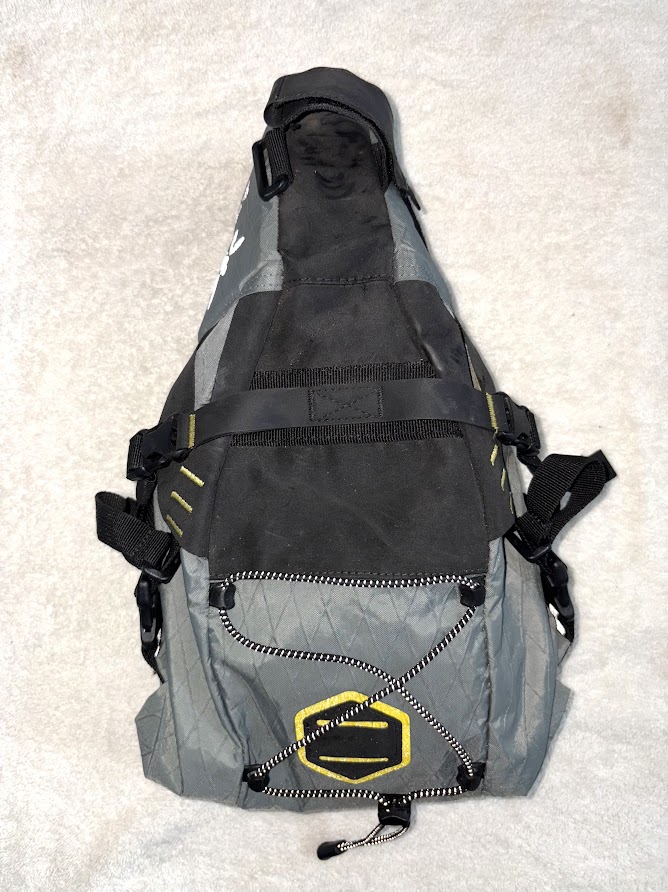
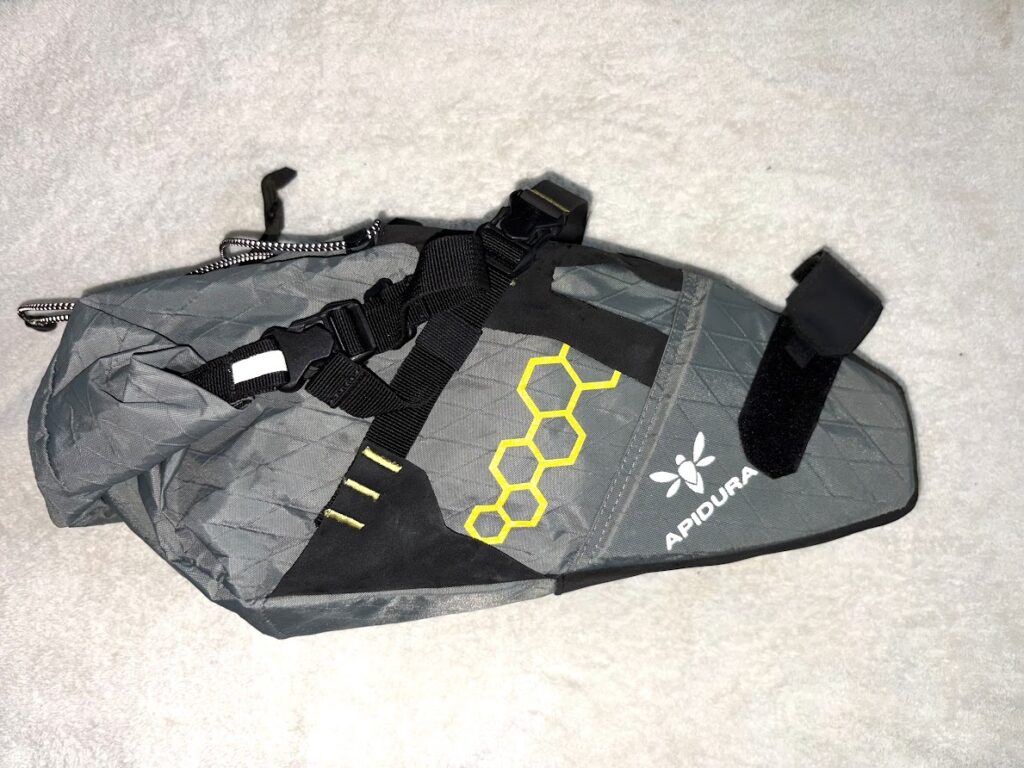
Apidura 7L bag – LEJOG’s drop bag staging required me to carry a change of bib shorts at the first overnight. Other items in my bag included tool kit, 2 spare tubes, my control clothes. It was easy to take off and put back on the bike, which was an essential feature as I needed to carry it with me while at overnight controls, especially the 2 where I needed to exchange items with my drop bag.
Frame Bag
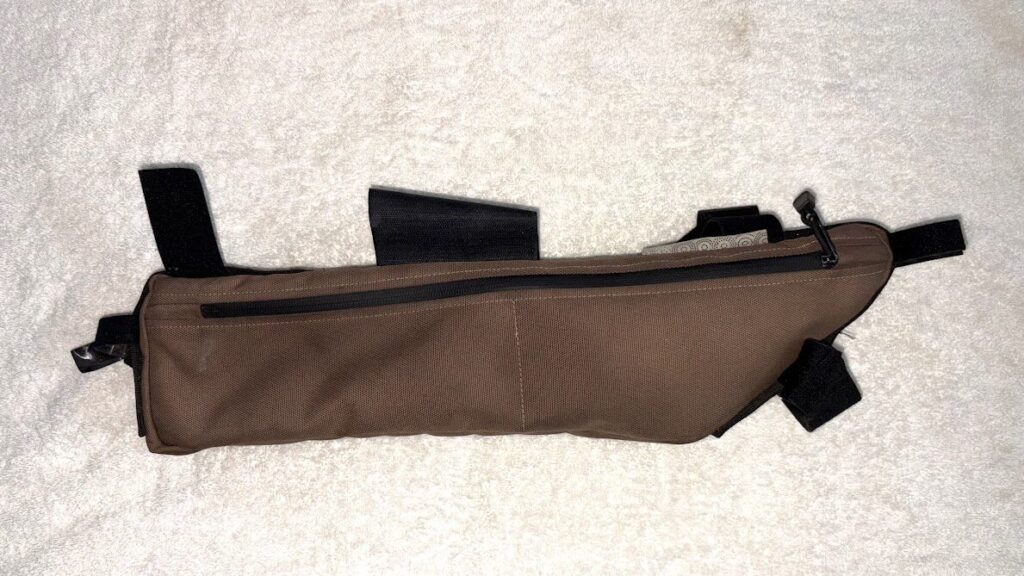
Outer Shell medium frame bag – I decided to use a frame bag to carry smaller clothing items (light full-finger glovers, gaiter), on-ride food and the NiteRider headlight. I ran into an issue with getting to my down tube water bottle, so I installed a side access bottle cage. My other minor gripe was the material used for the straps. They scuffed up my other Ibis Hakka gravel carbon frame.
Handlebar Bag
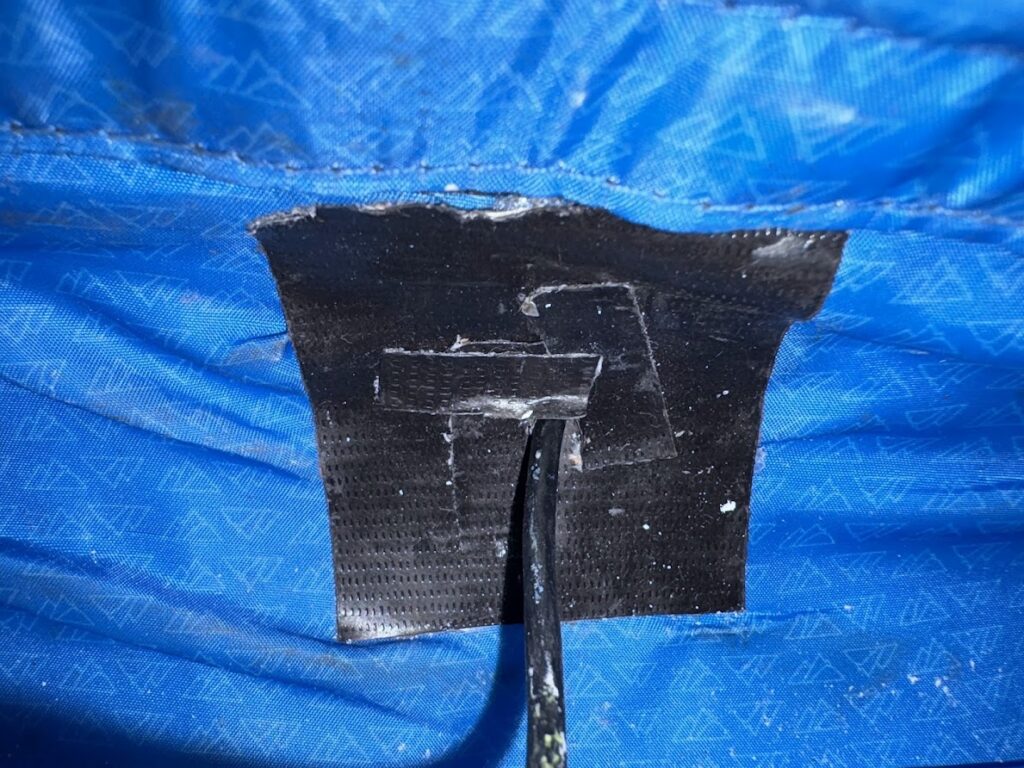
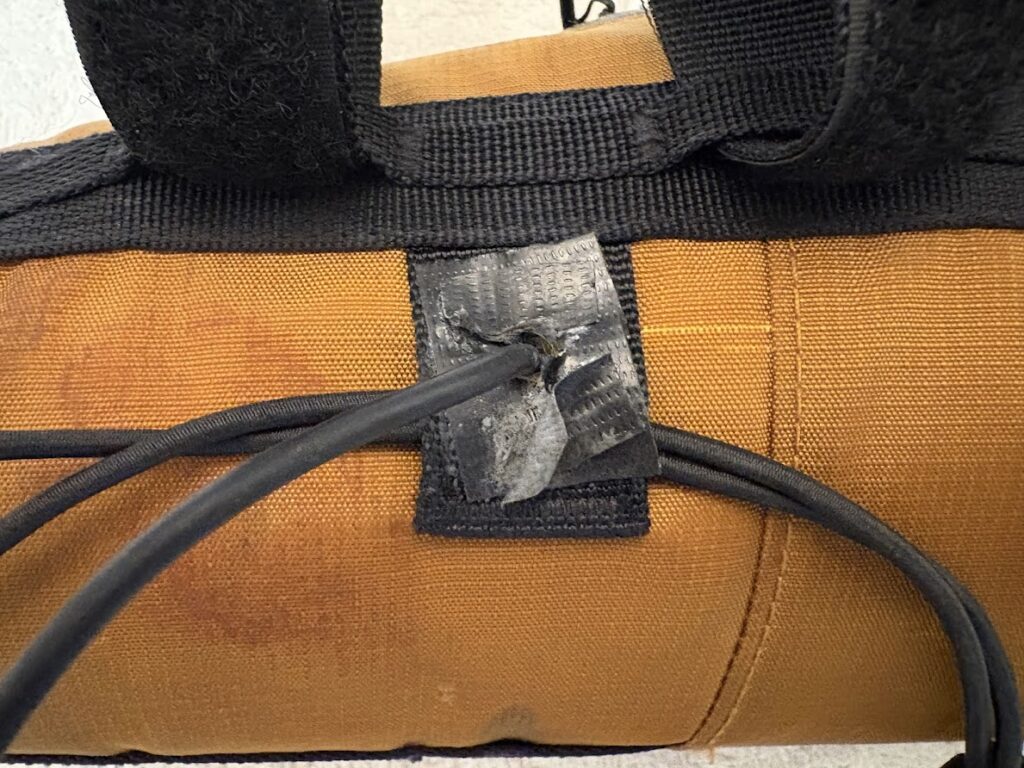
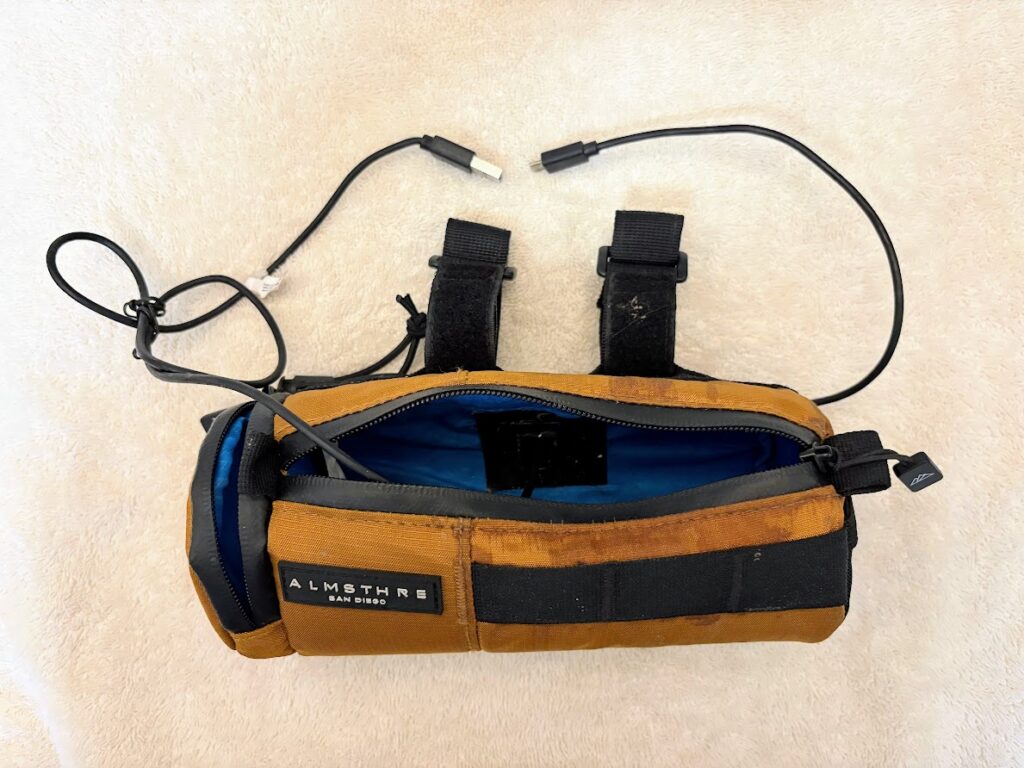
Almstre handlebar bag compact 3.5” diameter x 7.5” long. I use this bag to carry my 10,000 mAh battery, care kit and a plastic spoon. I needed to route a USB cable to connect the battery to the Garmin/headlight while riding. If I ran it through the zipper opening, rain and the resulting leak would ruin its content. I punched a hole through the body of the bag facing the stem where water would least likely get to and pulled the cable through that hole. It was all for naught since I never rained during LEJOG. It was tested during the Garden State series last May. Content remained bone dry. My only issue was insufficient space so recently I bought a larger bag from Almstre.
Inside view of custom routingOutside view of custom routing
Repair Kit
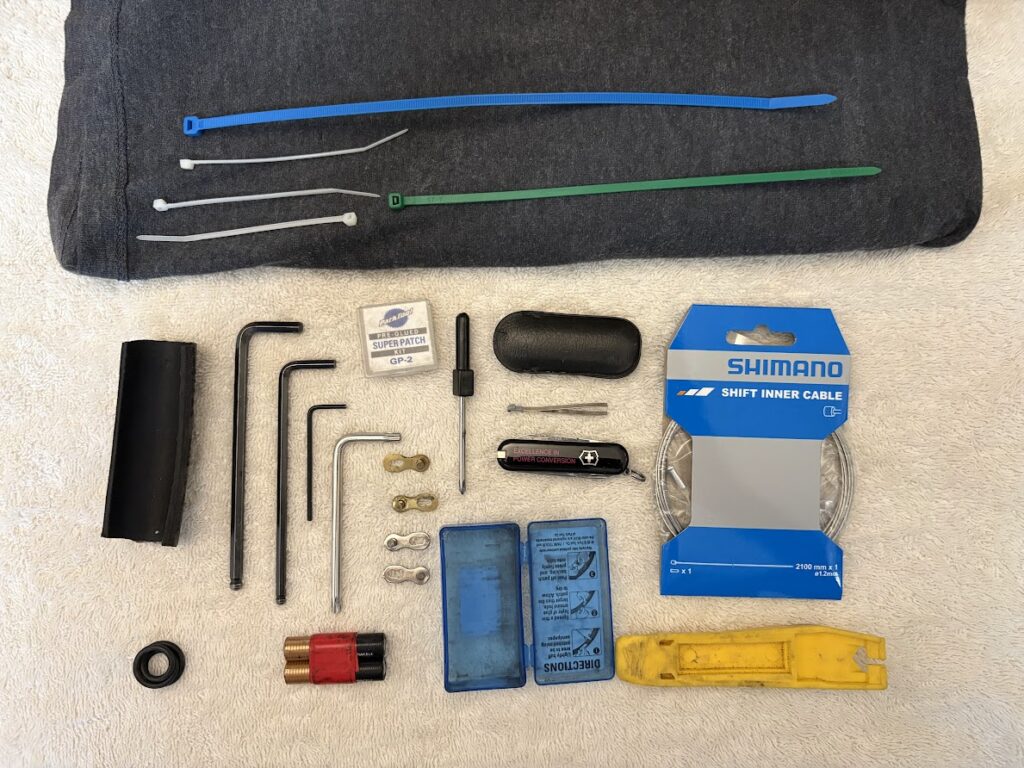
The items shown below are what I carry in my repair kit for LEJOG:
Spare zip ties
Tire boot made from cutting a section off of an old tire
5mm hex key
4mm hex key
2mm hex key (for derailleur adjustment)
Spare Garmin rubber band
2 AAA batteries for my rear light and additional electrical tape
Tube patch kits
Small phillips head screw driver
2 sets of 11-speed quick links
Small Swiss Army knife with a tweezer (to remove wires from tires)
Old Park Tools patch kit box to store quick links and Swiss Army knife
Pedro’s plastic tire spatula
LA Matt’s brevet savage spare derailleur cable (there is a back story!)
Zip ties are the caulk and duct tape for long distance cycling. It is the Jesus that saved many of my brevets from ignominious endings.
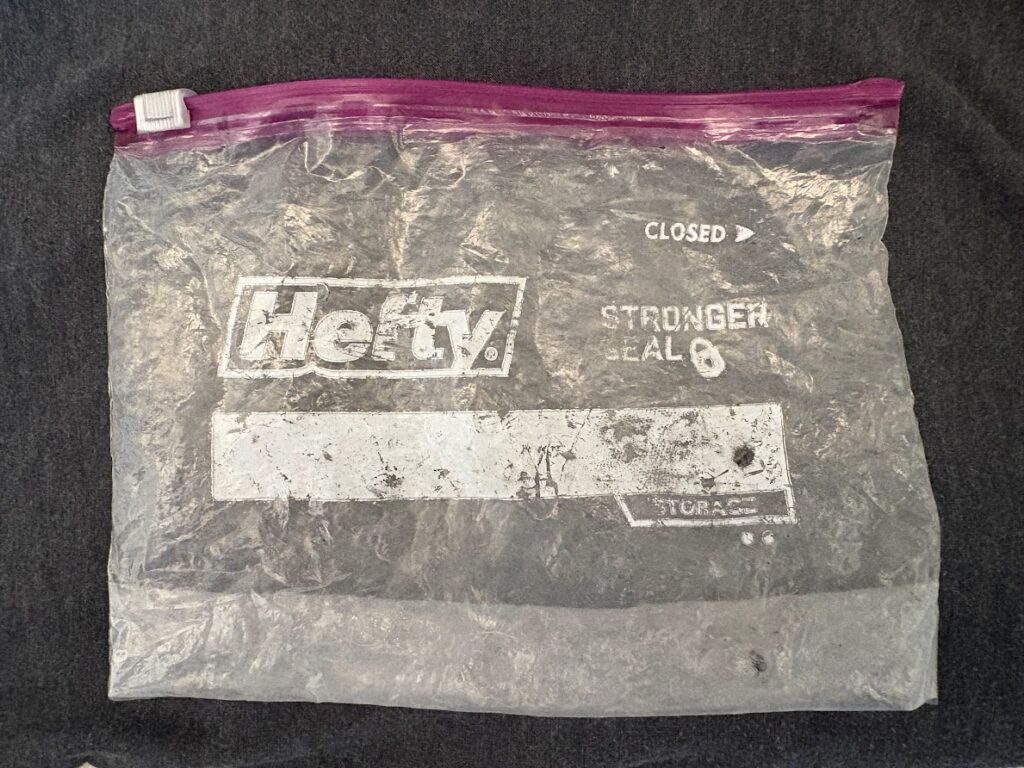
Below was (and still is) my fancy repair bag.
Care Kit
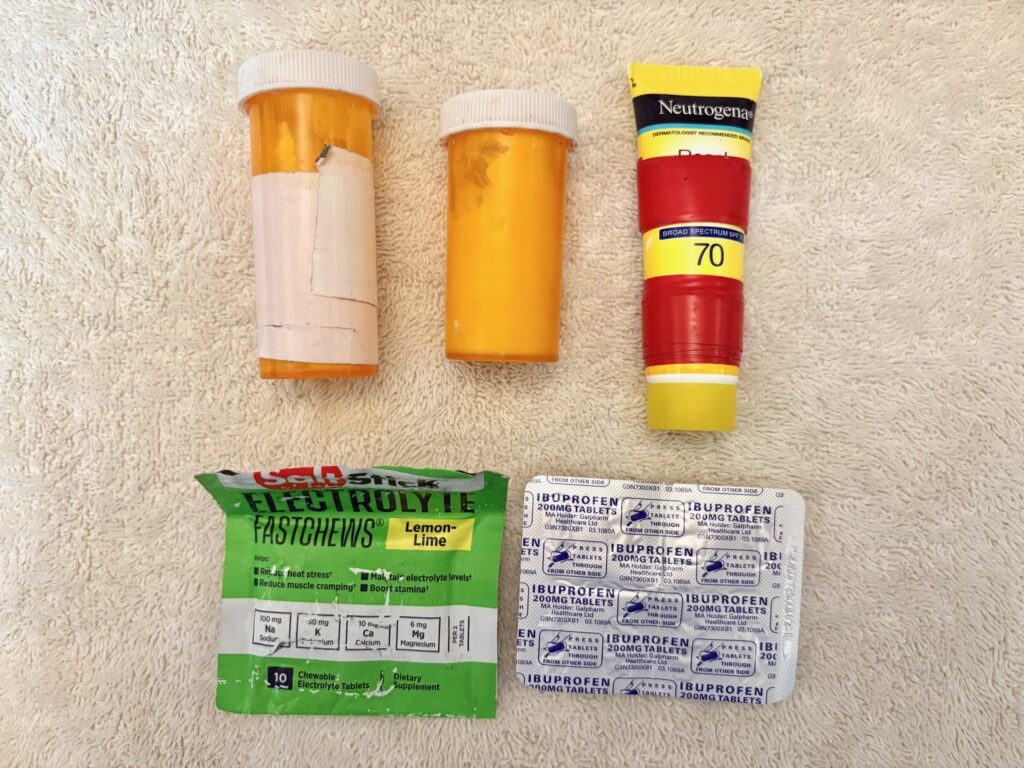
My kit contained antacid tablets (not in photo), ibuprofen, electrolyte pills, chamois cream and sun block. I recycled empty pill bottles as portable containers for chamois cream so I could easily pack in my handlebar bag. Mid-ride touch up were necessities. I packed a spare bottle in my saddle bag. When I accessed my drop bag, I would refill with the tube I packed in each. I preferred DZ Nuts for its 4 oz tube packaging. It was pricey but its form factor enabled easier transport.
I wrapped spare duct tape around 1 chamois cream bottle as well as spare electrical trap around the sun block tube.
Control clothes
I packed a lightweight shirt and a pair of loose boxer shorts to wear at controls after showers. I needed maximum airflow in that nether region of the undercarriage to recover. Again, an important lesson I learned at LEL 20i7.
Drop bags
We were allowed 2 drop bags for 4 overnight controls. Each bag didn’t have much capacity compared to a back pack. Trade-off had to be made given this limitation. For the first bag at Golborne, I packed 1 bib shorts. Upon my arrival, I would pick up the fresh shorts and jersey and put my 2 used shorts from Day 1 and 2 into the drop bag for pick up at the finish. When I arrived at Kirkburn at the end of Day 3, I then changed my shorts and jersey for Day 4 and 5. I needed to pack my post ride change of clothes so I had to sacrifice another clean bib shorts for Day 5 in the Kirkburn drop bag. In each bag I also packed two 10,000 mAh batteries and one 5,000 mAh battery, 2 tubes, a tube of chamois cream, on-ride snacks and electrolyte powder.
Route Planning and Scouting
Because we were looking for hotels in lieu of controls to grab sleep, I had to scope out places that would support our late arrival/early departure. Quaint B&Bs and small local hotels were many, but most would be closed when we would likely arrive after 9:00PM. That limited the choices and thus forced us to look for national or international chain hotels farther than I would have liked.
As a result, I had to prepare an itinerary to show where I would be from day to day, control to control. I also inserted the name and distance of the hotels. I searched for places to eat to account for early check out.
Photography
I use an iPhone for all my photos, on or off the bike. For LEJOG, I was still using an iPhone SE with a single lens. It took good enough photos.
The most important thing I tried to work on was composition. When possible, I applied the “rules of thirds” to place the subject along the 4 lines (2 vertical, 2 horizontal) cutting the plane into thirds. Avoid placing subjects right in the middle. Sometimes if I couldn’t compose during the shot, I worked on it when cropping. I tried to find repeating patterns (houses, fences, etc) or leading lines (road, streams).
I developed and honed my quick draw skill when pulling my phone out of my right rear jersey pocket to snap a picture. When I crashed and separated my right AC joint in November 2024, I lost so much range of motion that I couldn’t reach the phone in time from my pocket. I tried to stage the phone in my frame back to no avail. For NJ Randos’ Garden State series, I had to forego many photos. I have recovered enough of my range of motion in the latter half of 2025 to start taking photos more regularly.
Navigation
Andy sent out the full RWGPS route. My Garmin 1030 would not be able to handle that amount of data. I broke the route down to each day’s ride. I customized the turn-by-turns to account for when our hotels were located off course. Then for each day’s file, I created a backup so that if the main file became corrupted for whatever reason, I have a backup file. When riding, I often just left the map screen on so I can follow. My average speed and current speed were vanity data.
Booking Lodging at Start and Finish
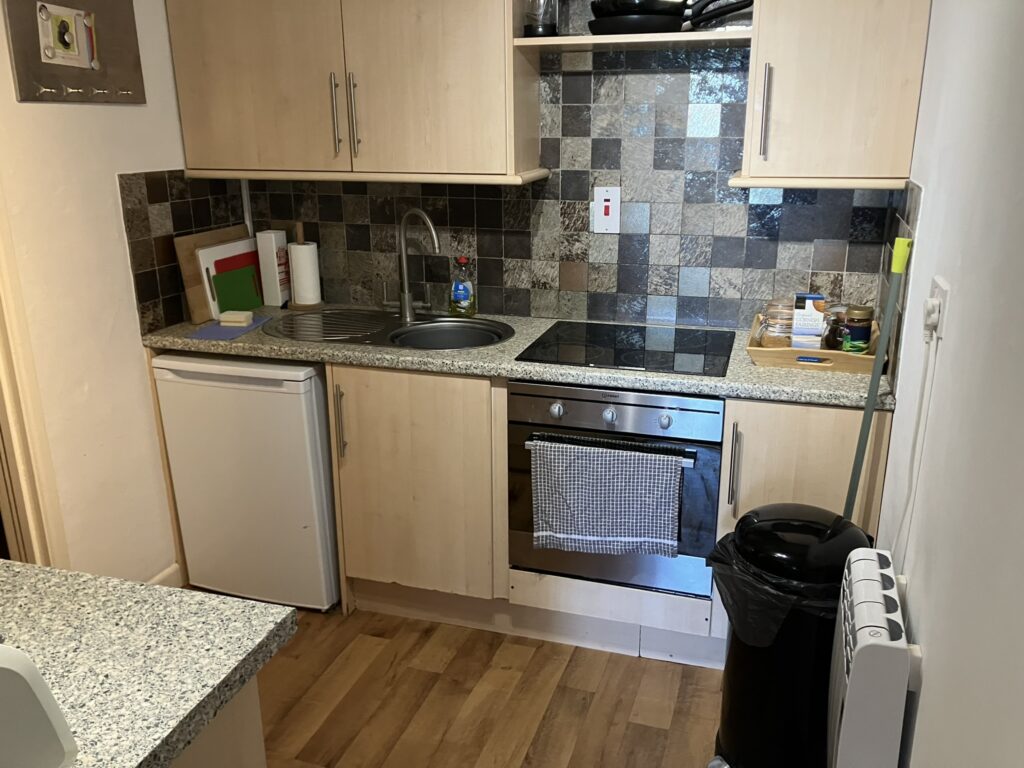
I am now an adherent to Airbnb. For the start, we found a place that was walking distance to the start HQ. The property had a full kitchen that enabled us to buy food of our choosing to cook and enjoy. There were 3 beds for Michael, LA Matt and me. Came out to $645 for 3 nights.
At the finish we found a motor home that was so close to the John O’Groats that I was able to walk to despite being drunk and tired at the end. It was $103 for 1 night.
I was never a big fan of Airbnb until now.
Transport to Land’s End and from John O’Groats
I reached out to Tal Katzir, Israeli Randonneurs RBA and current LRM president. He first tipped me off about LEJOG. His guidance on transport was to reserve a one-way rental a car from London and drop it off at Penzance; then for John O’Groats, bike to Wick to pick up the rental car and then drive it back to London. Given what ended up happening, Michael rented a car and drove to John O’Groats to bring Matt and me back to London.
Storage of Bike Box and Other Belongings
In the mid-90s, I studied in London for my masters. I reached out to a classmate, Cheri, who not only offered me a place store my belongings, she invited me to stay at her home throughout my visit before and after LEJOG. Her boyfriend, who was a cycling enthusiast as well, let me use his repair stand then helped me put together and take apart my bike. He also guided me on several shakedown rides through Richmond, taking me to see Hampton Court Palace where King Henry VIII resided and along the banks of the River Thames. To celebrate my finish, she invited Fiona, another classmate, with her partner and hosted a lavish dinner with bottles of wine and delightful conversation about art, literature and British comedy, all on the pretext to help me recover from my calorie deficit. Always good to have friends at RIGHT places.
With Cheri and David, my gracious hosts
Training
Last time I trained for a bike race was in 2017. The moment my team rolled into Dockland at Annapolis to end our RAAM campaign, I set aside my power meter and HRM strap. Recently I started to wear the strap. All the zone this and zone that and tempo whatever seemed to distract the purpose of randonneuring, which for me was to ride my bike with friends over stupidly long distances. For LEJOG, I was not striving for any fast times. A good time was just that, having a good time and exploring a new country, taking in amazing views. Don’t get me wrong: if striving for tempo vs threshold intervals and chatting up about FTP and Watts-Not are what float your boat, sail on, commodore.
I distilled riding my bike into 2 zones: Zone Fun and Zone None: 100% in Fun and 0% in None! To paraphrase John Quincy Adams: I am the well-wisher to all who defines whatever it may be for their Zone Fun; I am a vindicator only of my own.
For LEJOG, I completed a full SR series (I recall that year I scheduled routes with massive climbs to prepare for an 8k600). In July I then scheduled a 300/300/200 weekend; the final 200km was to get my head into restarting the motor after 600 km of riding. Yogi Berra summed up randonneuring pretty well when describing baseball: “… is 90% mental. The other half is physical.”
Reflecting on LEJOG, I grossly over-estimated my capabilities and under-estimated the route. In the end, I finished 30 minutes less than my target of 110 hours. But the toll was much higher than I ever anticipated. “The best laid schemes….”
Recommend LEJOG?
Would I recommend anyone to give LEJOG a go? Hell yes! But with provisos.
Would I go back to take part in LEJOG again? Hell no! I was lucky to have no inclement weather in 2024.
I would consider a more relaxed form of LEJOG. Hurrying past Tintern Abby, Monmouth, Balmoral Castle and Castle Cawdor, I’d like to go back to visit those important places of British history and literature. Next time I am to stay at every hotel I book.
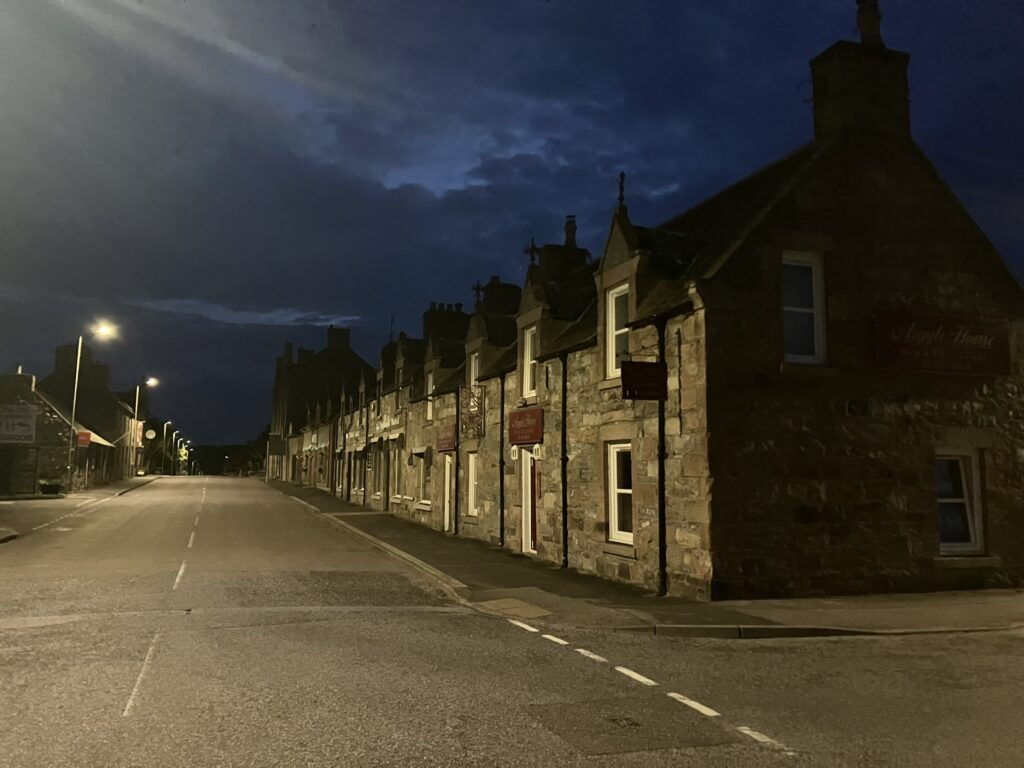
At 3:14AM, just before the phone alarm announced the appointed time, I got up and made preparation for the final push to John O’Groats. Surprisingly the joint aches and sinus congestion evaporated like water droplets hitting a hot pan. I suited up and walked out to my bike to prepare for the final 180 miles.
The streetlight I mistook for the sun
With a protesting stomach, I met Mimo to leave at 4:00AM. Late last night Expat Matt made it to the Argyle Guest House. He was just starting to pack up his saddle bag as we mounted our bikes. “It’s 4:04 now” I announced in a very noticeable tone of aggravation. He told us to go ahead and would catch up to us. We clipped in and left Tomintoul.
It was comfortable riding into the sunrise. The silence of dawn was only broken by the ratchety whines of our freewheels when we were descending. Not long after leaving Tomintoul, light pierced through the horizon, giving new hope.
This region of Scotland was blessed with extraordinarily natural rugged beauty. We would ride through heather and grassland plains followed by densely wooded forests. Gentle rollers were ahead and behind us. About 30 miles into the day’s journey, I spotted the sign pointing to Cawdor Castle. I imagined Macbeth, after his elevation to Thane of Cawdor, walked the castle’s hallways pondering pensively as Lady Macbeth. exhorting him to “screw your courage to the sticking-place and we’ll not fail” before that fateful decision to pursue his murderous deed.
“We’ll not fail!” I murmured to myself. Instead of being one murdering, I was being murdered by the pain in my back and the soreness in my ass. Lael Wilcox, when asked about facing physical discomfort during any endurance race, said, “I tell myself that the pain won’t last forever. I check in with myself to see if I’m doing my best. Even if I feel terrible, if I’m trying my hardest, that’s all I can do. For the most part, I really enjoy being out there – seeing the natural beauty, spending time alone with my thoughts and pushing my physical limits.” I kept reminding myself: screw your courage to the sticking-place!
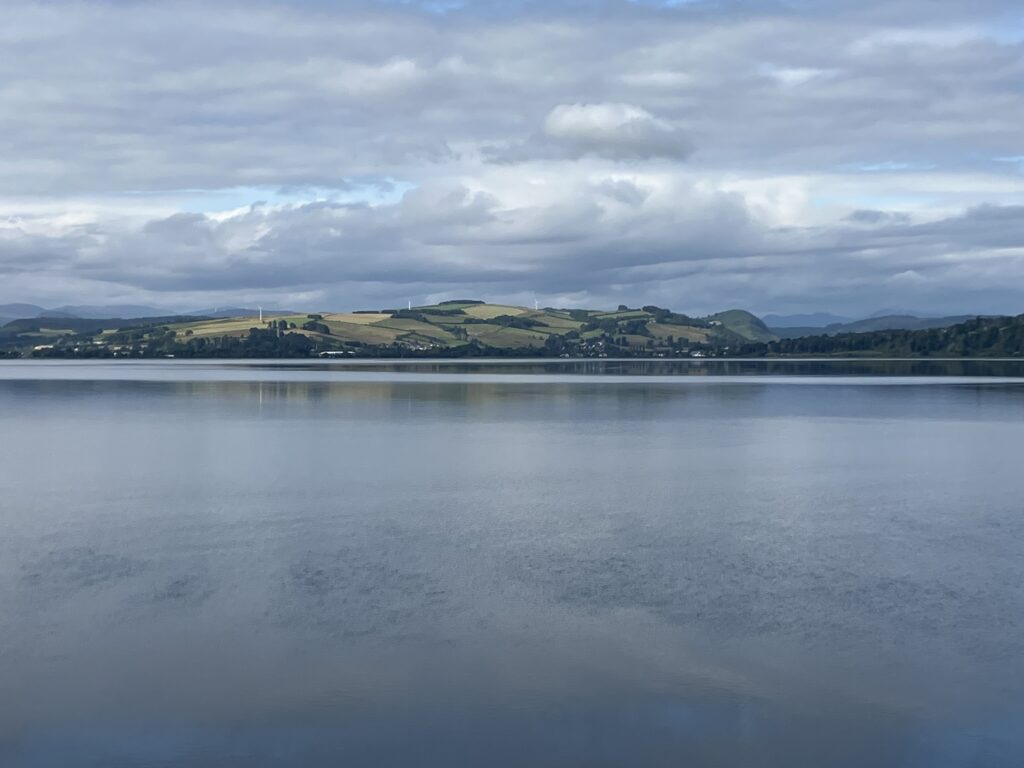
We finally reached sea level when the Firth of Moray came into view. Not long after, the distance sign to Inverness appeared. Pedaling west, our exhilaration shot through the roof when a sign for Tesco emerged. Pulling into the parking lot, we dashed to the store, dismounted and ran in to start our hoarding, after logging 47 miles since 4:00AM. I spotted Tesco’s Café just opening and went in to order a good old fashion British fry up of eggs, bacon, black pudding, and toast. Type of cholesterol and impact on health were not selection criteria when starved of calories.
We arrived at Kirkhill control by mid-morning. Upon entering the community center, I saw that volunteer worker at Golborne who saved my LEJOG helping out. When she saw me enter, a beaming smile erupted from her face. She marched right to me and with the warmth that could cure cancer exclaimed “I knew you can finish this!” I felt like a failing student now being praised by the teacher for turning around.
When I lost faith in myself, her stern insistence reset my expectation. I became fixated on how far I fell behind. She helped to change my mind set by focusing on the progress I made after I recovered the next morning. She became my good Lady Macbeth, exhorting me to murder my doubts so that I would not fail.
Puerile humor
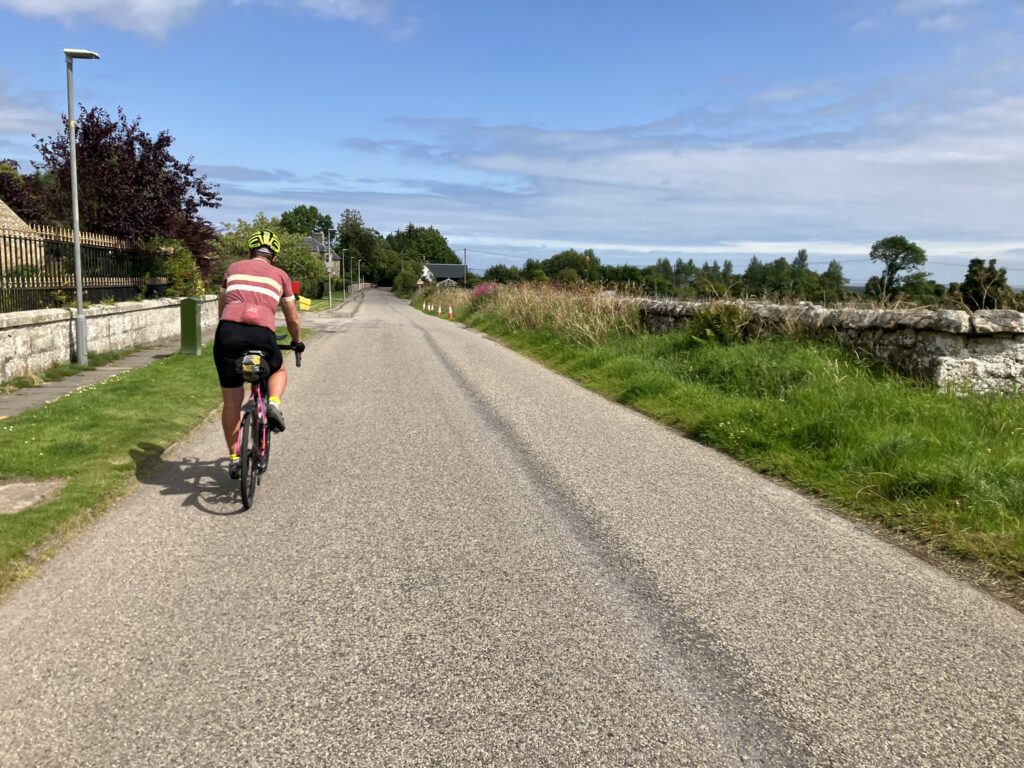
Still full from the Tesco feasting, we left after just getting our brevet card stamped. The roads were fairly flat as we followed along the coastline, crossing various firths and rivers. With about 100 miles left, the route took us off the busy A9 road to find respite spinning through the quiet countryside.
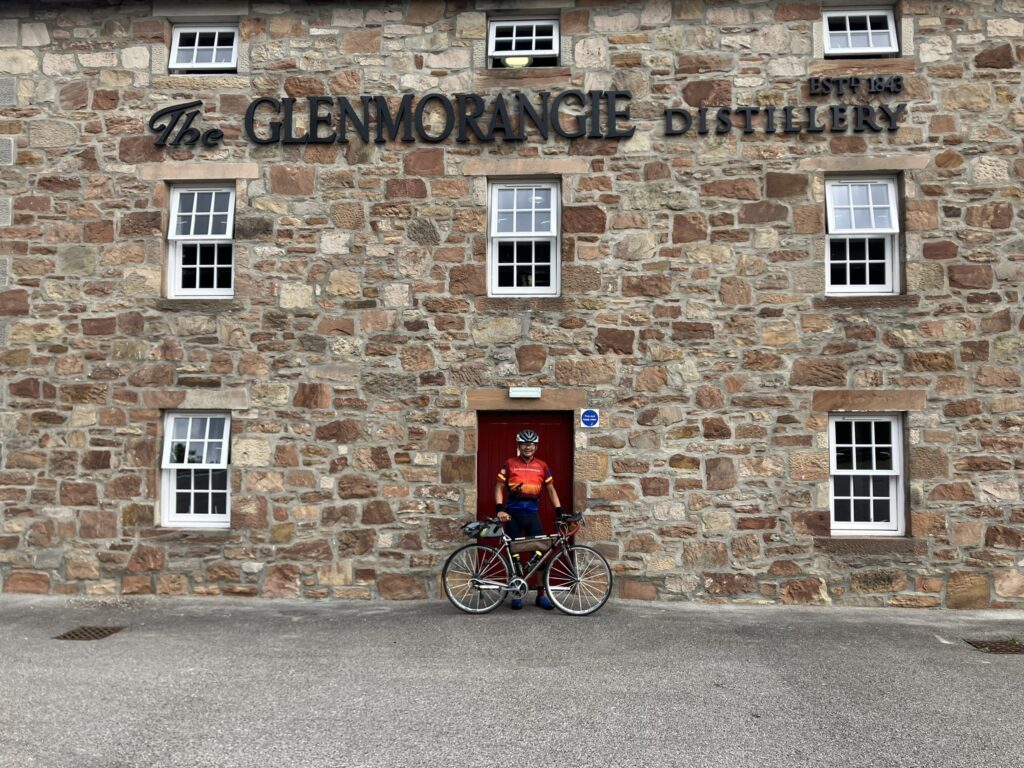
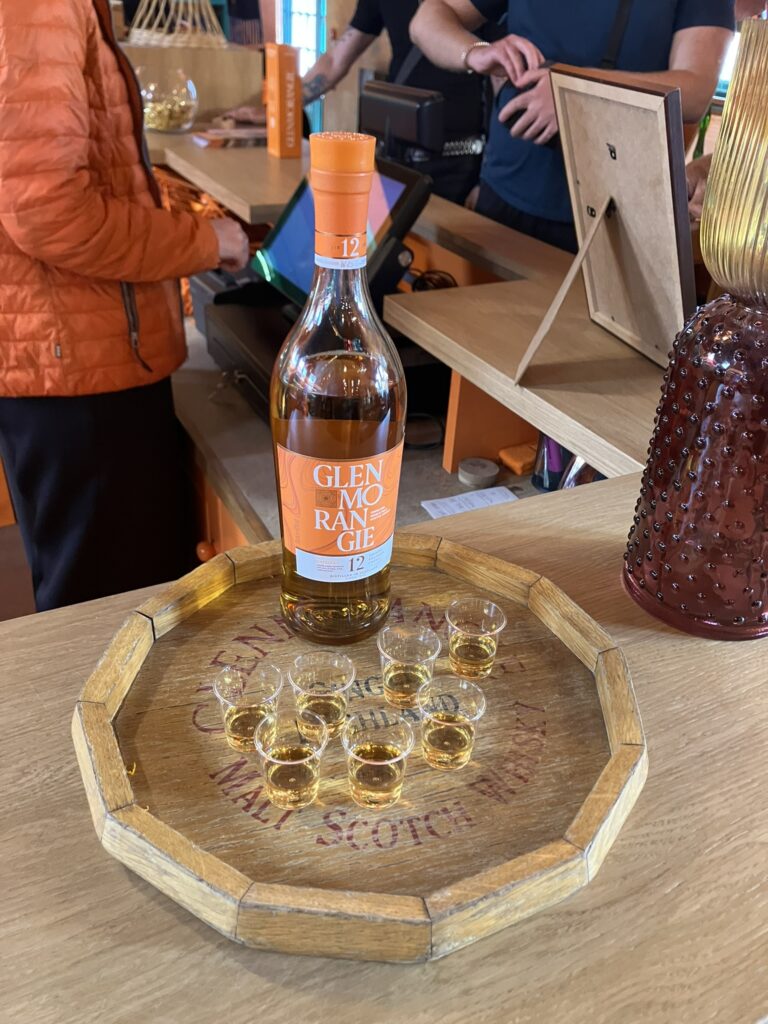
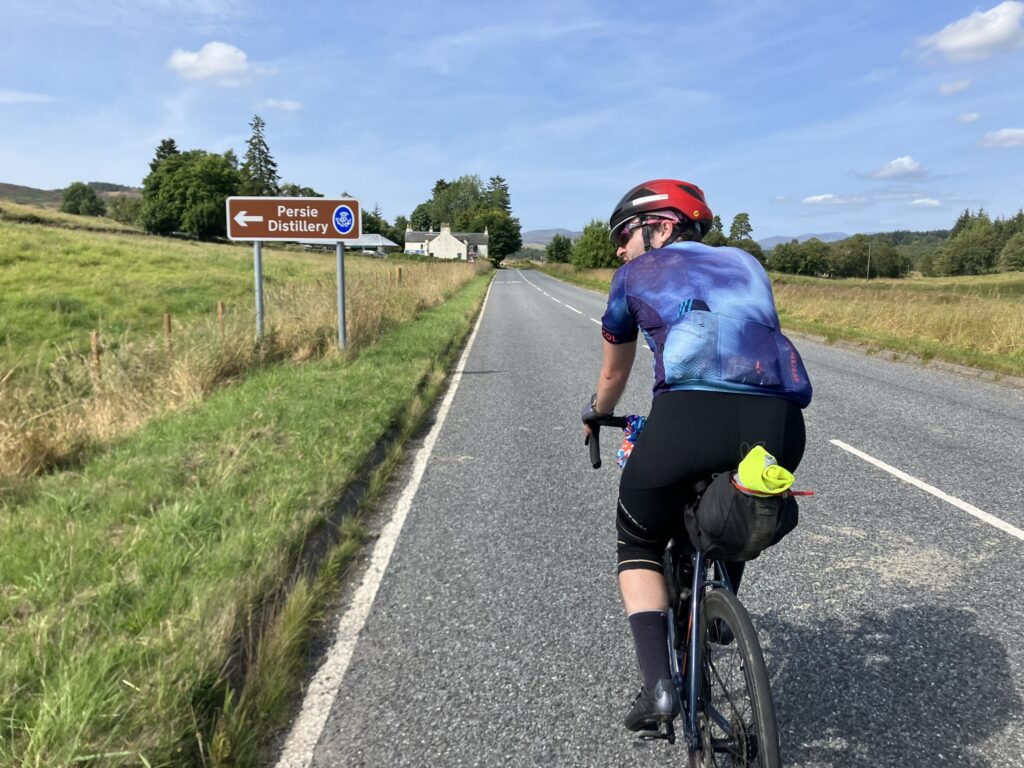
While reviewing the route during early preparation, I found a distillery just north of Tain. I promised myself that I would stop to have a shot of whisky to celebrate my last day. When Mimo and I left Tomintoul, I promised him that we would enjoy whisky tasting this day.
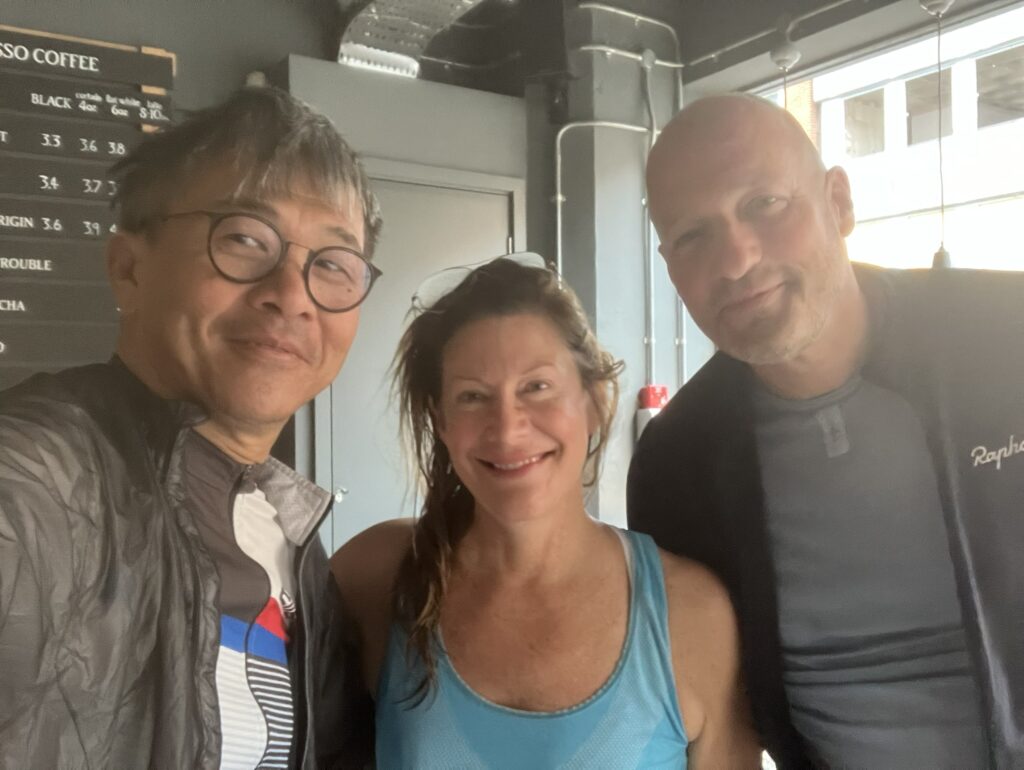
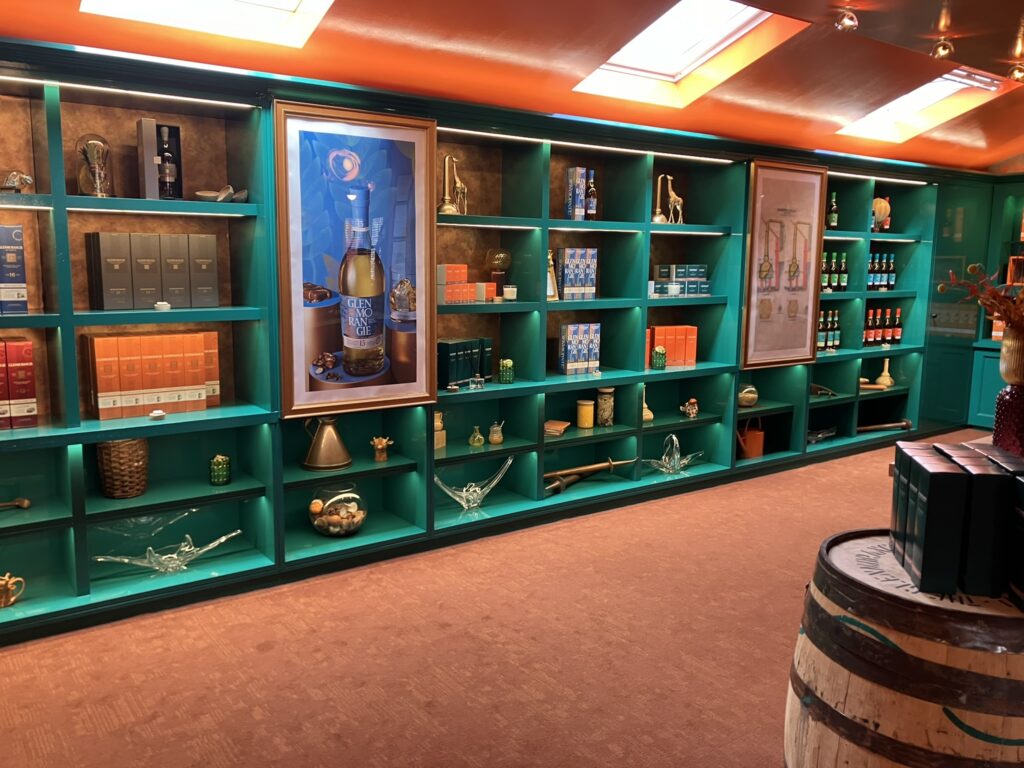
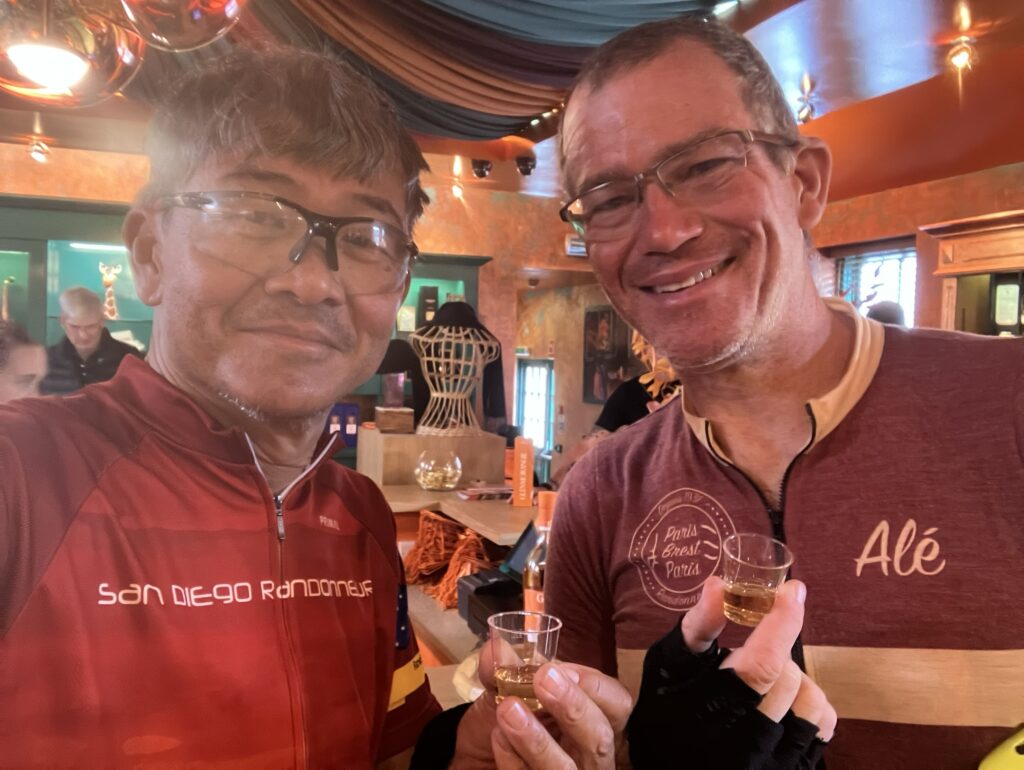
Once we rejoined the A9 at Tain, I spotted the sign for Glenmorangie. We found the gift shop and tasting room with small plastic shot glasses filled with the Highland elixir. Practicing good Scottish economy, the volume was small for it was free. We each grabbed a shot, took that ceremonial selfie and downed it. It was enough to wet the tongue. Any more would be imprudent in our current state. Satisfied with the ceremony, we pushed on for the finish.
The 68 miles to Wick was a gauntlet of passing cars, RVs and occasional freight trucks. Any majestic beauty was lost to the vehicles passing us. British drivers were frustrated by us delaying their journey to their holiday destination but followed British traffic law that required them to pass in the other lane. Continental drivers, perhaps ignorant of local regulations or felt they could misbehave in a foreign country, were less generous. Twice I was buzzed: one car with a German license plate, the other French. In the organizer’s defense, perhaps there was no other way to avoid hell’s highway to keep the 1,400 km distance.
Dipping down to the mouth of River Helmsdale, the climb out was a struggle for the steepness, my lethargy and passing car traffic. I expected this section to be flat. Portions of the eastern Scottish coast brought back the horrible memories of Cornwall. I felt I was suffering PTSD.
Passing Wick, traffic diminished significantly. The road became flat and farm fields dominated the landscape. At this point I was spending more time looking at my Garmin watching the distance to the finish tick down. The adage that “a watched pot never boils” applied to distance counting: a watched Garmin never reaches the finish. Painfully slow, compounded by the physical pain returning, I held on to Mimo’s wheel as we approached the finish. Descending into the John O’Groats parking lot with the North Sea as its backdrop, I felt that insurmountable relief rather than joy to see Andy and Michael waiting for me.
Photo by Andy Corless
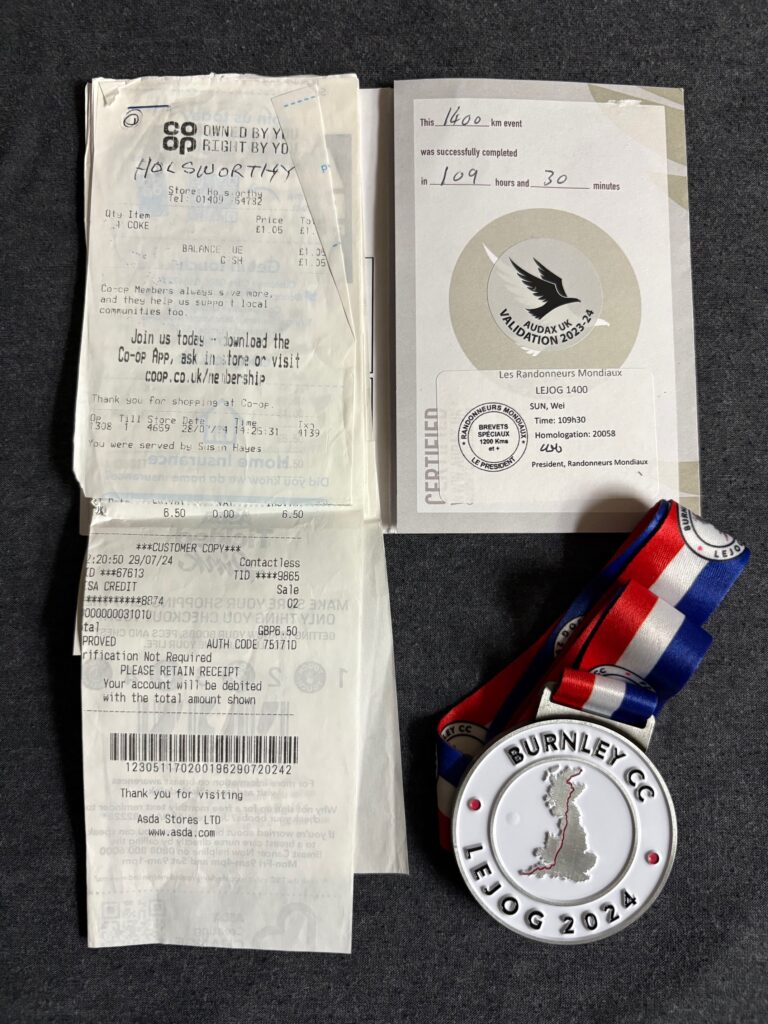
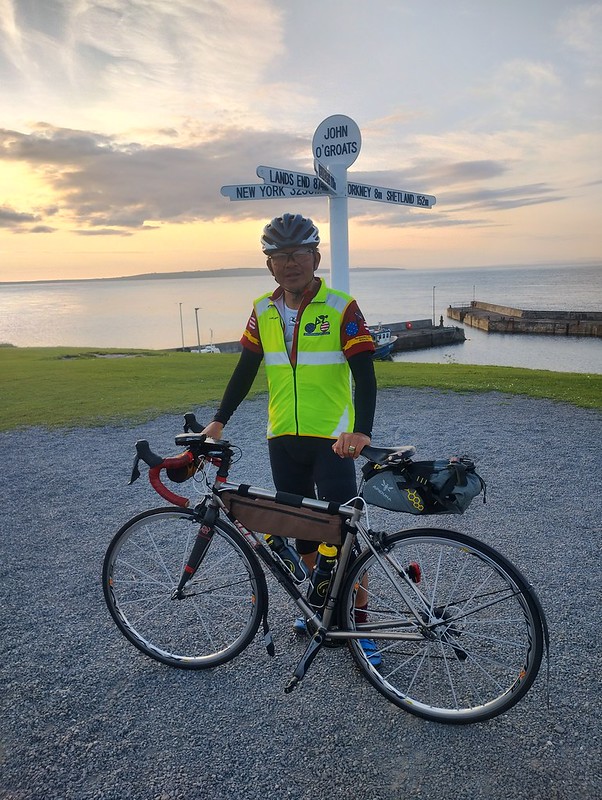
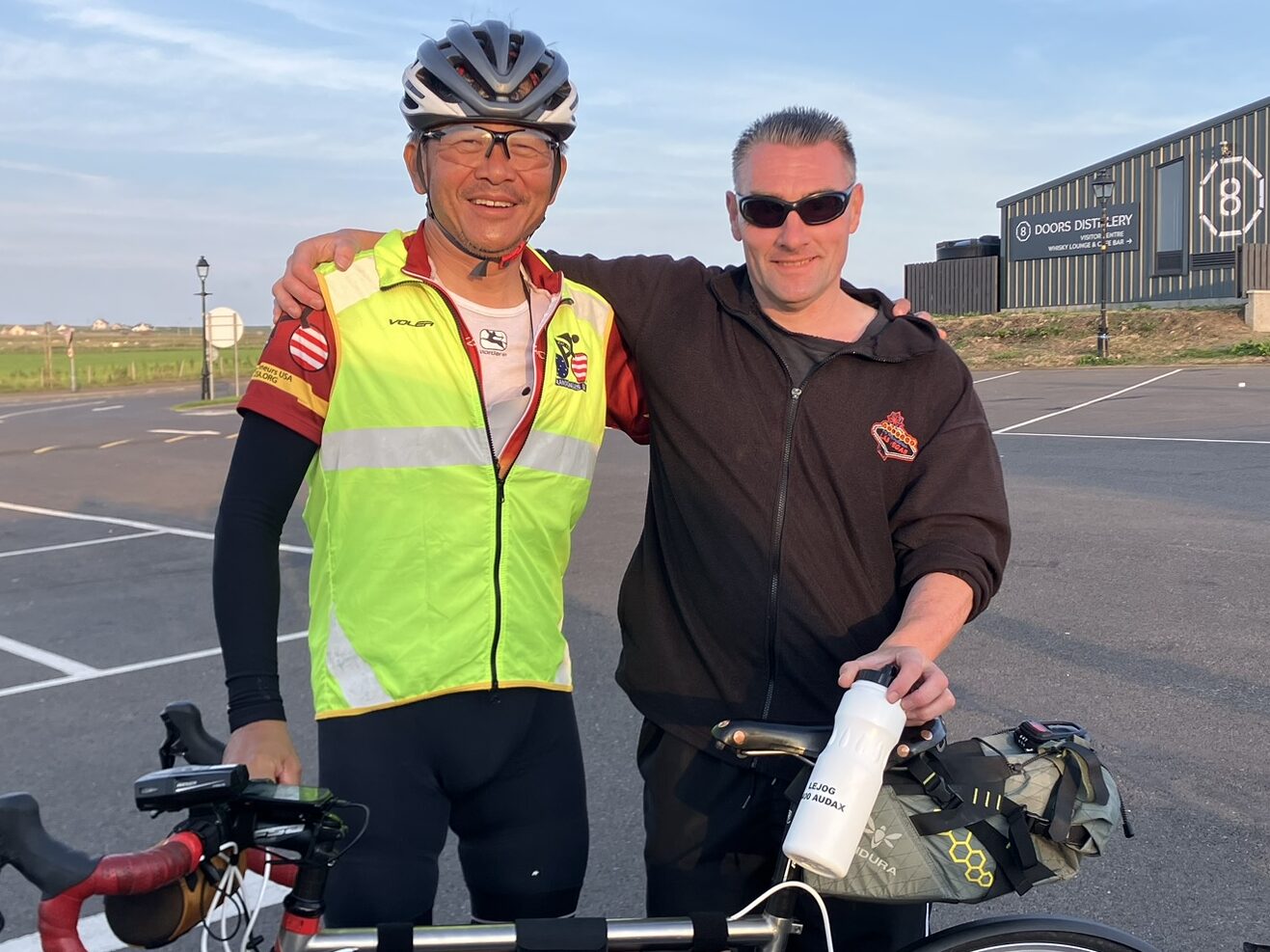
Grand randonnees always start with a roar and finish with an anticlimactic whimper. LEJOG was no exception. I handed Andy my brevet card with the stack of receipts I collected. He looked at his watch and wrote down: “109” for hours followed by “30” for minutes. He congratulated me, pulled a black suitcase out of his van, unzipped it and handed a commemorative water bottle: plain white with “LEJOG 2024” printed in black letters, symbolic of his unadorned nature. He took a photo of me standing at the John O’Groats sign as I asked for a photo with him. I picked up my drop bags, thanked him for organizing this amazing adventure and bid farewell. Mimo took off in a hurry as his lodging was back at Wick, adding another 15 miles before he could unclip and take off his shoes.
Michael congratulated me. I thanked him profusely for all his help during my darkest moments. With nary a fanfare we walked to the Airbnb we booked at the caravan and camp site just 100 yards from the parking lot. After a nice long hot shower and putting on fresh clothes other than cycling kit, we walked to the John O’Groats Brewery to have a few celebratory pints.
With each sip, that oppressive weight of pushing forward finally lifted. In another room a larger group of LEJOG finishers were celebrating boisterously. I opted to share this quiet moment with a friend. It was a bittersweet exchange. That triumphant feeling we both shared at PBP 2019 was instead replaced by an underlying regret I felt that the same triumph could not be replicated. Michael whole-heartedly celebrated my finish; I thanked Michael for all his help. No less heart-felt in either direction, yet it felt asymmetric.
Soon the sun slipped into the cover of the North Sea. As we walked back to our Airbnb, we began to discuss about the next randonnee with the right mix of Homeric adventure sprinkled with good bits of Quixotic ambition.
Whether I woke up or just imagined that I did, I couldn’t tell. I only recalled being still drowsy when everyone in the room started to suit up. Meeting Mimo and Expat Matt at the dining area, we needed to pow-wow given last night’s clusterfuck. Issues before us:
All of us barely slept.
The next control with beds was at Kirkhill, 200+ mile / 320+ km.
This stretch had the most elevation gain (2 steep, 2 moderate climbs) totaling 11,000+ ft / 3,600+ m.
The non-refundable hotel rooms I reserved in Inverness only shaved off 10 miles / 16 km.
Scotland was cold in the dark.
By my estimation, we needed to bed down somewhere closer to get some sleep for recovery.
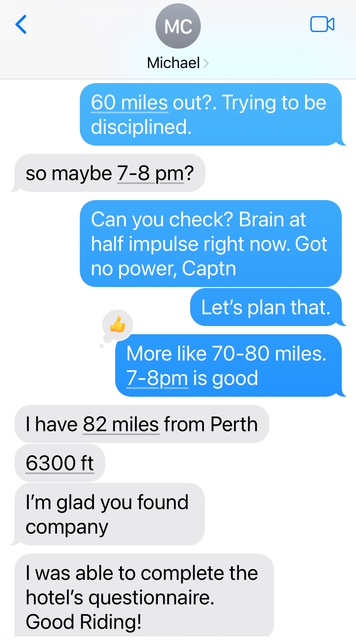
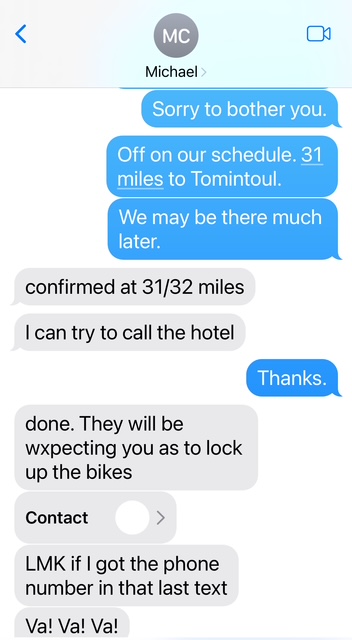
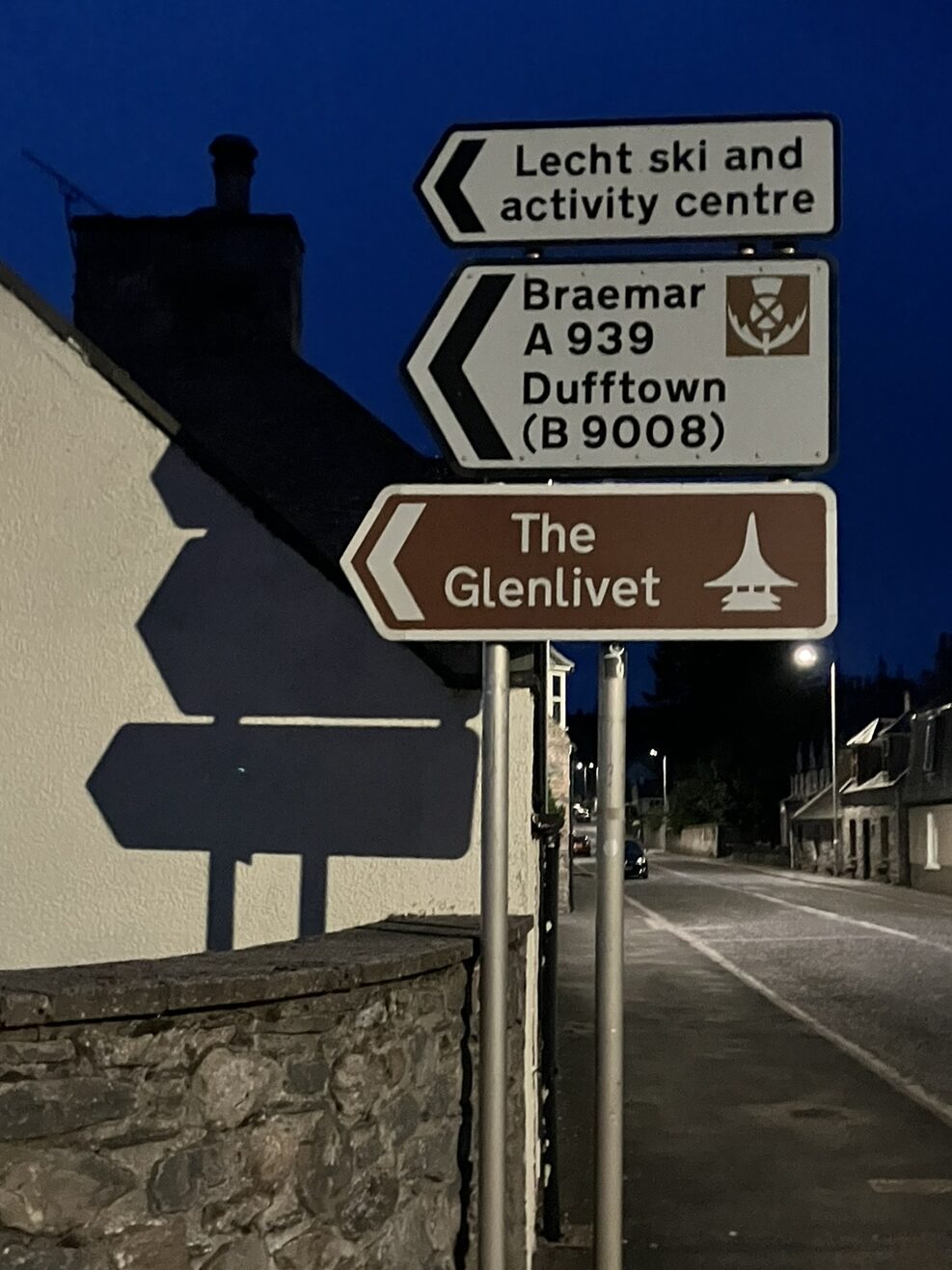
Throughout this trek, Michael and I maintained contact. I would send him a quick status on my progress. We also needed to sort out car rental at the finish. That morning at Kirkburn, I was in no mental condition to work out logistics. In earlier revisions of our timetable, I was considering lodging in the town of Tomintoul just past the Braemar control. We opted further down the course as staying in Tomintoul would extend the last day’s travel to nearly 300km. I just couldn’t remember if it was before or after Lecht, the toughest climb of the day.
We exchanged texts throughout the day as he made arrangements for us.
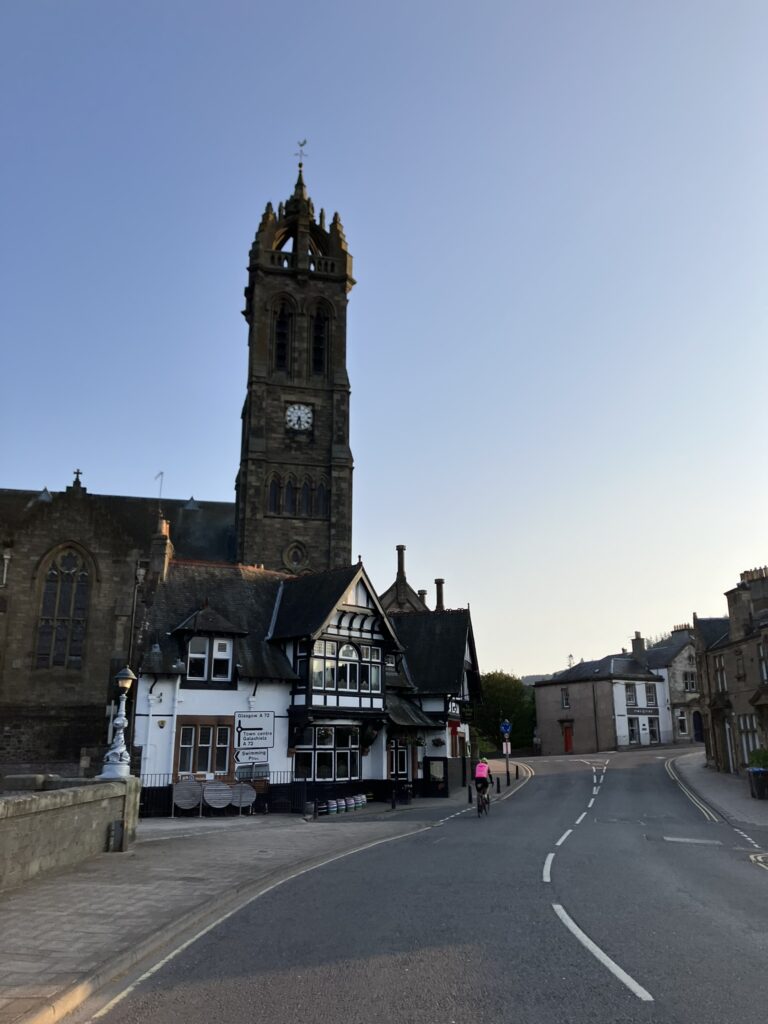
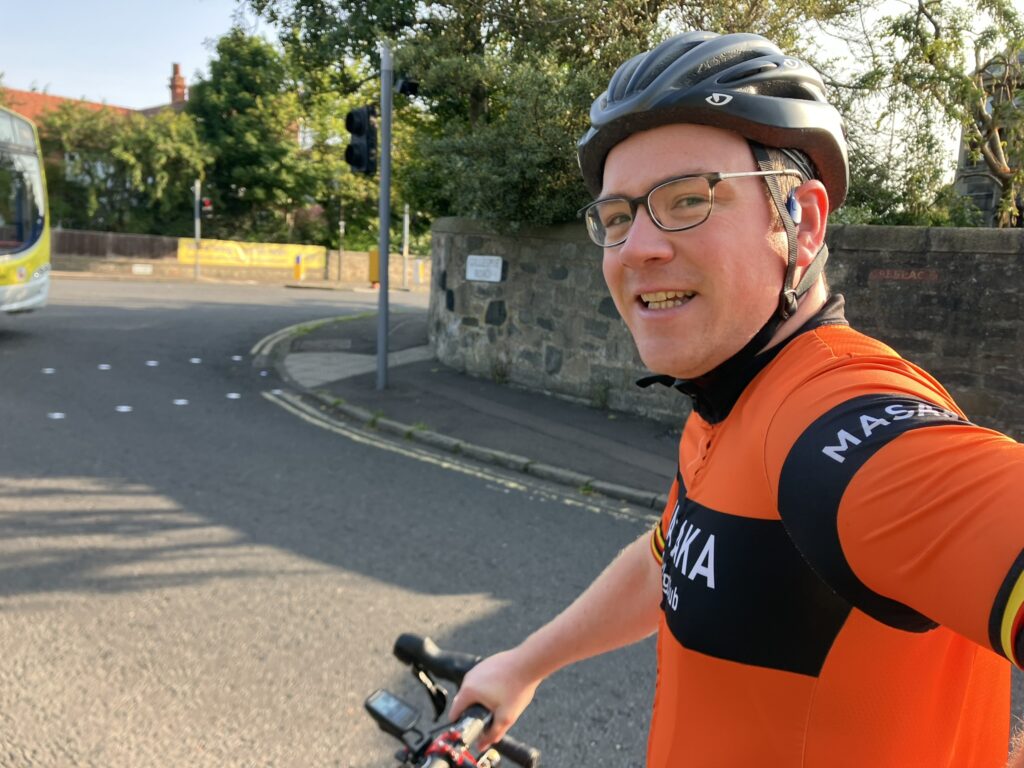
After scavenging for whatever that was palatable at the control, Mimo, Expat Matt and I left heading to Edinburgh. Crossing the River Tweed and through Peeples, we saw the steeple of the Old Parish Church with its ornate roof. The landscape was more pastural as we rode by various farms. Approaching Edinburgh, Ewan on his way to work joined us for a bit and guided us to a bakery along the route. He suggested Greggs and highly recommended their sausage rolls. After he departed, we followed his directions but to our dismay, the bakery was not open yet for business.
Old Parish Church, PeeplesOur local scout, Ewan
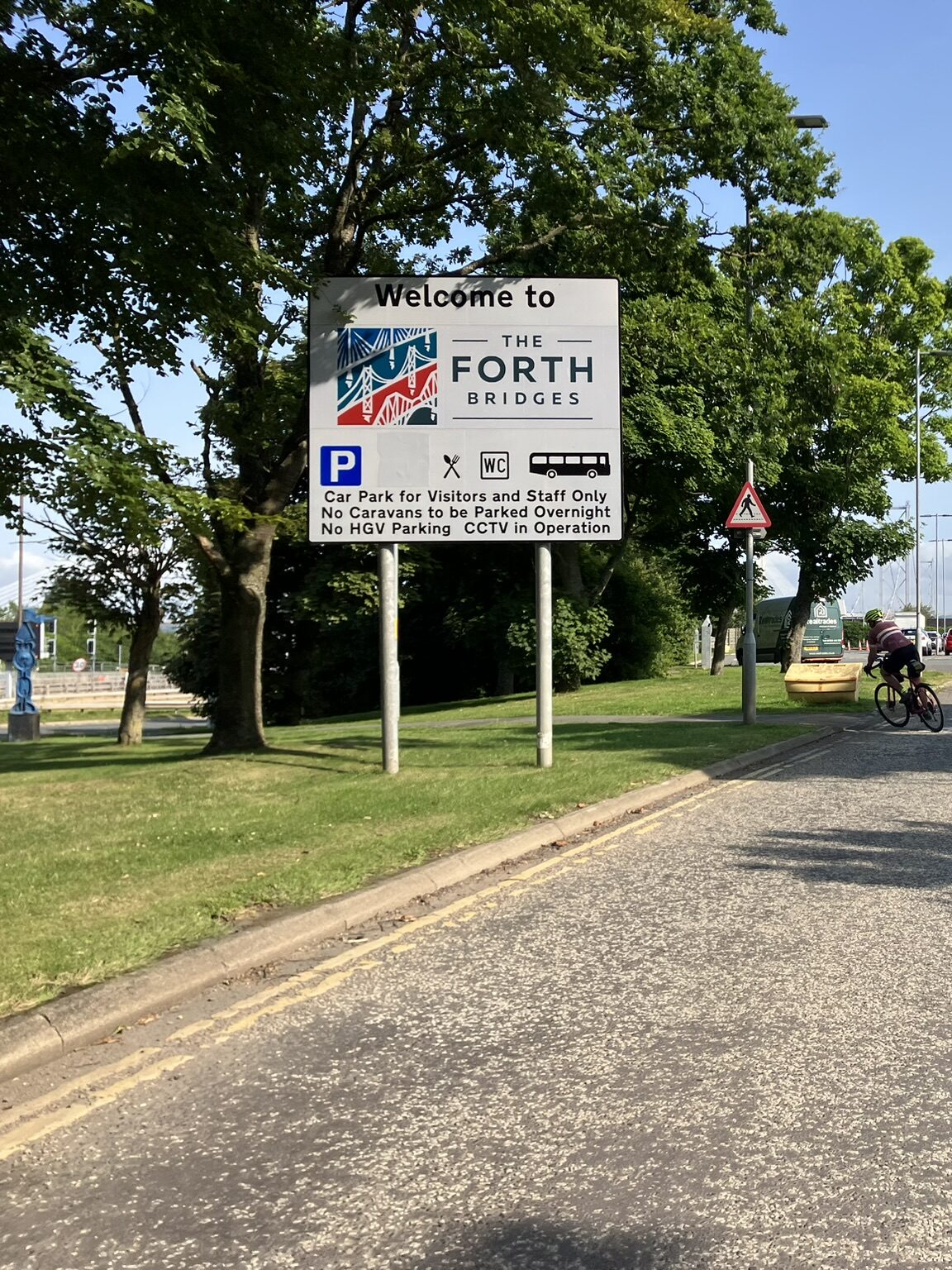
With our morale slightly dented, I recalled a McDonalds in Queensferry just before the Forth River crossing. Telling our stomachs to shut up, we rolled on. The route avoided Edinburgh’s city center and kept us on dedicated bike paths, but we were surrounded by industrial and office complexes. Approaching Queensferry, we saw the McDs. Not surprisingly there was a small congregation of LEJOGers. Not in my wildest dreams that I would confess my unconditional love for a McDonald’s breakfast sandwich at this point in my randonneur life.
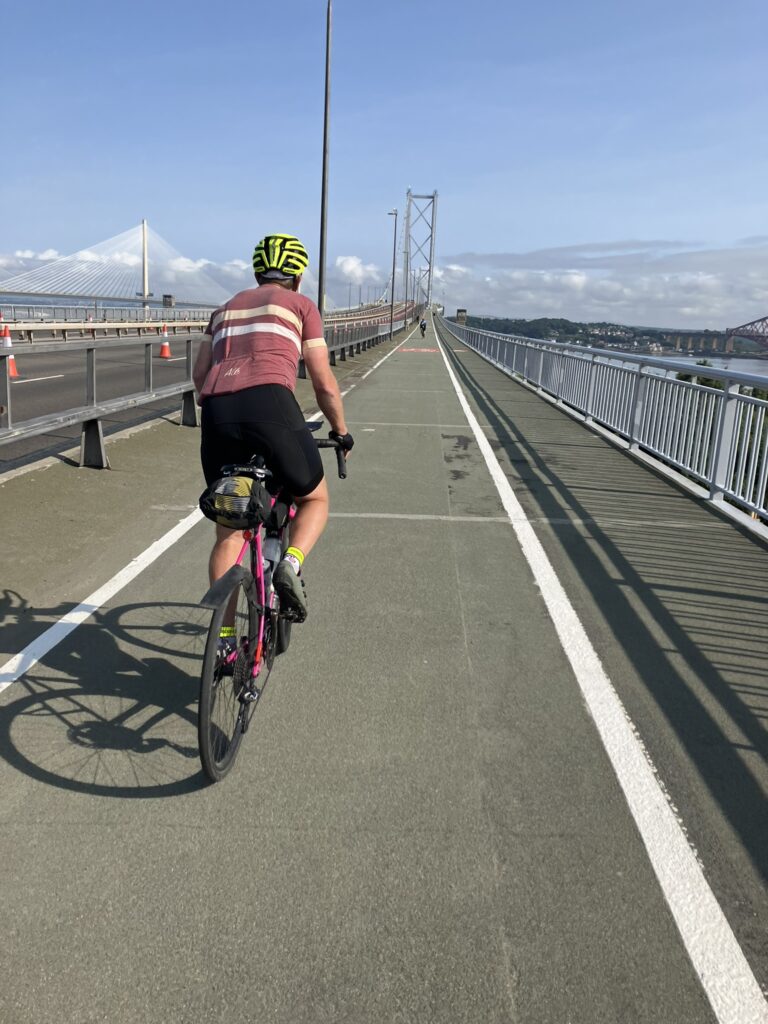
Bridge entranceRiding Forth
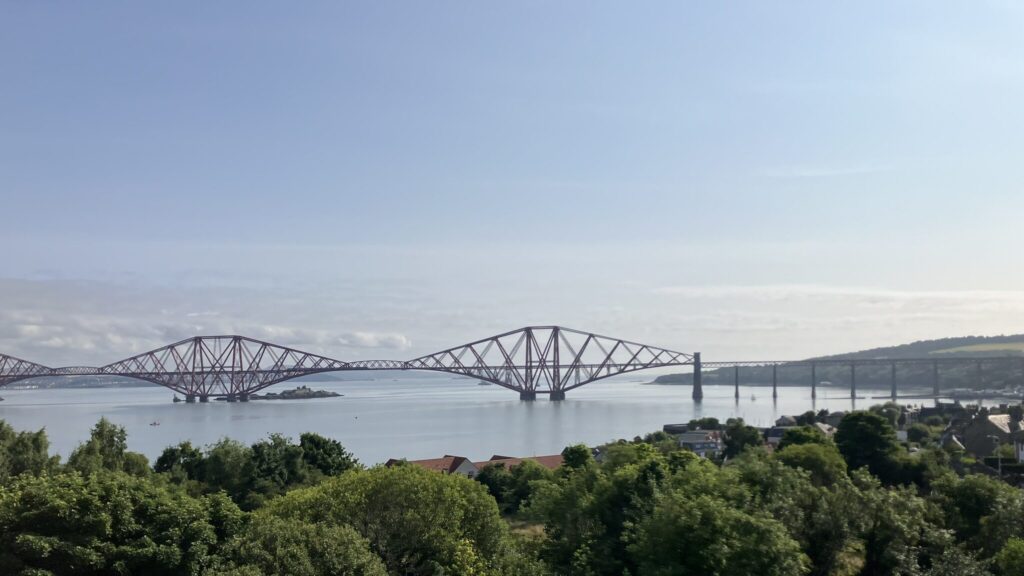
Crossing the Firth of Forth was a momentous occasion on this journey. It meant the beginning of the end. The firth, Scottish Gaelic for estuary, separated the wilds of the Highlands from the urbanity of the Lowlands. 3 bridges crossed this span of water. One of which, the Forth Bridge, represented an historic achievement in engineering. One of the greatest cantilever trussed bridges in place, its forthright and unadorned display of its structural components symbolized Scottish national identity and ingenuity. While crossing the Forth Road Bridge, I was able to see that glorious red architectural wonder in the distance on a clear Scottish morning.
Crossing the Firth of Forth
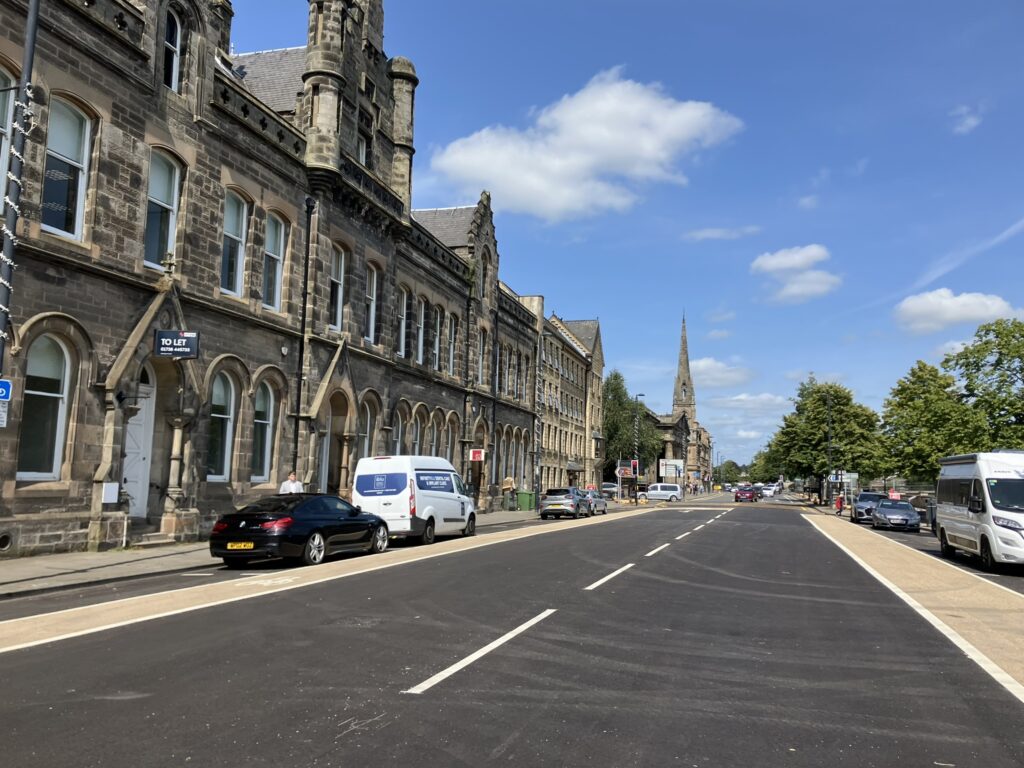
Our next destination was the control at Perth. The landscape was mainly rolling green hills with a couple of short climbs. Stone masonry buildings dominated towns and cities in Scotland as well. Switching pulls, Mimo and I made a quick work to reach Perth control. At the Tesco we joined another congregation of LEJOGers grabbing food and water. Established along the banks of the River Tay, the city’s distinction was its wide boulevard through its center. Rolling in from the south and then along the Tay, the tall spire of St Matthew’s Church dominated the skyline.
Perth
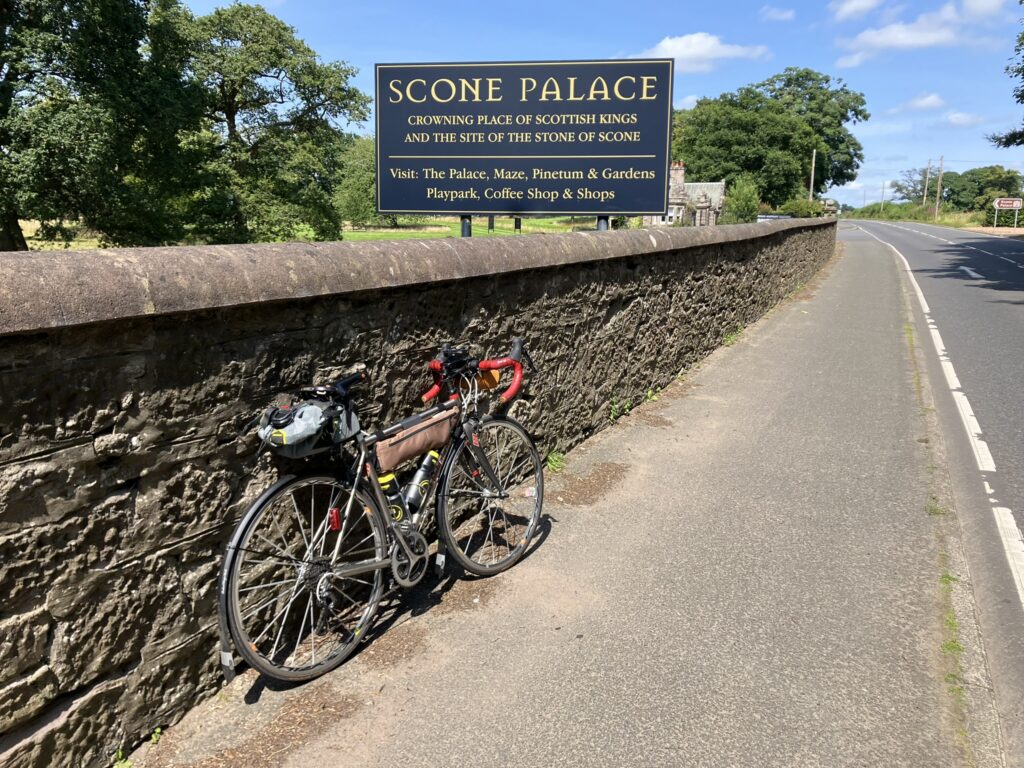
After crossing the river, I continued north and came across Scone Palace. I wondered if the ubiquitous cafe pastry was first baked at this castle and served to Scottish aristocracy with their whisky and haggis after a frustrating day hitting small balls with a crooked stick through sheep fields to claim a day of exercise. Not far down the road from the castle, I saw the “Strawberry Farm Shop” to my right, with big signs out front advertising their various strawberry derived delectables. Feeling a bit tired, I pulled in and ordered a double espresso latte with a strawberry pastry.
Looking for coffee to go with my scone
Continuing through green fields and pastures, we passed Blairgowrie and Rattray. From there on, the route became a steady incline as we began our ascent to the 4 upcoming summits. About this time another LEJOGer caught up to me. Earlier we crossed paths at the Queensferry McDs. We decided to ride together for a bit just to break up the monotonic day.
King Charles of LEJOG
Not long into our conversation, I learned that his name was Charles from Yorkshire. I asked in jest how it felt to ride through Lancaster as a Yorkshireman. Appreciating the underlying humor and reference to the War of the Roses, he chuckled and replied that though the war was long over, he was still proud to display the white rose of Yorkshire.
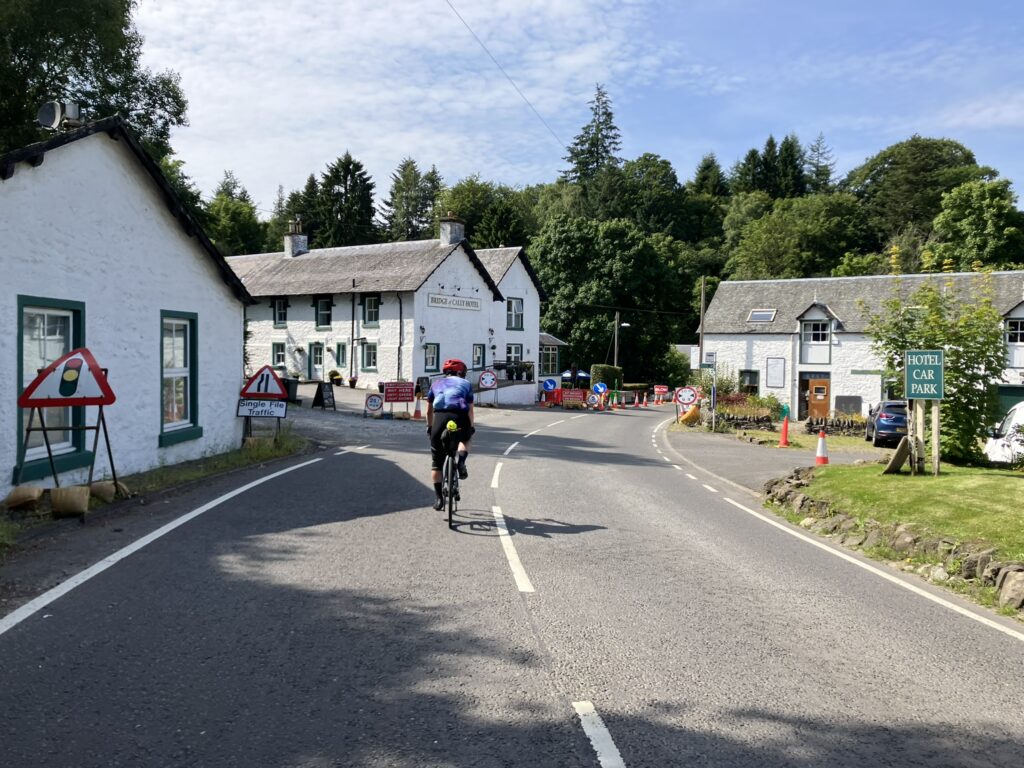
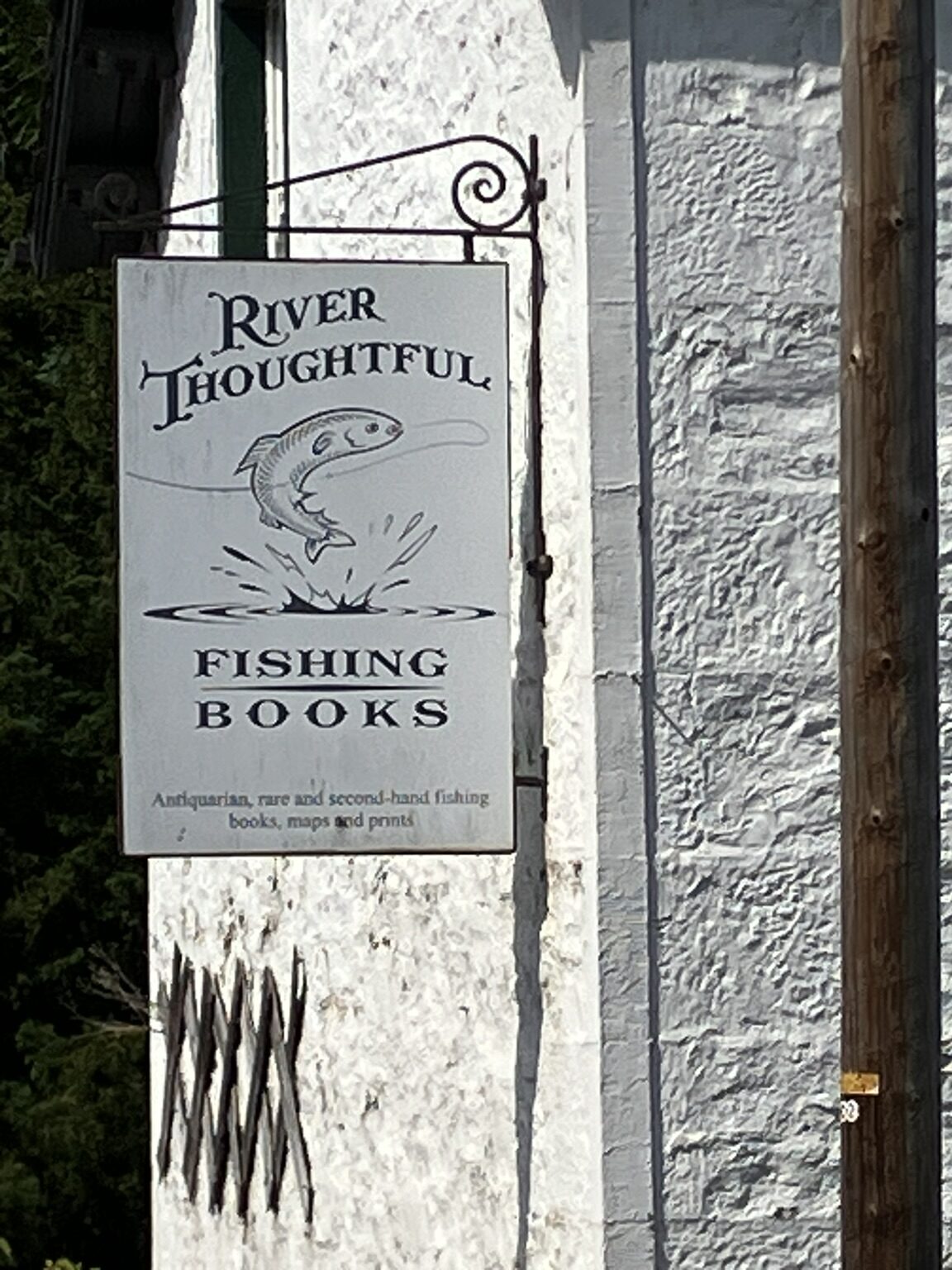
Crossing over River Ericht at the Bridge of Cally, I stumbled onto a sign for an antiquarian book shop. After bicycles, my 2nd passion is book collecting. Though I don’t always read them, I appreciate the craft and conservation of old books; how they are bound and decorated. The reification of ethereal thoughts onto pages that can be carried, leafed through and displayed reinforces that perceived permanence of ideas that could exist across time and space. Alas it is just my naive perception, as written thought has been made extinct too many times in human history. Ironically, if there were only print, I wouldn’t be able to share my ride musings with you as you read on.
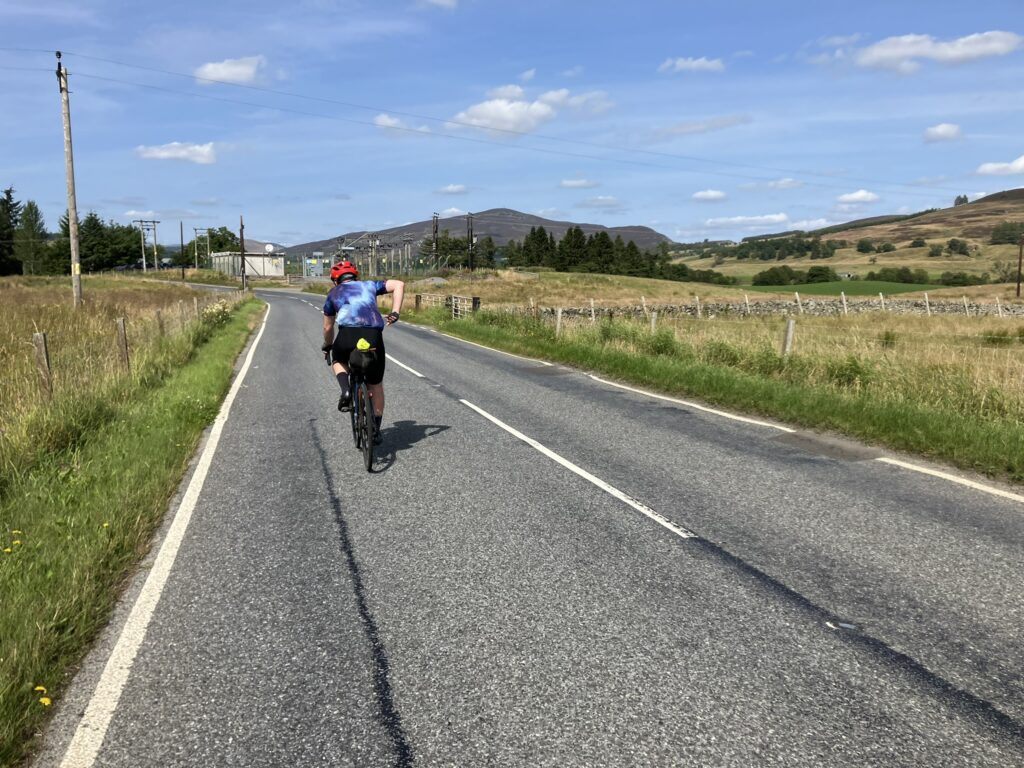
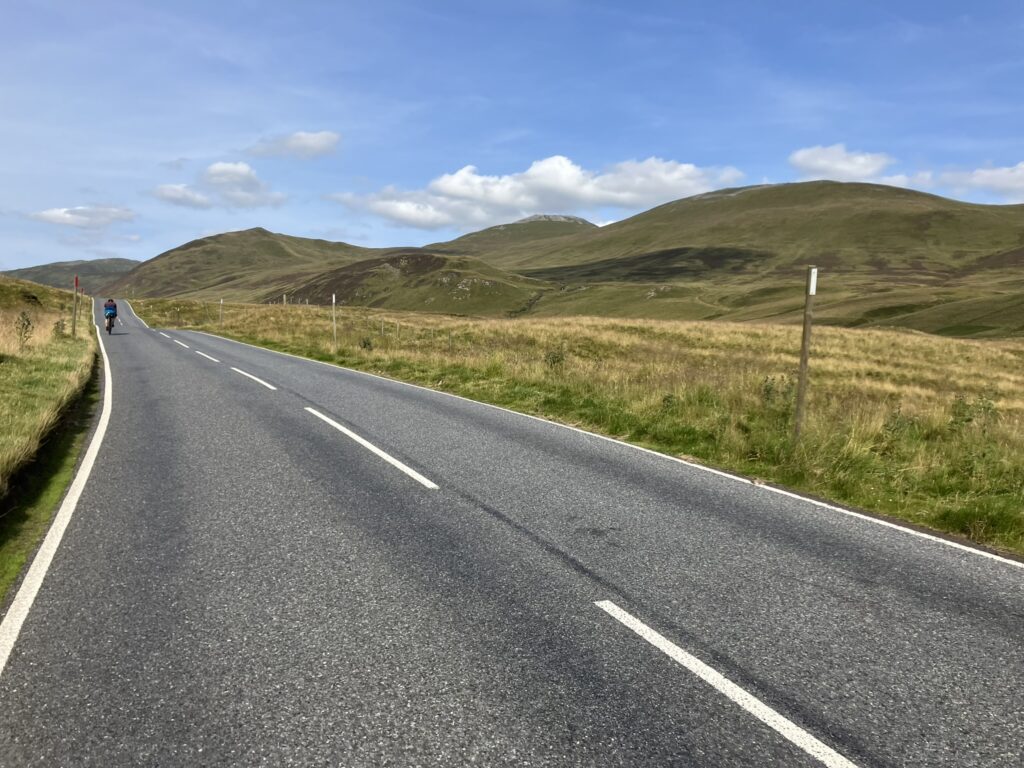
Alas, my chit-chat with Charles was brief as he powered on into the mountains while I accepted my fate to lumber on in my tired state after entering the Cairngorms National Park. The landscape transformed into breathtaking views of barren windswept peaks around me. The filtered light through the scattering clouds with exposed patches of blue accentuated the folds and crevasses of the mountainside. At this time Mimo rejoined me.
I take the high road…
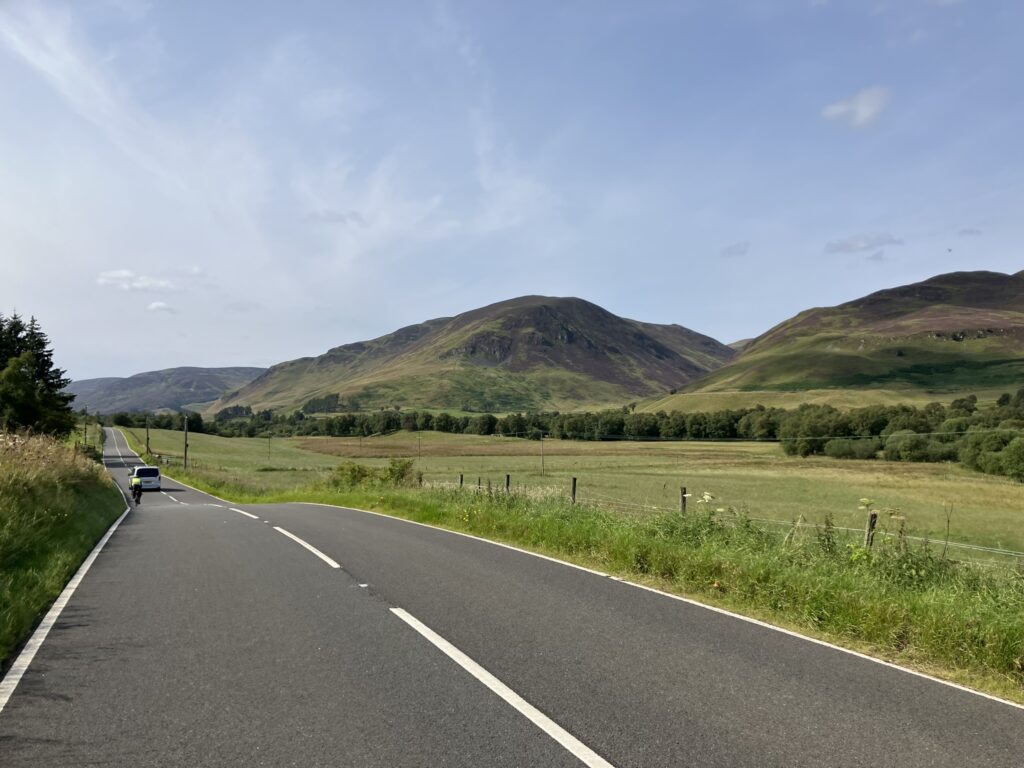
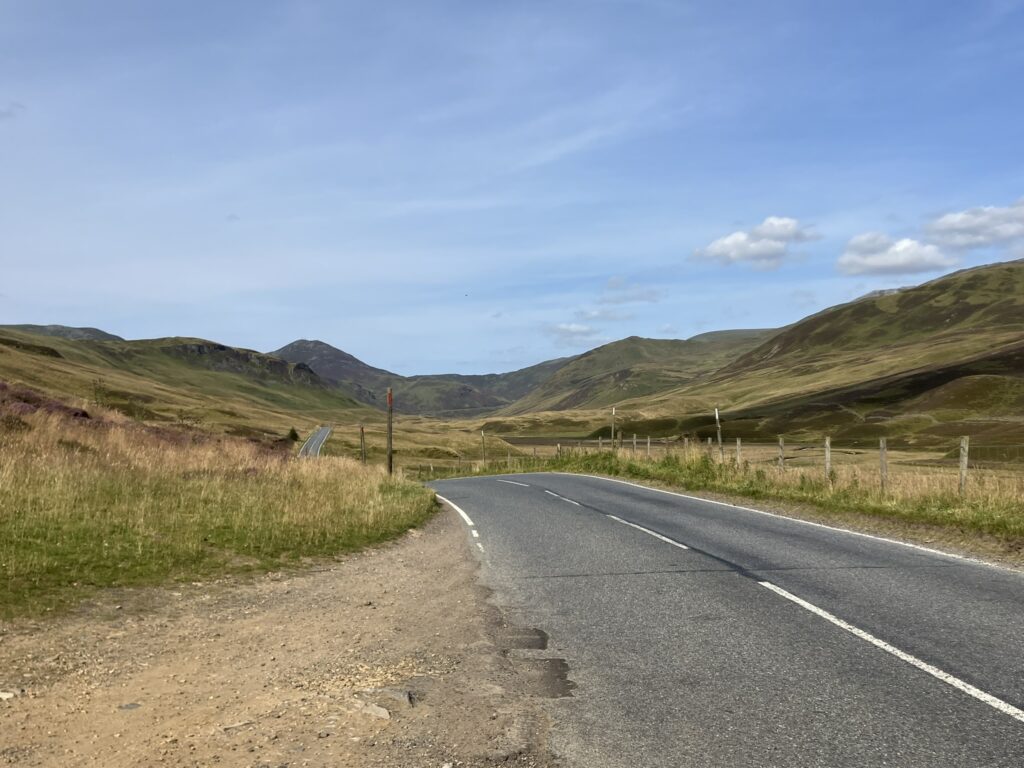
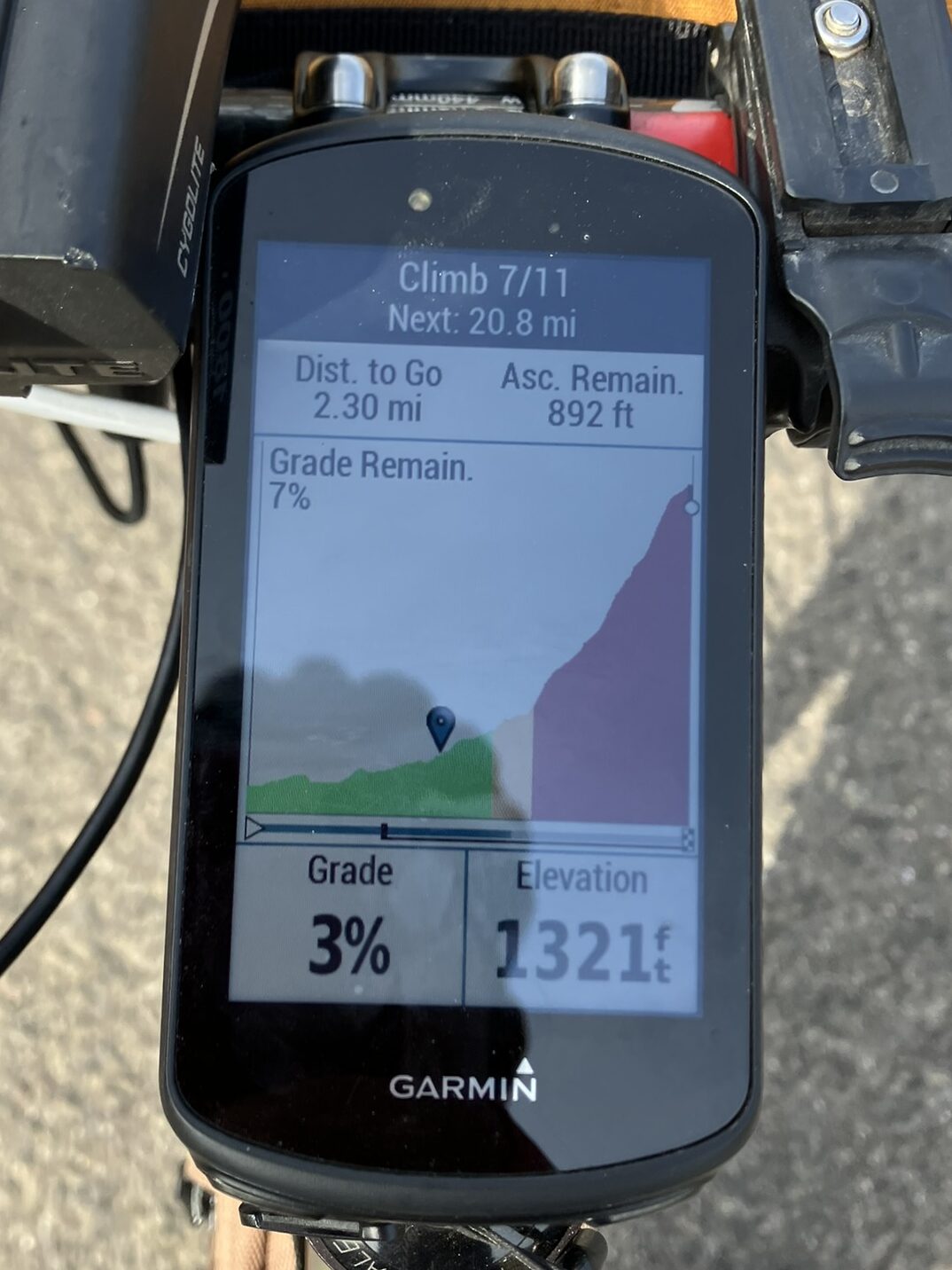
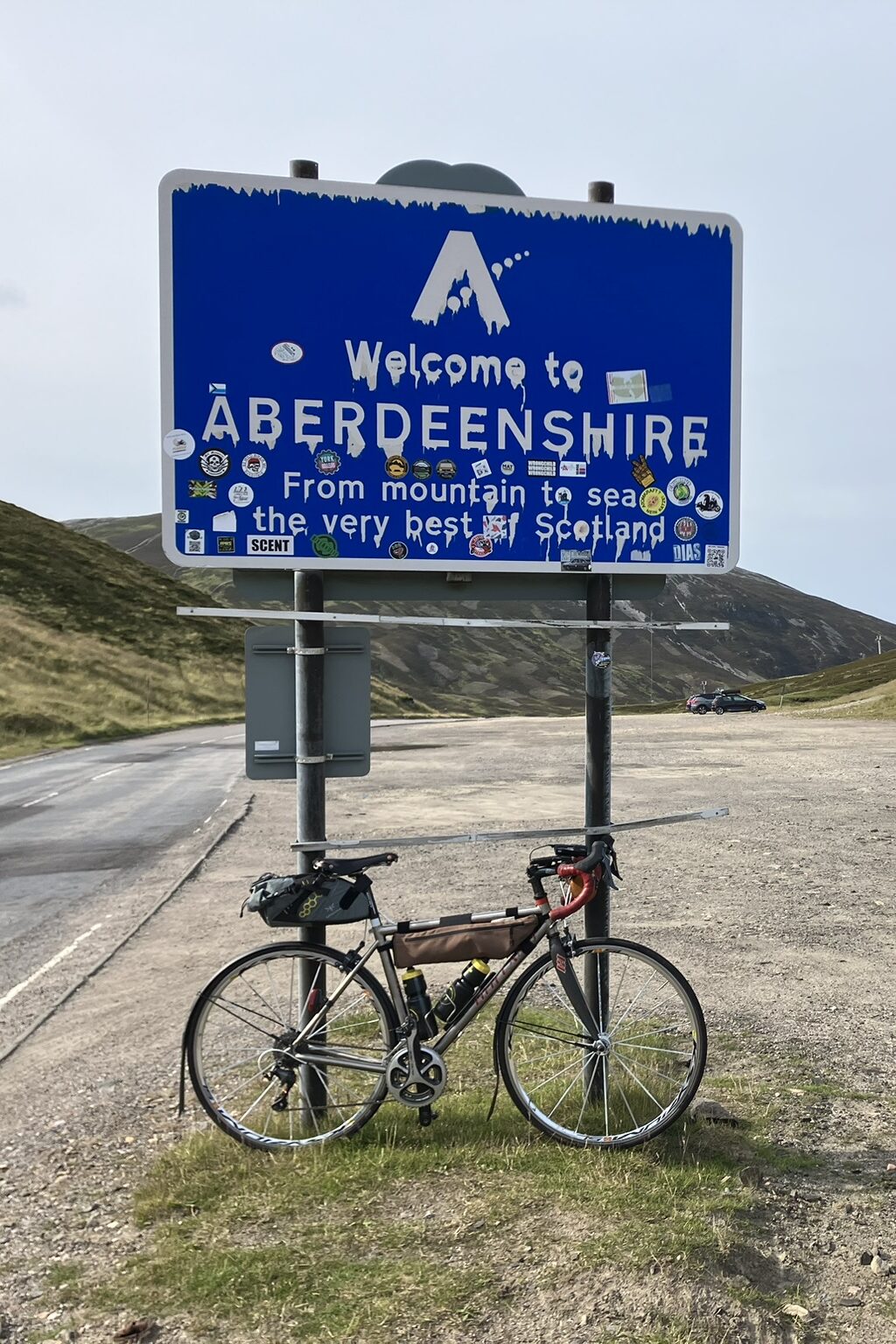
The grade began to steepen about 4 miles to the top of Glenshee, the first of 4 summits. The grade reached more than 12%. A sign welcoming us to Aberdeenshire was a teaser as I crawled my way up to Cairnwell Pass, the highest public road in the UK. Passing the Glenshee ski resort, we were rewarded with an extended descent to the valley floor, with the road following along Clunie Water.
I wanted to shift up in the back as I was flying downhill. Suddenly my rear derailleur wouldn’t index properly. I could shift down as that action increased cable tension. It was when shifting up it would be sticking. Holy Mother of God! How could this failure happen so soon?!
A month ago on a 300k training ride with Michael, near the end I started to experience shifting problems in the back. When I returned home, I first examined the derailleur itself, but quickly concluded that as a dumb spring, it merely responded to cable tension. I then pulled back the right rubber hood, exposing the cable to discover fraying that caused a couple of strands to snap and jam up the shifter. I changed out my shifter cables 4 months earlier. What gives? I was certain the shifter was the cause but didn’t have the time nor know-how to troubleshoot further. I replaced the cable and decided to pack a spare shifter cable for the trip, ripping a page out of LA Matt’s playbook on how to salvage a brevet.
Reaching the Braemar control, I made a beeline for the lead worker to ask for tools. He took me to another staff worker who was washing dishes to see if he could help. This guy had an emotional meltdown, complaining how he couldn’t do multiple tasks at the same time. Blah. Blah. Blah. As he whined like a good Englishman, I calmly and very slowly said: I don’t need you to do anything. I just need you to show me where you have your tools so that I can replace the cable myself. He settled down and led me to his tool bag. I found a cutter and awl. He offered a cable as well. I took it as payment for witnessing his drama act.
In 10 minutes, I replaced the cable with the one I brought, knowing it should last over the next 350km to the finish. Other riders seeing me repair on the fly were amazed at my MacGyvering skills.
Mimo and I were just 31 miles to Tomintoul but still had to negotiate over 3 summits, with the Mighty Lecht as the final obstacle. We left Braemar. Still in the valley floor, this portion of Cairngorms was wooded and the topography was relaxing as the road rolled along by the River Dee. Approaching a turn, we were near the entrance to Balmoral Castle, the British royal family’s Scottish home.
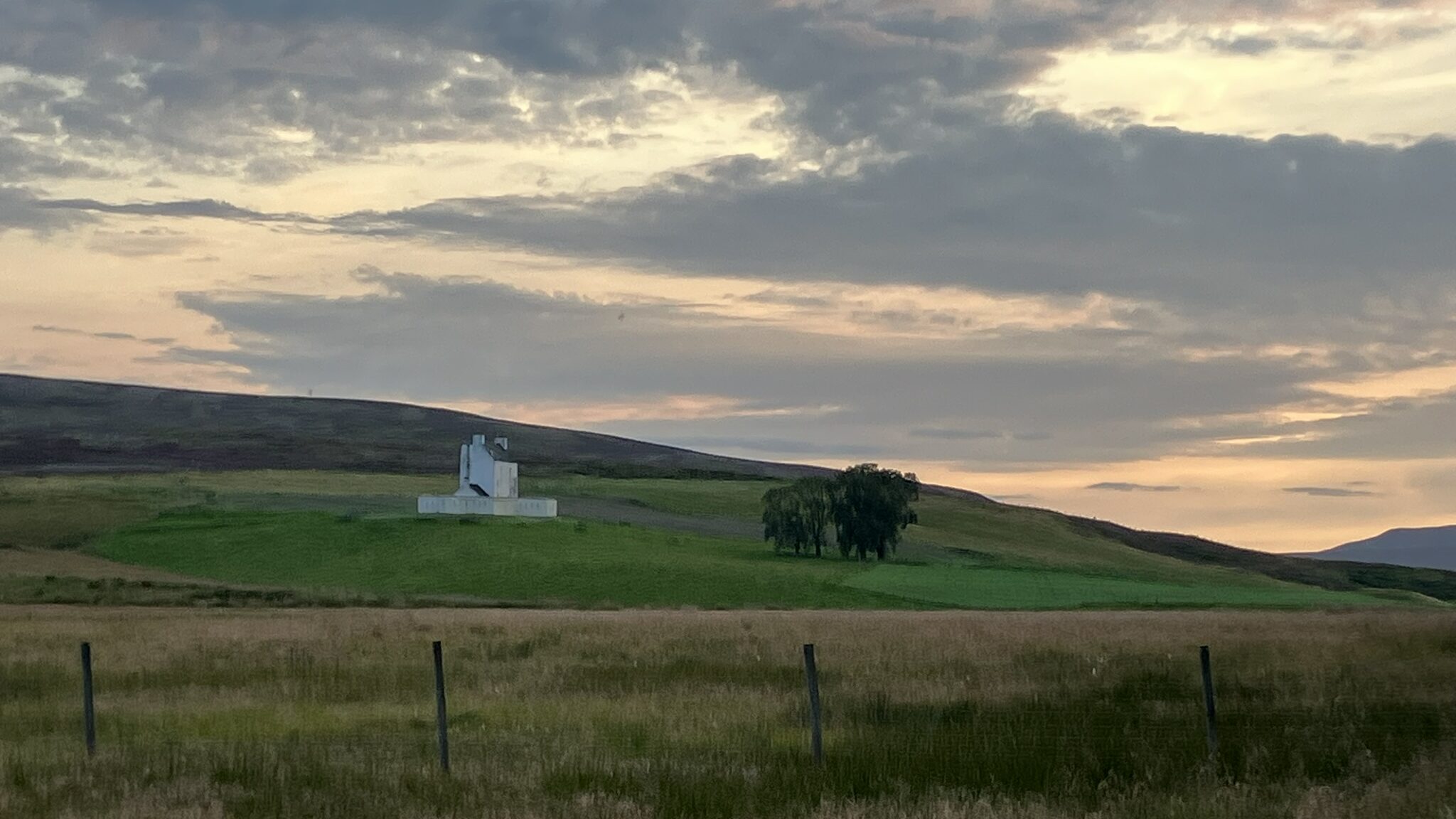
The first two climbs were manageable. Heading toward Lecht, we rolled by a brilliantly green pasture with this stunningly bright white building standing as a solitary sentry. With the sun now at the horizon, the building reflected a reddish hue.
The moment we turned onto the climb, we were greeted by a grade sign screaming “20%”. After all the miles on my legs and at most 10 hours sleep and an assortment of gear loaded on my bike, I opted discretion over vanity. I dismounted and walked the steep portions of the climb, not risk falling over and hurting myself. Soon we reached the summit and were welcomed by the Lecht ski resort, if only briefly. The sun was now well over the horizon with its trailing light fast becoming dim as we started our descent to Tomintoul. On any other occasion, bombing down from a high peak would be joyous. With the onset of night and the concomitant highland chill around 48° F made for a miserable ride after factoring in wind chill and exhaustion. Combined with a throbbing ache around my left should and left lower back, I was a broken man.
I wanted this day to end.
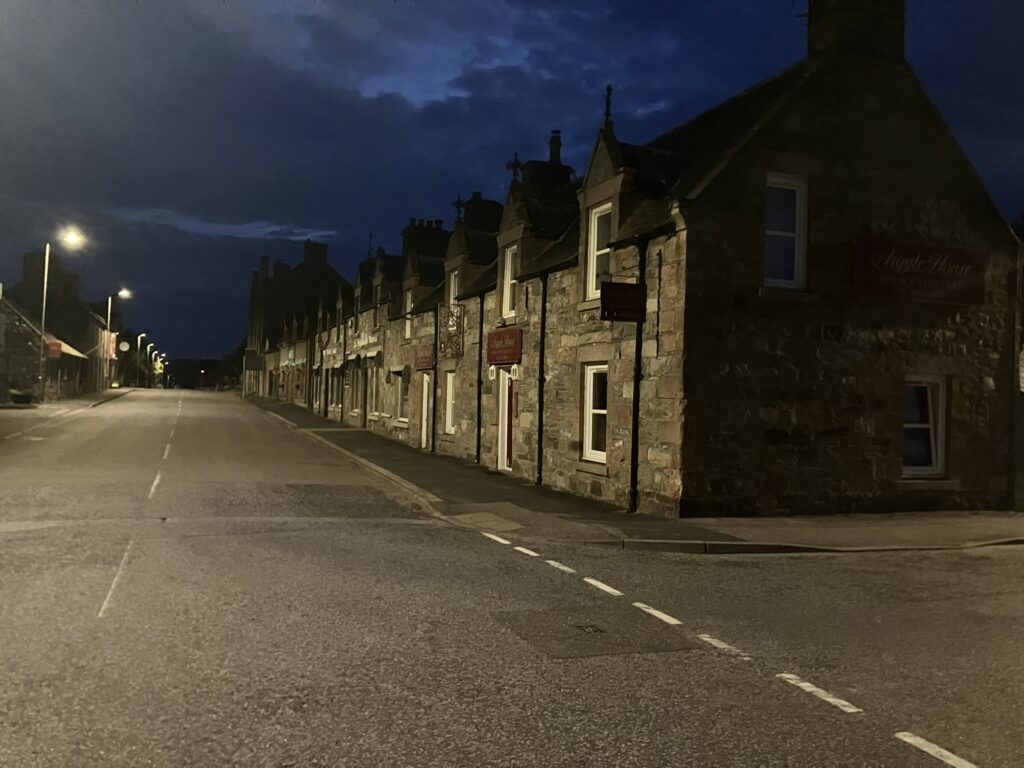
Soon we pulled into Tomintoul and found the Argyle Guest House where Michael booked for us. Though deep in the Scottish Highland, the guest house’s proprietors were actually New Zealanders. They were a kind couple in their retirement, enjoying a slower pace of life running this lodging to keep busy rather than to make money. After securing our bikes and grabbing our gear, we asked our host if there was any food. “I’m afraid we don’t have food.” Do you have anything canned? “No, no canned food.” Do you have leftover bread? “No. We have bread and other fresh food delivered daily and breakfast is served at 8:00AM.” Mimo and I were set to leave at 4:00AM to cover the remaining 300k. I accepted my lot and entered my room to dine instead on a large serving of self-pity.
Downtown Tomintoul
I showered, picked up my phone and set the alarm for 3:15, noting that it was 10:00PM… I put my head down to finally enjoy a soft bed, clean sheets and hopefully sleep to recover from an abusive couple of days….
The rustling sound of people getting up and changing into their kits in the low dim glow of approaching dawn brought me back to this side of consciousness. Sitting up, the heavy weight of that oppressive hopelessness seemed to have lifted. Regaining sobriety of awareness, I also regained my purpose to continue, albeit with less confidence than before. I repeated to myself: let’s just get to the next overnight control before making any decisions.
While shuffling around the control to get ready, I heard that familiar booming voice emerging from the hallway announcing warm-hearted greetings to all. It was from none other than Mimo. From the DC/Virginia region, his incessant smiling and cheerful disposition complemented each other like maple syrup over hot pancakes. He was never slow to compliment, always swift to encourage, the personification of that Chumbawamba chorus: “I get knocked down, but I get up again, ain’t gonna let anything get me down…” Given the fragility of my recovery, I realized that I needed someone like Mimo to encourage me. I asked him if I could join him.
Mimo and I headed north to resume. We were going to have to forage along the route to supplement what was lacking at the control. About 25 miles into the day’s journey, we spotted a Costa Coffee, a UK based cafe chain. By then any pastry or breakfast sandwiches they offered was like manna from heaven. The decent coffee boosted the octane rating of the meal.
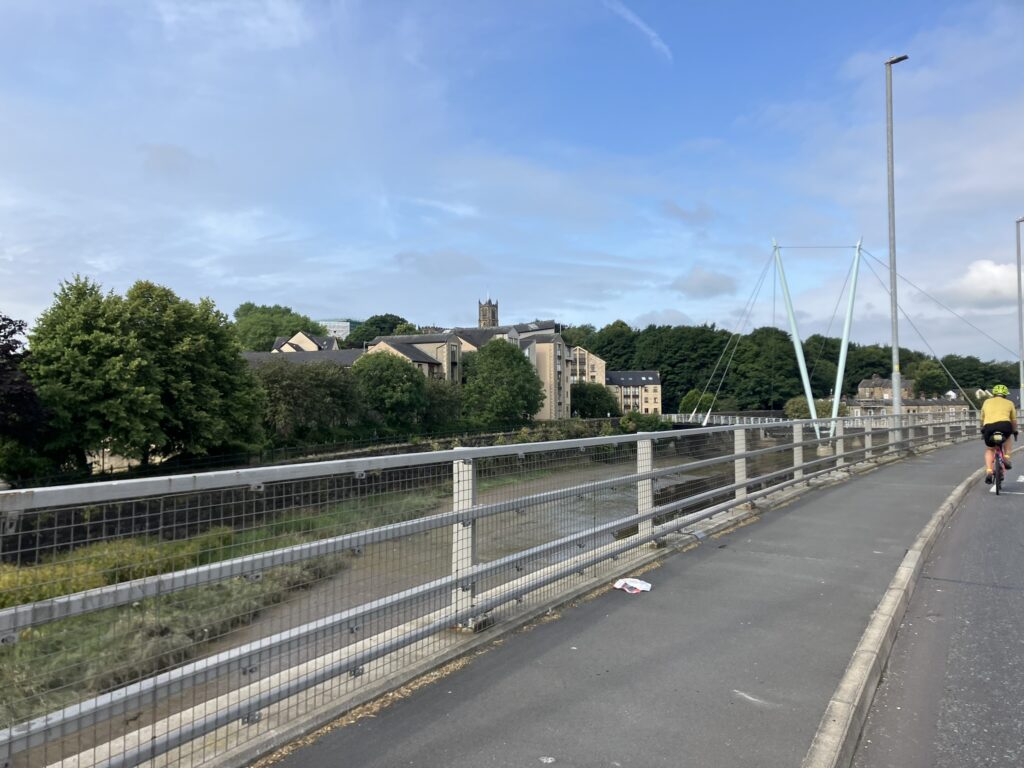
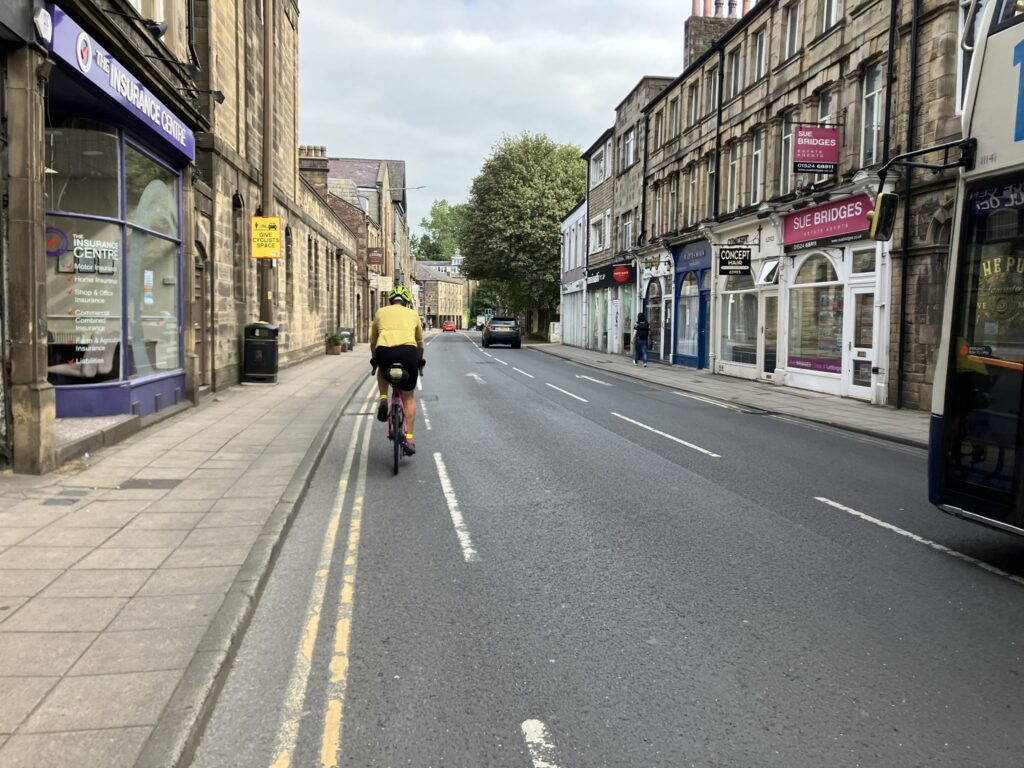
We continued through small cities such as Wigan and Preston, the once mighty Industrial North that powered Britain’s global rise, now displaying the region and the nation’s decay. En route we passed through Lancaster. Architecture at time point changed noticeably. Rather than the wood-framed structures, the primary building material was stone.
Lancaster, River LuneLancaster
The Esso truck stop in Warton was our first intermediate control for the day. It marked a change in our surroundings, as we made our way into more scenic landscape of Cumbria and northwestern England.
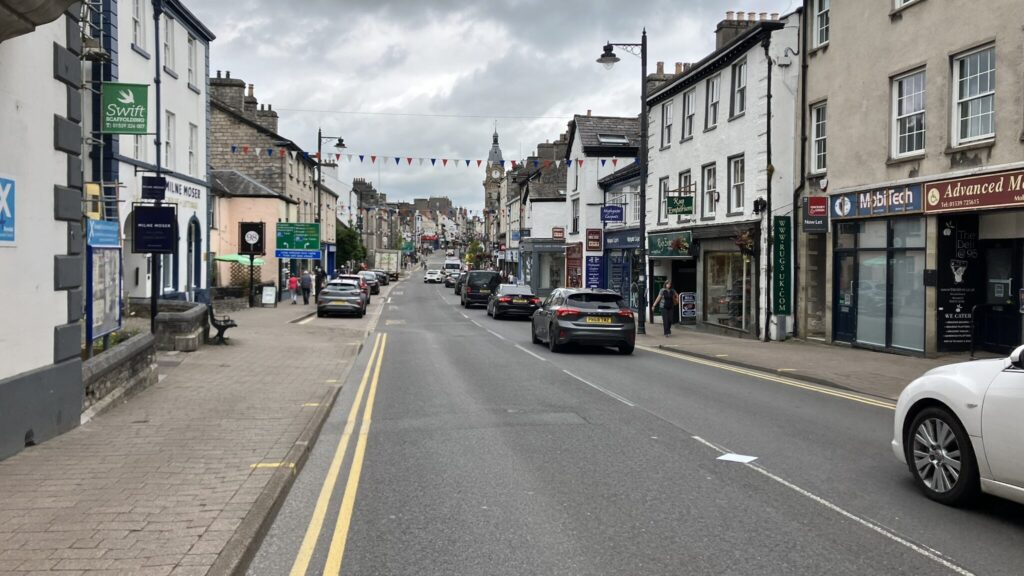
Kendal
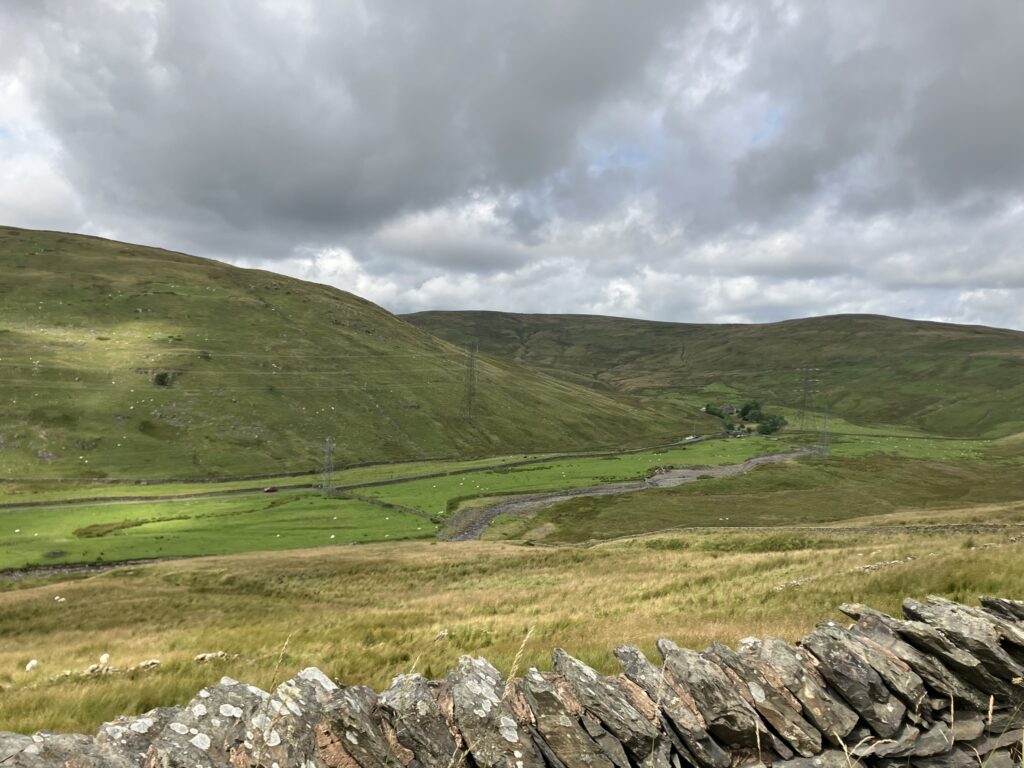
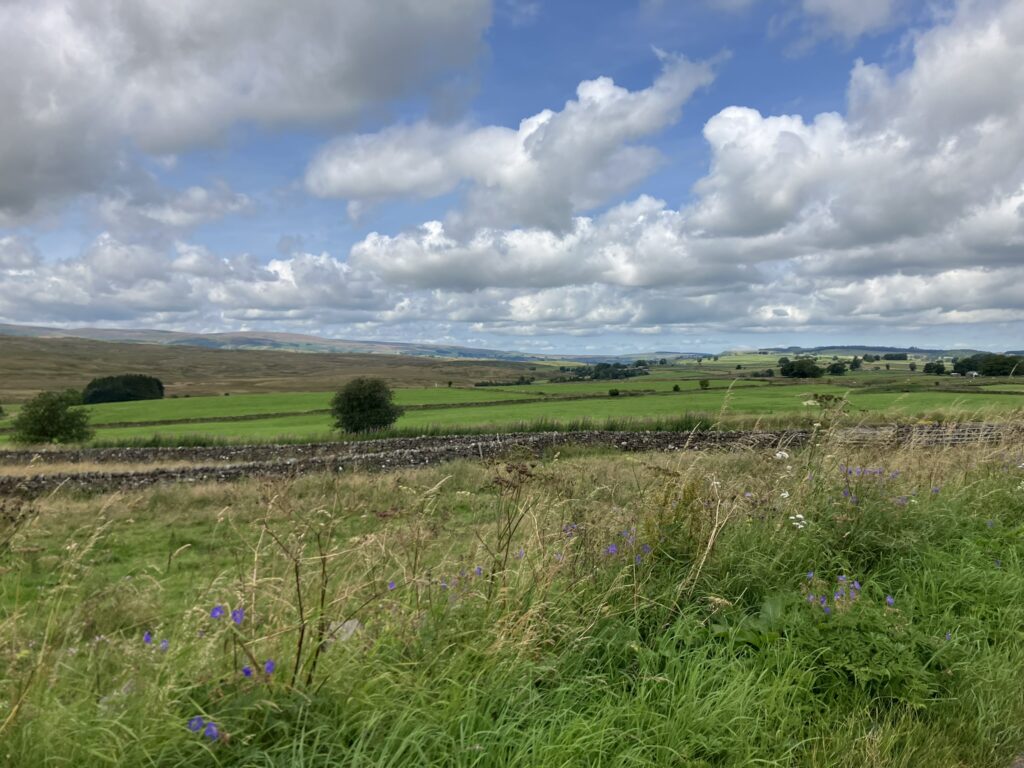
Passing Kendal, the terrain changed to rough undulations with the roads flanked by treeless fields and tufts of grass, instead of the smooth green pastures in the south. Boundary markers changed from stone to stacked slate. Riding along the eastern edge of the English Lake District made renown by William Wordsworth and his sister Dorothy, the stunning beauty of that rugged landscape was also on display just outside the national park’s boundary as I approached the first long climb on this route, the Bretherdale Head summit.
Bretherdale HeadBretherdale Head
It was a steady grade about 9 miles in length and over 1,300 ft in gain. With dark clouds hovering just ahead of me, the varying quality of light reflected through and off the clouds mixed with the blemished patches of dark grey, white and blue over the green and brown of the fields created a contradictory scene of ominous welcome. As I followed the twists and turns of the road, I felt what seemed like an errant drop of water on my face, then no more.
Bretherdale Head summit
After Mimo caught up to me near the summit, we descended into the valley floor, now more verdant than on the other side. Since our last stop was about 40 miles at Carlisle, we decided to find a place to eat when we reached Penrith about 6 miles further.
By now, I caught wind that LA Matt had abandoned. The square-tapered bottom bracket on his steel frame bike started to unthread. He made several attempts to tighten on his own, but his repairs ate into his time. Eventually he couldn’t recover at his pace. At Golborne he ended his journey.
The route took us through Carlisle’s city center. Passing by the Carlisle Citadel with its imposing twin towers made of reddish bricks, we wove our way through the city to cross the River Eden. Further on, we found the control which was a McDonalds. Still full after the Penrith stop, I ordered a small order of fries and a double espresso to ward off the late afternoon drowsiness. Other randos came and went. Eventually Expat Matt joined us as we made our way to cross into Scotland.
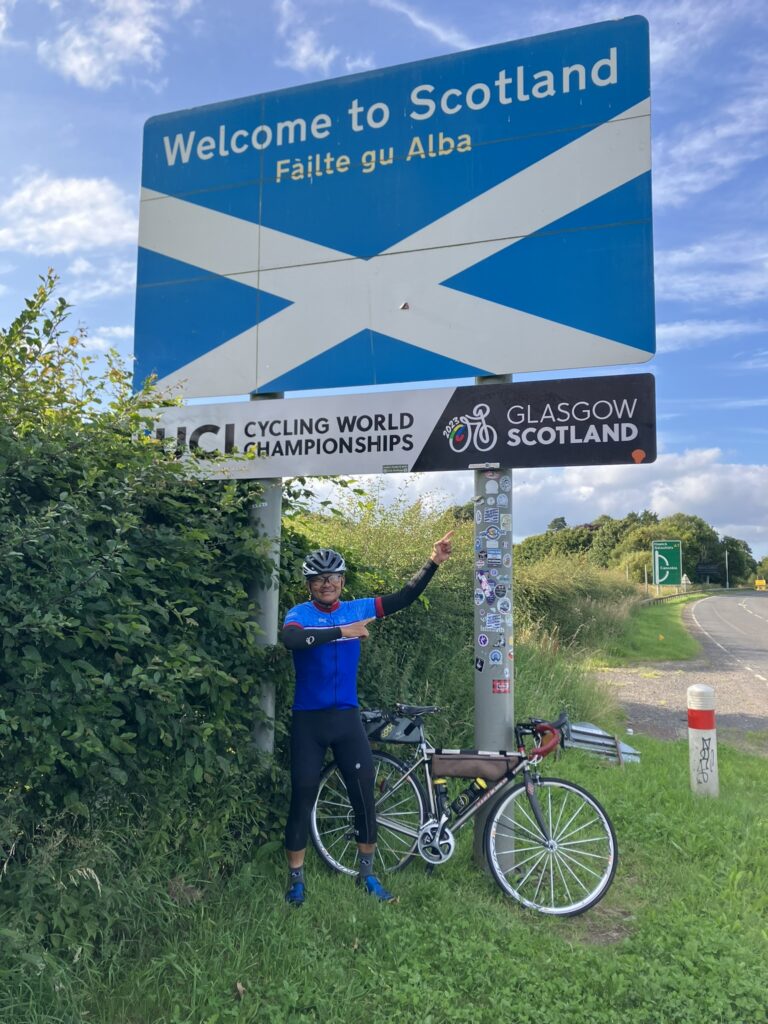
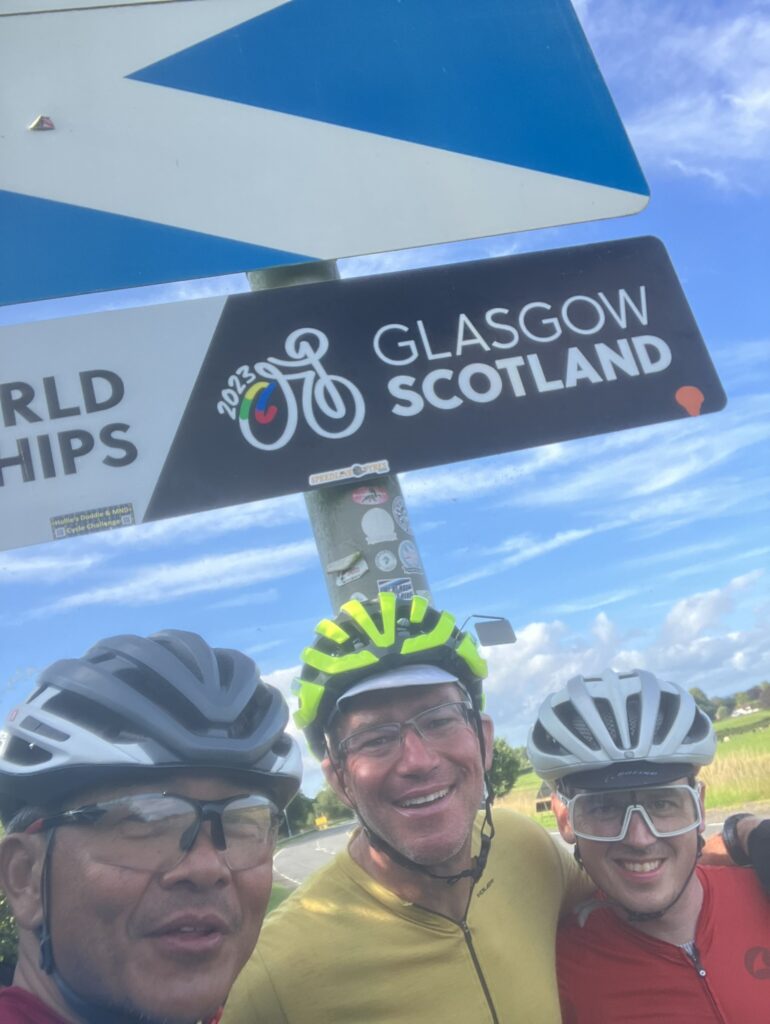
We started to ascend on a gentle grade after leaving Longtown. 3 miles further down and we spotted the “Welcome to Scotland” sign with the blue and white of the cross of St Andrew. We stopped for photos to celebrate our final “country”, having cycled more than half the distance to our destination.
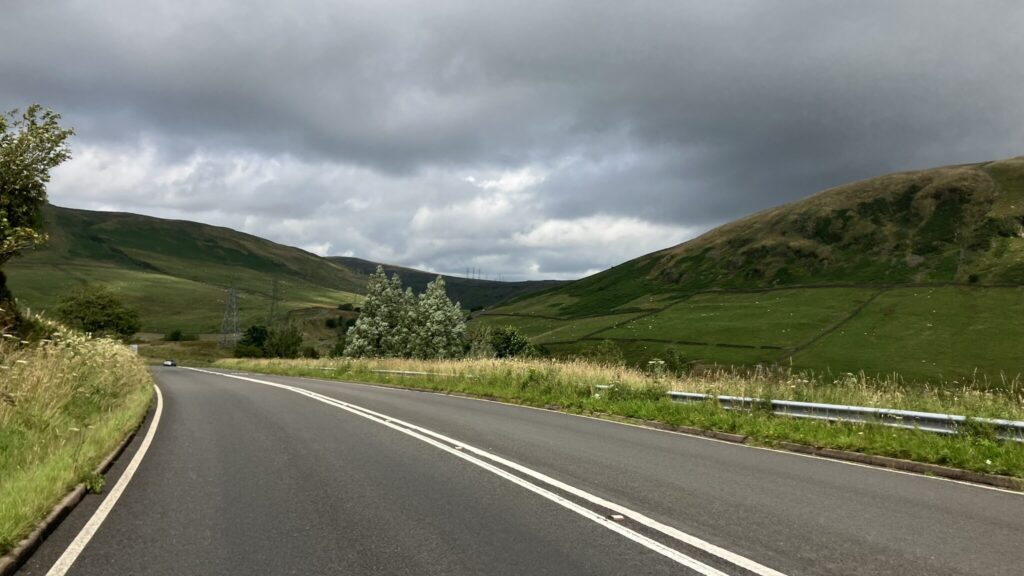
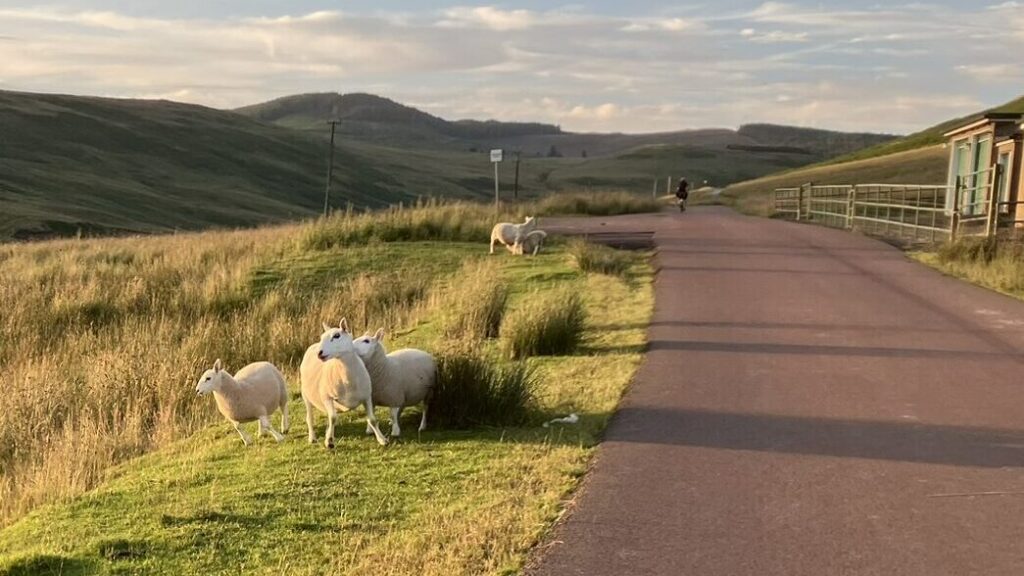
Though considered the Lowlands, the contours of the landscape was much hillier than the “low” in its name suggested. Long climbs followed by long descents on either side of the summit. The change in pace was a respite for me from those treacherous spiky peaks of the south. Large swathes of forestry land were on either side of the road. When no trees were present, the barren sides were dotted with grazing sheep.
Seeing a farmer’s field along the side of the road reminded me of Robert Burn’s “Ode to a Mouse” in which he made his timeless observation on fate.
The best laid schemes o’ mice and men
Gang aft agley (often go awry)
Not just poignant in describing life in general, it certainly captured the essence of my LEJOG experience thus far. How many non-refundable rooms I left empty as I fell behind schedule? How many timetables I have discarded in the middle of brevets due to mechanical or physical failings?
Unlike Burns’ “beastie”, I wasn’t yet going to knuckle under fate’s demands.
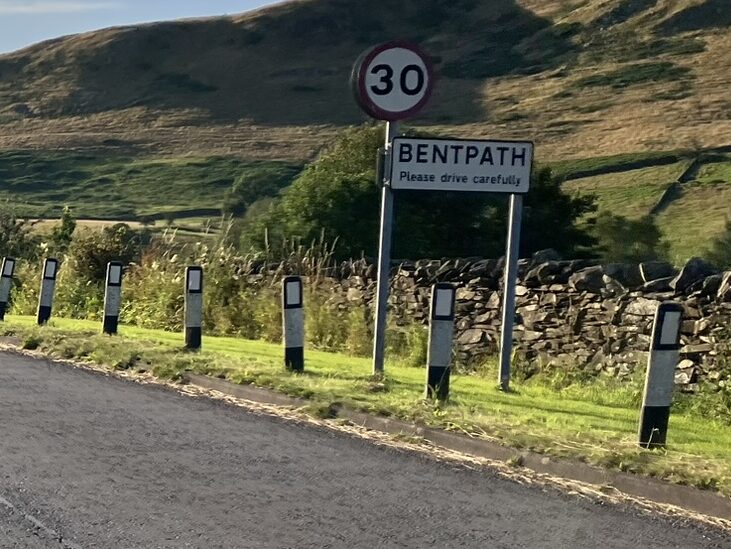
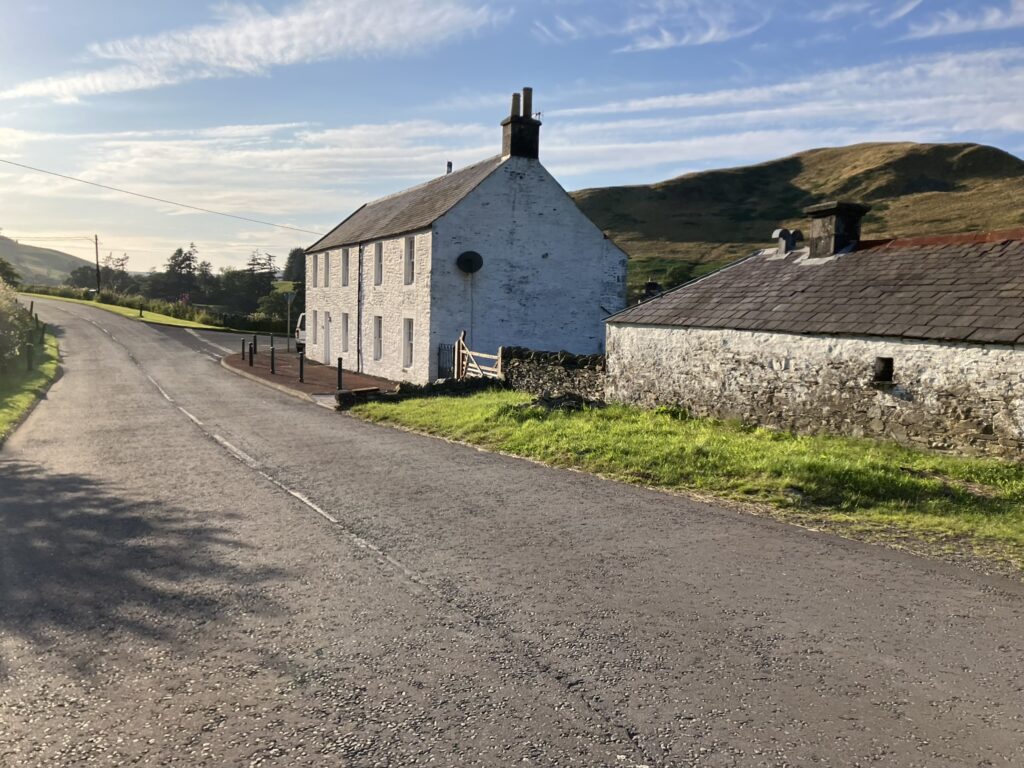
Just after Langholm, we climbed and then descended on newly chip-sealed roads with very loose gravel, making the ride very sketchy at times. On the side of the road loose rocks piled up, making bike handling a challenge. Expat Matt who crashed and then recovered on Day 1 in Cornwall took extra precautions when descending. Mimo and I bombed down them but would soft-pedal so that he could catch up. We biked through small Scottish villages, some like Bentpath, where just a solitary building or two stood.
As the sun began to make its final drive toward the horizon, the air became noticeably cooler. Another LEJOGer passed us. I hammered up a climb to catch that rider, more out of a need to stay warm than to race. Soon darkness prevailed.
Scottish gravel sector
We arrived at the Kirkburn control. Andy greeted us in person: “All the beds are taken. Bath towels are still a little wet as I couldn’t dry them in time at the laundry”. His plan at this control went further awry as the owner refused his request to set up air mattresses. While there were still some available sofas, I tried to “secure” a spot by placing my drop bag and gear on it before heading off to shower and eat. For food they offered pasta with tomato sauce. The pasta was soggy but with a crunch in the middle: they were half cooked and let it sit in an inch of water that wasn’t drained off. How the fuck could any adult not know how to boil and prepare pasta?
If suffering through a shitty meal wasn’t enough punishment, by the time I was ready to sleep, another rider had occupied my sofa with my belongings pushed to the floor. In muted indignation I collected my stuff and sought out a clearing on the hardwood floor to try to “sleep”. Just after laying down, I felt a persistent cold breeze about an inch high off the floor, blowing in from underneath the doorway through the gap. I got back up, put on my arm and knee warmers, vest, jersey and wool gaiters to stay warm. My drop bag became a pillow. I asked Andy if there were other places. The most he could offer was to let me know when a bunk bed became available after a rider left.
Not long on the floor, I felt a sharp jab on my arm followed by that distinctive Lancastrian voice: “A rider is leaving, and a bed is available. Take it now!” I jumped up, gathered my stuff in a corner and followed him. Looking around me I saw riders nearly taking up all the floor space. In earlier times, we would have called this set up a spreader event. The only disease being spread that night was sleeplessness.
I crawled into the hot bunk and bundled up into a fetal position to regain warmth. Per the timetable, I was supposed to reach Queensferry, just before the Forth River Bridge crossing, about 40 miles further down. Another write-off.
My phone alarm sounded reveille at 4:30. After another shower to shake off the last vestige of sleep and a cup of hotel instant coffee to wring out that last drop of daze, I met Expat Matt at the lobby to continue our journey.
Knowing that we would be leaving well before the hotel’s breakfast service was available, I scouted out a Co-op in Avonmouth for our breakfast stop about 15 miles further on the course. Though the morning air was brisk, it was rejuvenatingly fresh, and the skies were again brilliantly clear. Taking in the good fortune, we rode to our breakfast stop, passing various verdant farm fields in the English countryside.
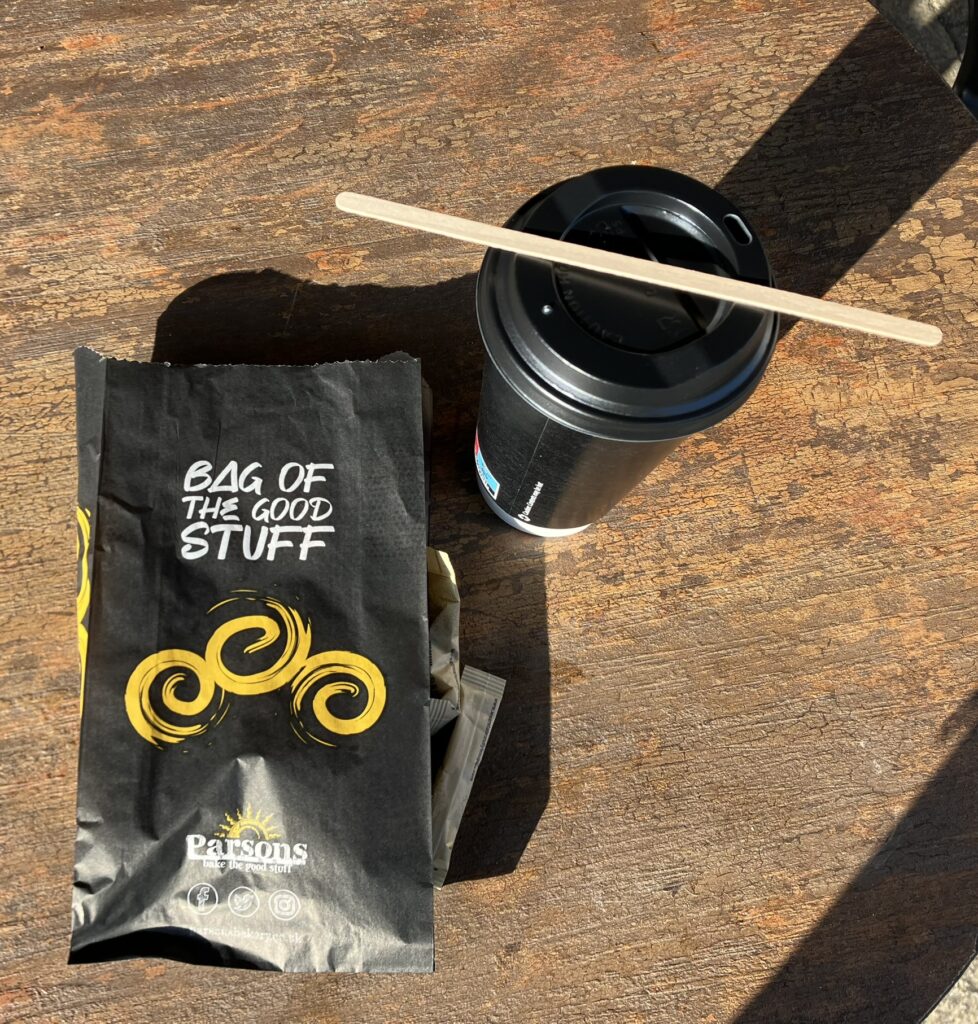
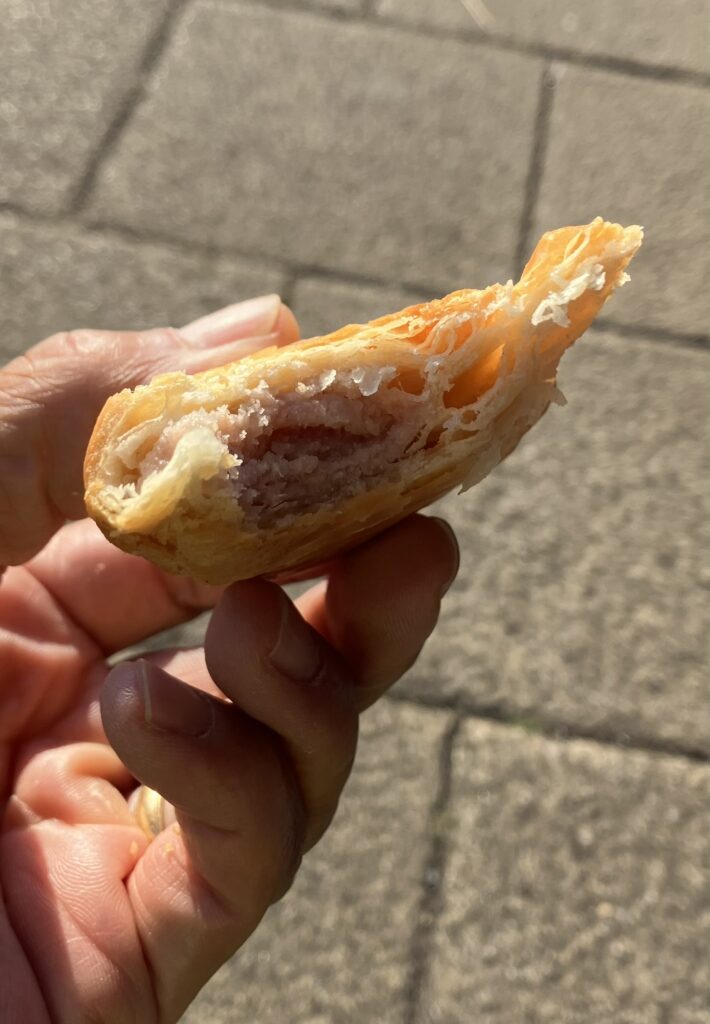
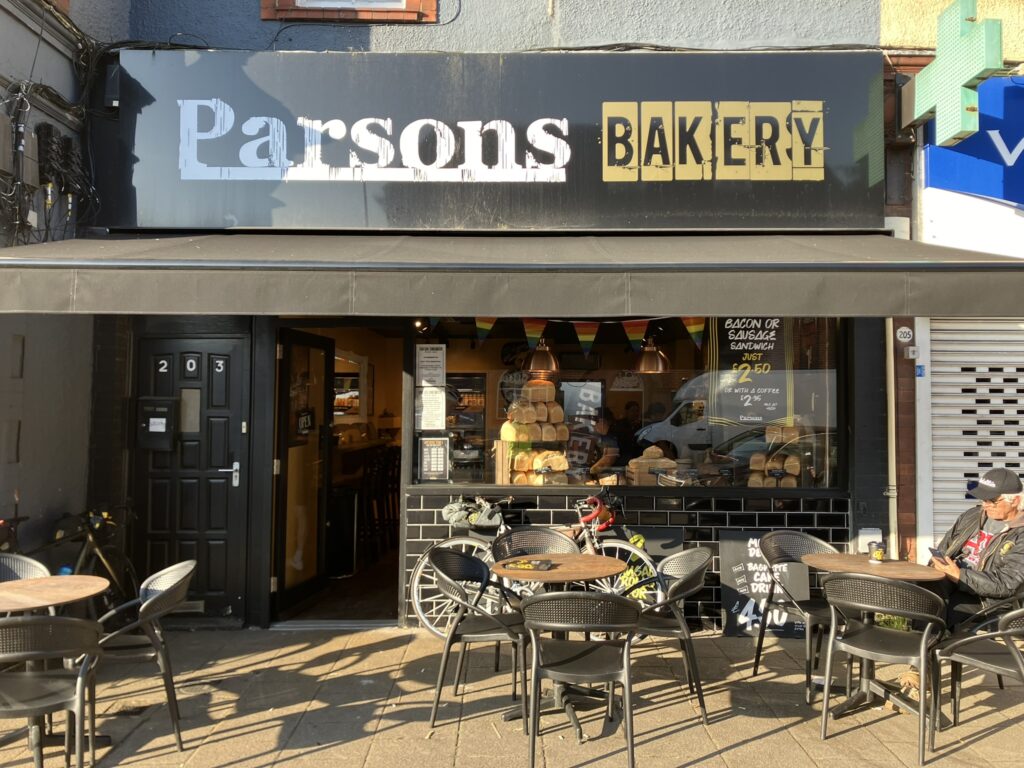
After a short climb, we entered the industrial and warehousing districts surrounding the port of Bristol. Crossing over the River Avon, we turned off course to find that Co-op. We stumbled onto a Parsons Bakery right next door. In Parsons, the fragrance of fresh baked breads and pastries, both sweet and savory, permeated in the air, entering through my nose and into the pores of my skin, boosting my morale. Skipping the traditional continental offerings of croissants and pain au chocolat, I chose a couple of sausage rolls, the iconic British breakfast of savory minced pork baked in puff pastry. Paired with a mediocre cup of cappuccino, it was the closest to heaven in Avonmouth.
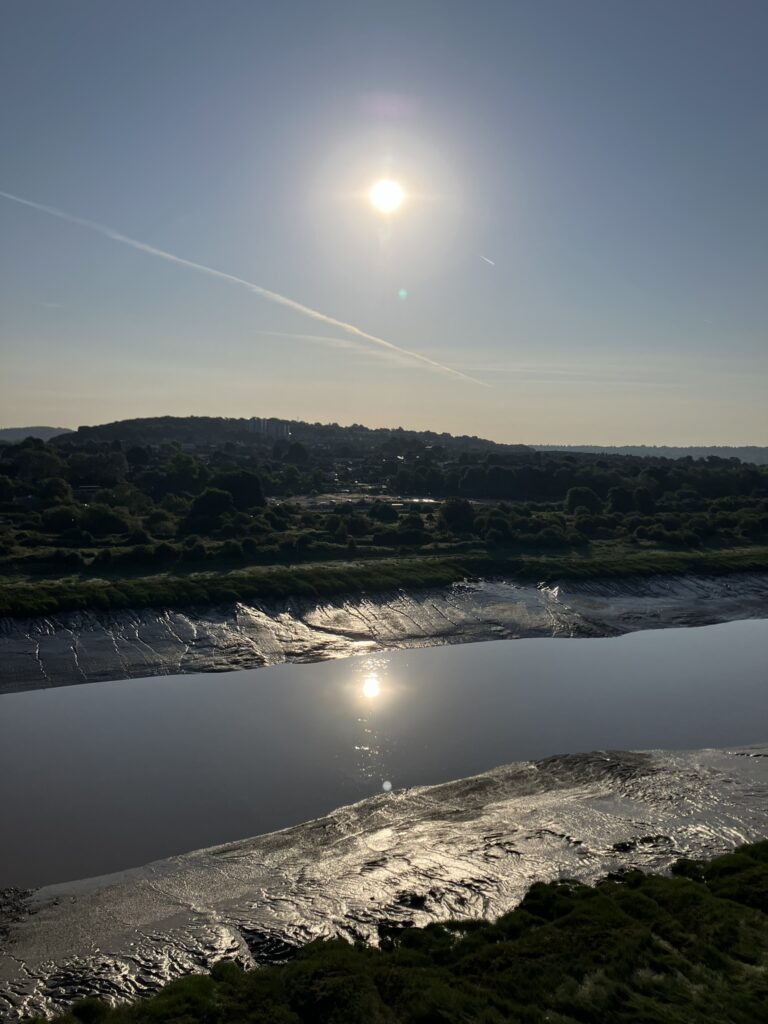
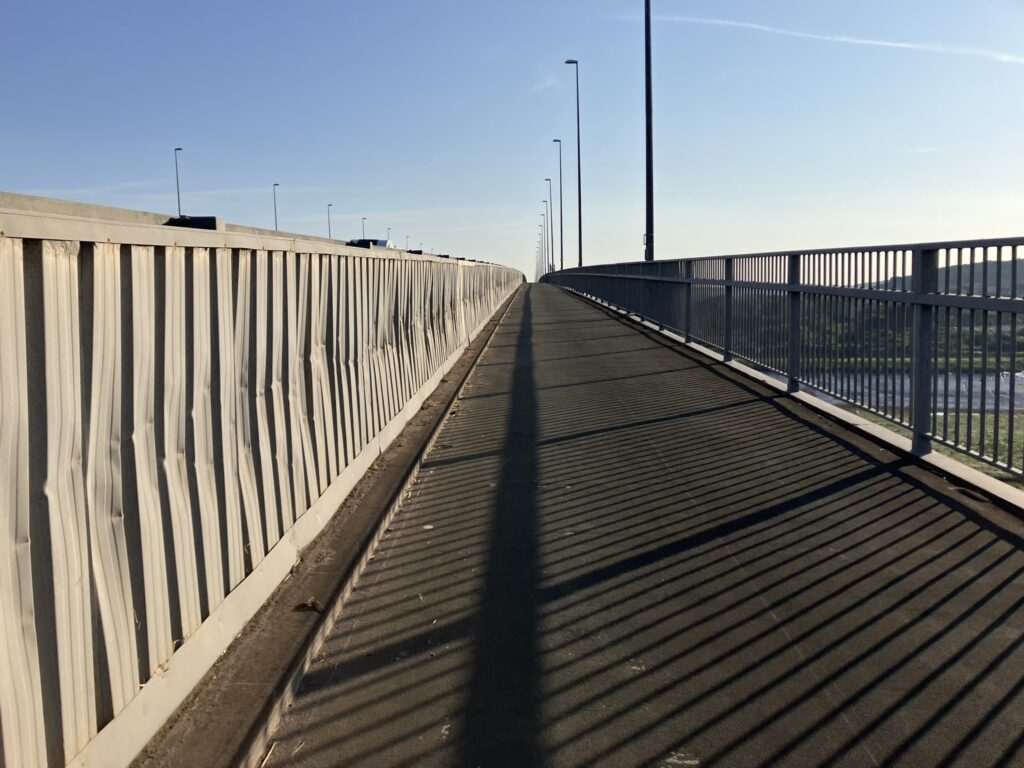
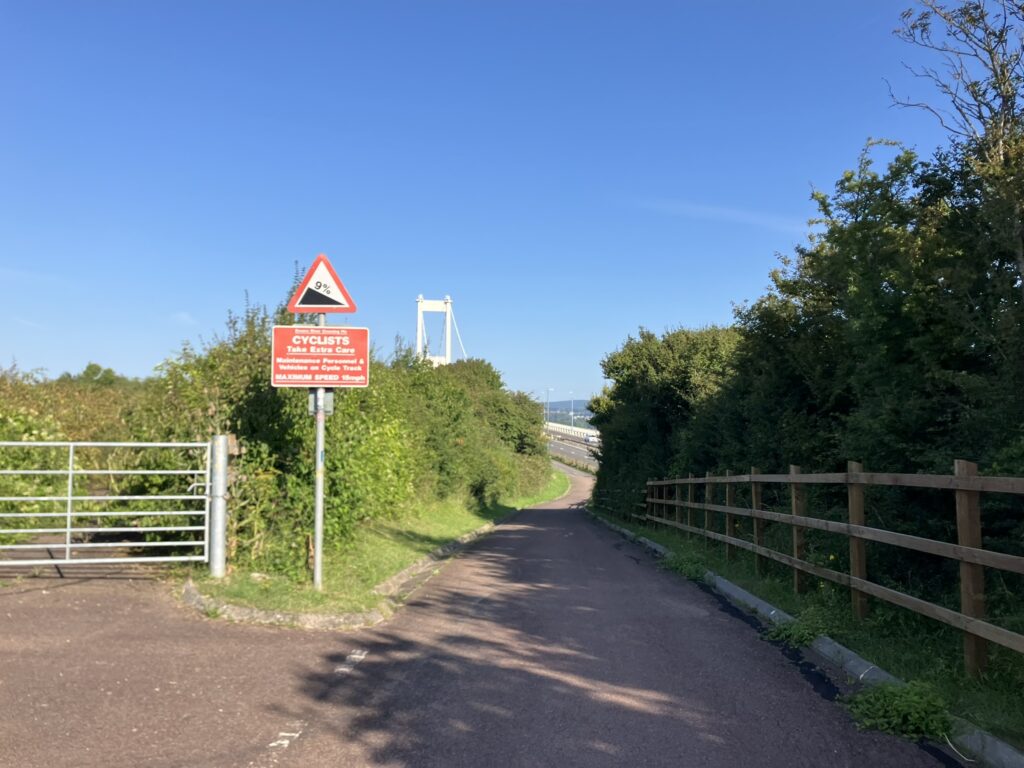
River AvonCrossing the River AvonApproaching the SevernTruck traffic
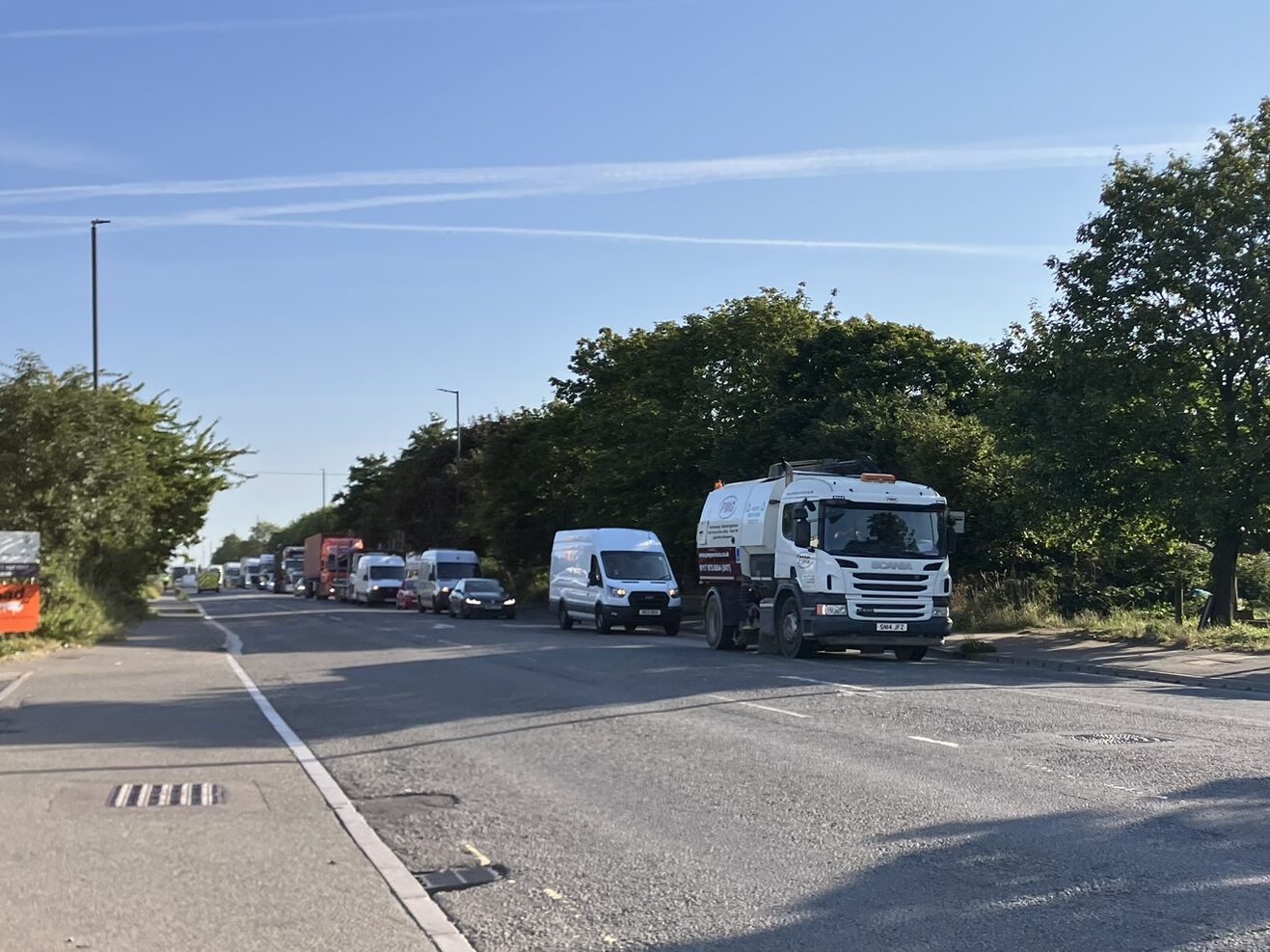
With full bellies, we made our way toward Severn Bridge to cross into Wales. The short trip to the bridge on a Monday morning meant accommodating truck traffic entering and leaving the port. Fortunately, the route choice afforded dedicated bike paths and sidewalks to separate ourselves from truck drivers on the clock. We rode on the bridge’s protected bike path to enter Wales.
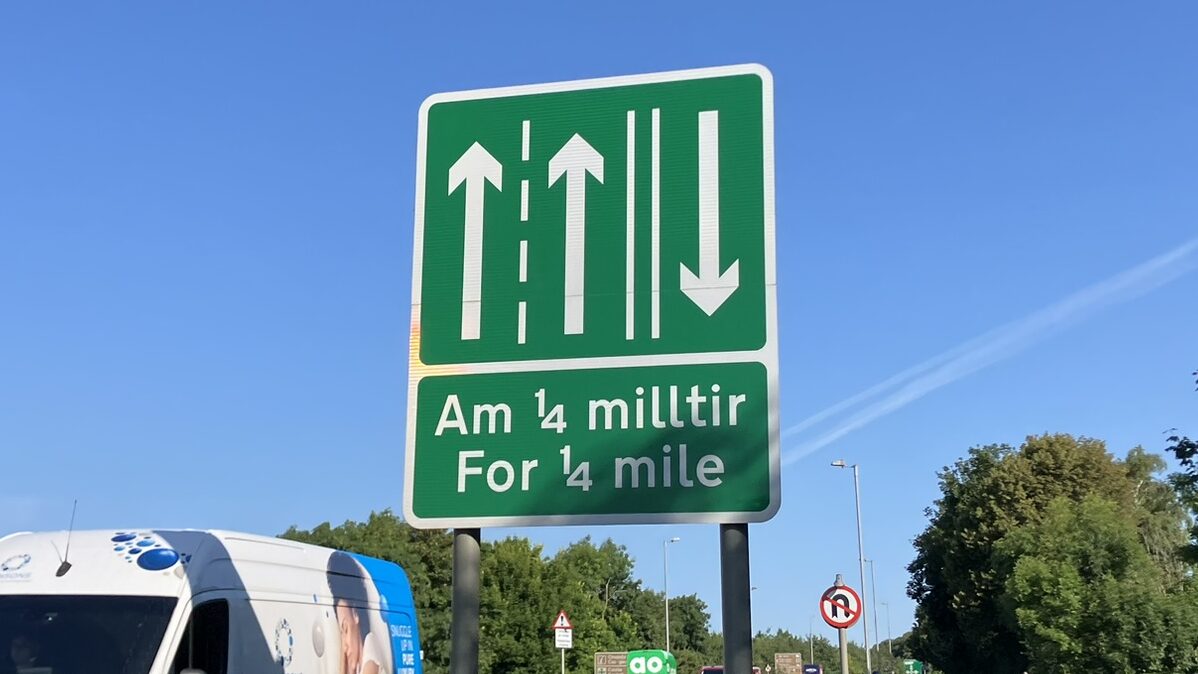
Street signs turned immediately bilingual to accommodate English as the second language. Riding past Chepstow, we entered the Wye Valley National Landscape. After waiting for Expat Matt at the first summit, we decided to split up. The soft, clean bed and sausage rolls did wonders for me and I wanted to go as far as I could on my tank of high spirits.
Expat Matt cresting the first Welsh summit
Continuing my climb toward the road’s summit by Beacon Hill under the forest’s shaded canopy as shelter against a surprisingly unforgiving sun, I chanced upon a road sign pointing toward Tintern Abby. William Wordsworth wrote in “Lines Composed a Few Miles above Tintern Abby”:
But oft, in lonely rooms, and mid the din
Of towns and cities, I have owed to them,
In hours of weariness, sensations sweet,
Felt in the blood, and felt along the heart,
And passing even into my purer mind
With tranquil restoration.
Being on the bike, whether for brevets, with friends on a beer or pastry ride or with my two sons on our mountain bikes, has afforded me occasions to see nature’s wonders while partaking in spontaneous conversations on ancient Greek’s middle voice, differences between antenna vs amplifier gain or the sublime elegance of Bach’s Brandenburg Concertos. These memories have sustained me “in the hours of my weariness” in finding “tranquil restoration” as I tread through that dull portion of life imprisoned in my black Prius as I commuted between home and office, then office to home, in that petty pace of a thoughtless pendulum. Wordsworth found release in his solitary wanderings. My spiritual freedom is born out of discoveries of new places while sharing the joy, if in the form of suffering through a ride long or short, with friends, both old and newly made.
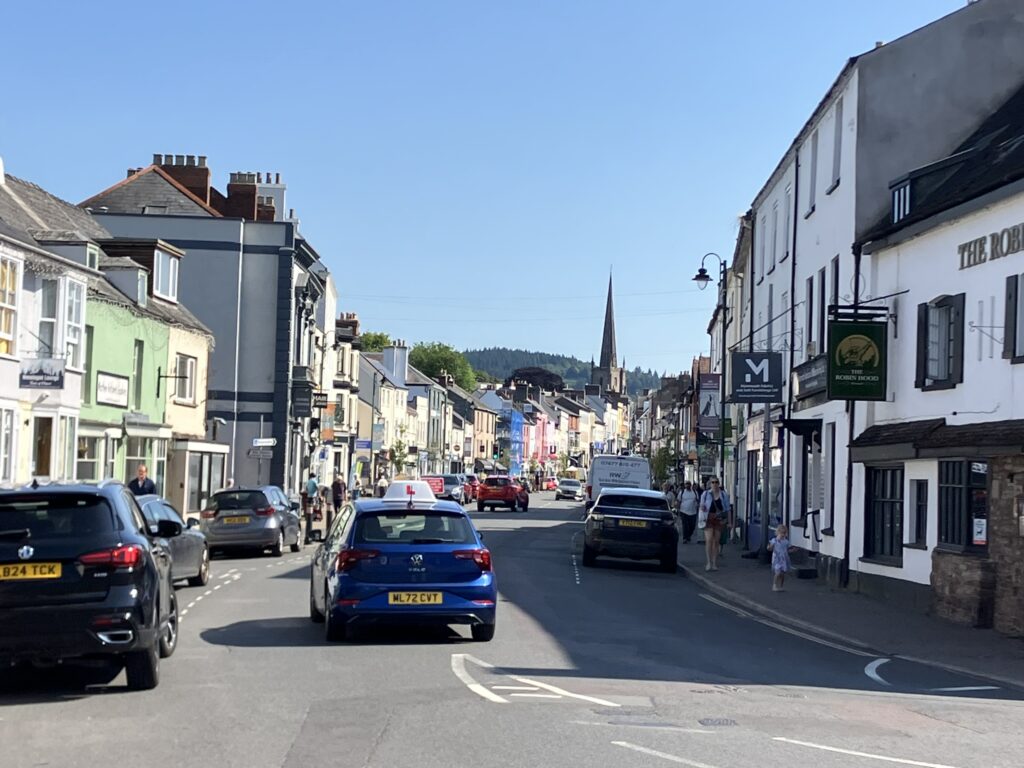
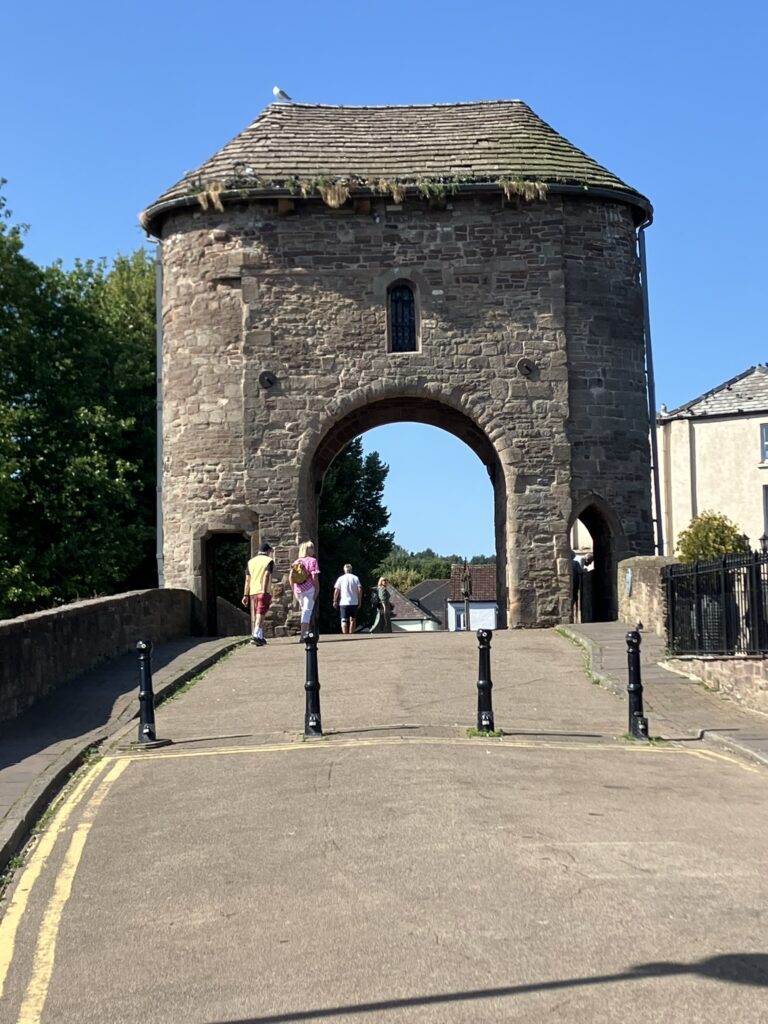
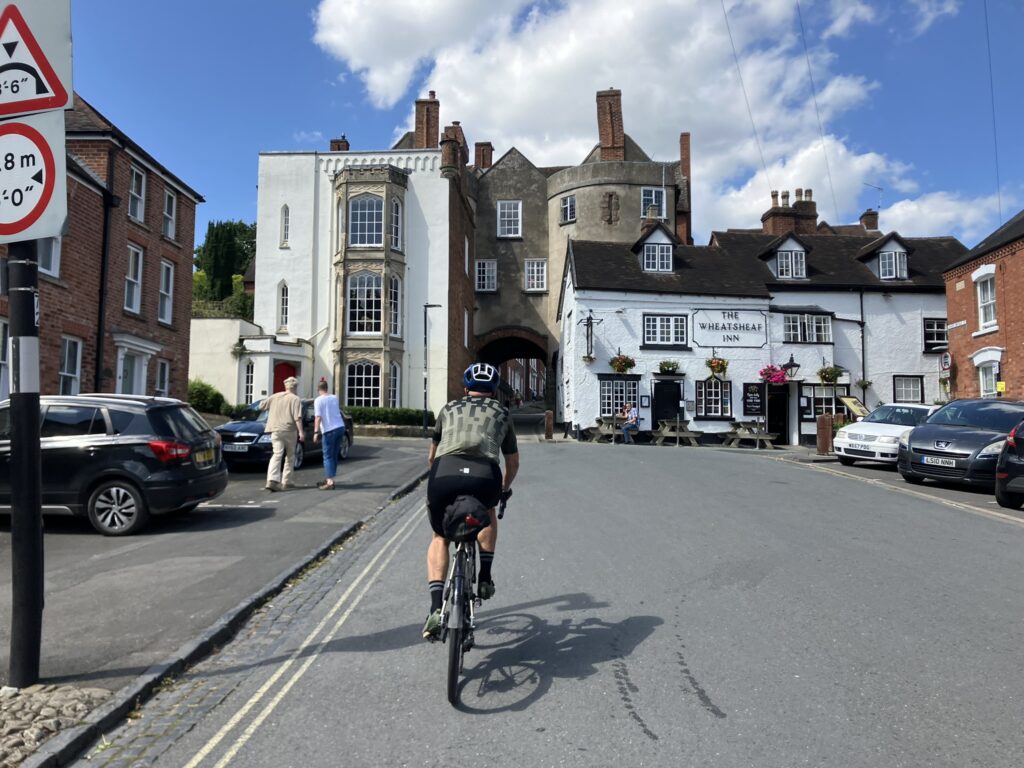
After a quick descent to the valley floor, I re-emerged in the presence of people and cars en masse as I entered the busy market town of Monmouth, a solitary sentry standing at the border with England defending Welsh identity. Monnow Bridge and its gate tower greeted me as I rolled down the town’s high street of shops and businesses. During my route research, I found Coffi Lab Monmouth that would provide a selection of civilized food and coffee drinks to sustain me through the day. Not far down the street I spotted the day’s Welsh Mecca.
Welsh country laneMonmonth High StreetMonnow Bridge
Another cyclist in gear and garb resembling a randonneur was sitting at an outside table. As he was on his phone, I left him alone and entered the café to order. I spied on their offering of porridge, English for oatmeal, accompanied by coffee, freshly squeezed orange juice and a croissant for my indulgences. Looking for seating outside to be close to my bike, that rider was off his phone and offered the empty seat at his table. After the initial interrogatives, he revealed he too was a LEJOGer. His Received Pronunciation with noticeable flat vowels suggested a Southern Hemisphere upbringing. Not long into our conversation I learned his name was Chris, an Australian now residing in the UK.
I was quite underwhelmed by the porridge. Rather than the traditional boiled slop fit for quakers and horses, the Lab’s modern interpretation altered it into a cup of muesli with milk. Still, I enjoyed my other indulgences while sharing a conversation with Chris about our respective LEJOG adventures up to this point. Like the rest of us, he complained about not having enough sleep.
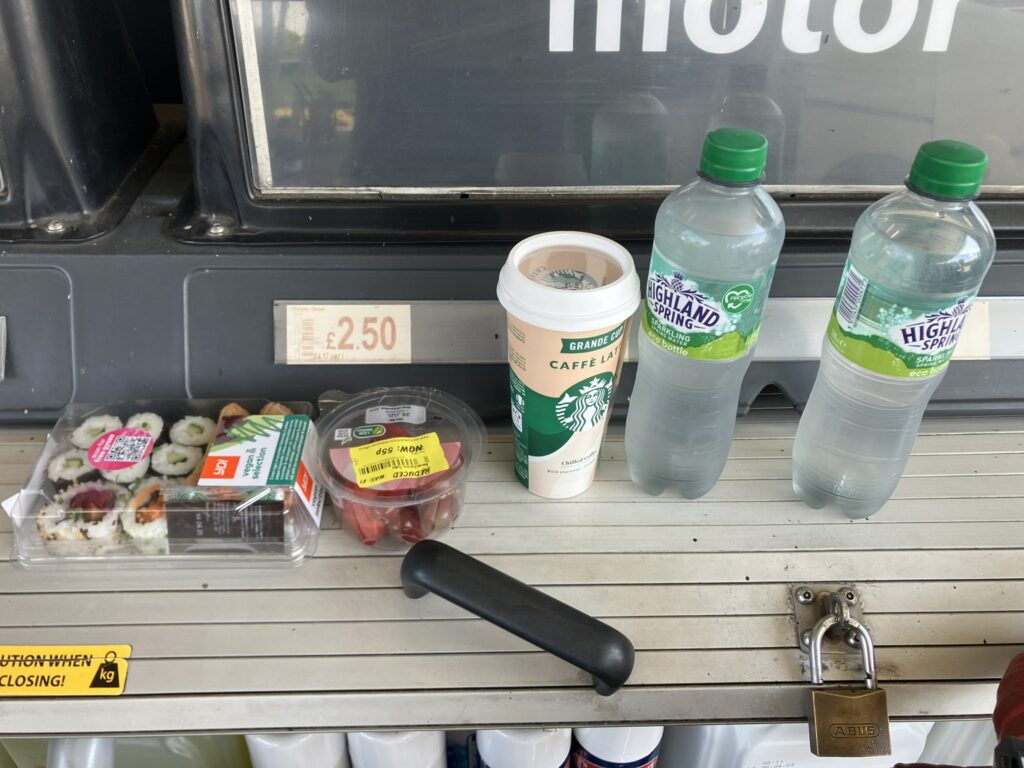
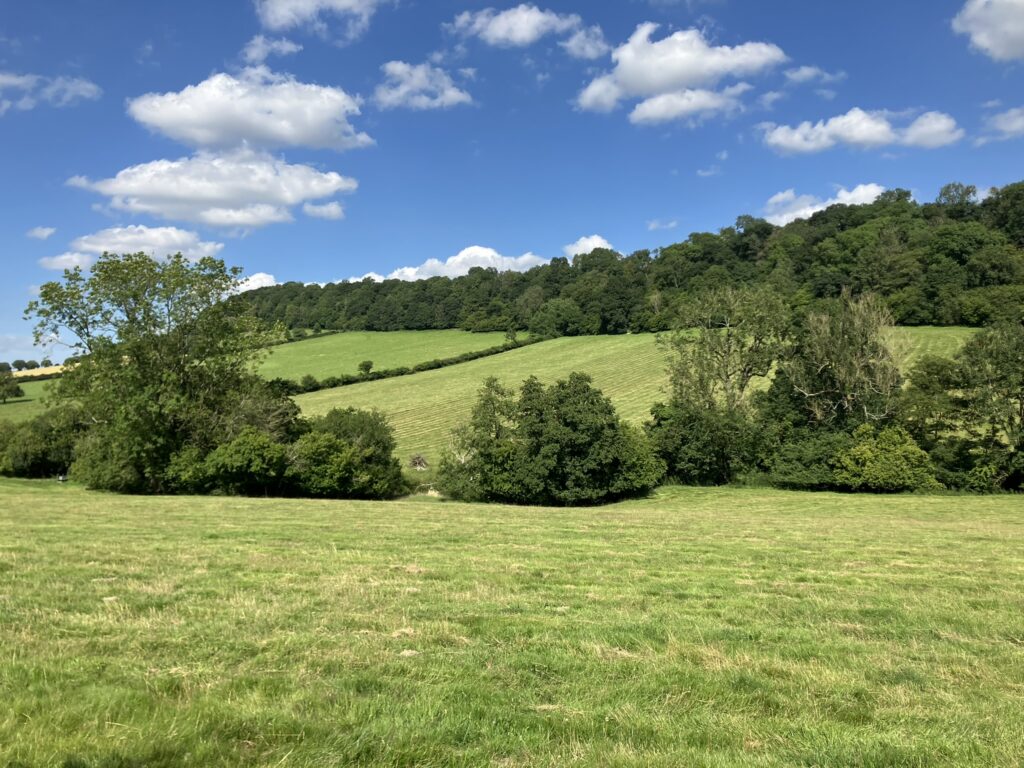
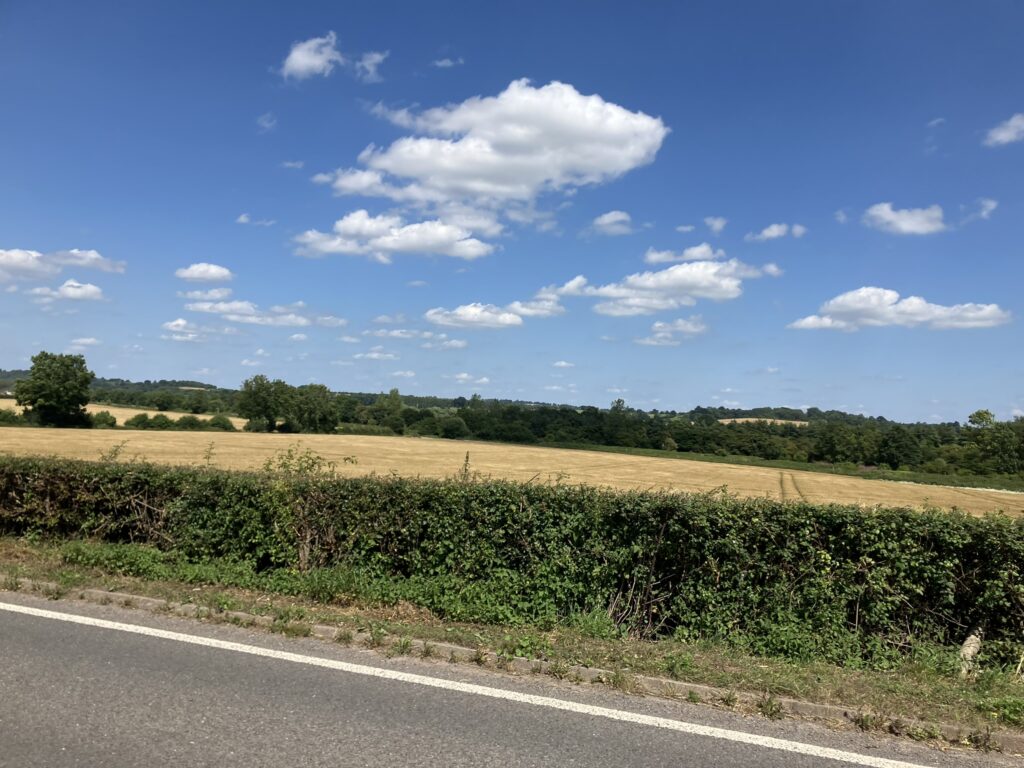
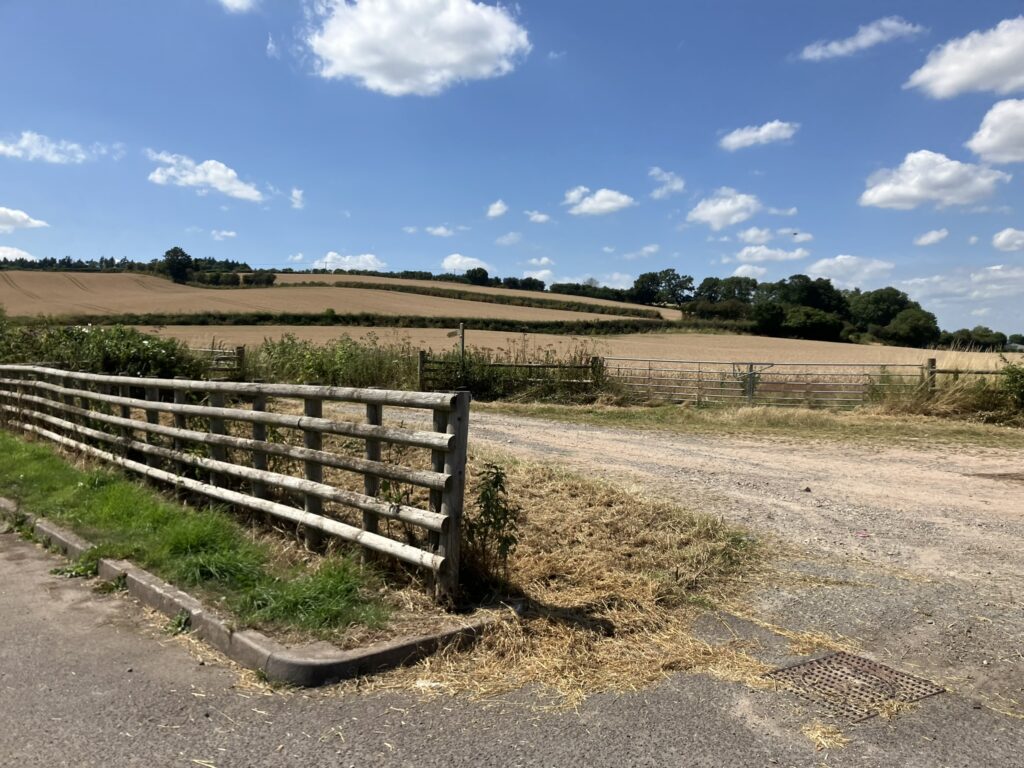
We mounted our bikes and crossed the border to re-enter England and pedal toward the Hereford control. The profile of the land changed dramatically, becoming more rolling as we passed hay fields ploughed and cultivated over centuries of human toil. Few trees except those planted by farmers, the road led us the control at the ADSA gas station in the city for our receipts collection and resupply.
Fine rando dining at Chez ADSA petrol station
Leaving the city, we again rode through more pastoral countryside, now entering Shropshire. In the distance I saw hills, perhaps the same that inspired AE Houseman to write “What are those blue remembered hills….?” The temperature started to rise, increasing our water consumption. He suggested a quick stop at the Tesco Express on Ludlow’s high street ahead of the actual control further down the road.
By mid-afternoon just outside Ludlow, Chris began to wane and decided to pull off somewhere to grab a quick ditch nap. Still feeling relatively fresh, I continued on by myself, chasing the clouds that roamed above me like airy sheep grazing on an azure plain.
But not too long after our separation, my stomach began to feel queasy, marking the start of my rando witching hour. If Achilles’ mother held his heel when dipping him into the River Styx, my mom held my stomach. Any misstep in food selection, I would start to feel bloated. I stopped at a local butcher shop to refill my water bottles and to take a breather. Still my stomach churned, now accompanied by an onset of acid reflux. The combined effect forced me to back off on my crank.
By the time I reached the Morrison’s Supermarket at the Market Drayton control, I decided to rest longer to let my stomach settle down while trying to take in as many calories as possible. Not long after, Chris arrived at the control with another group of LEJOGers. He invited me to join them as it was led by a strong rider. I took the offer and tried to hold on, but my legs were not having any of it. As the lead rider powered over a small rise, I lost grip of the train and dropped back, physically drained.
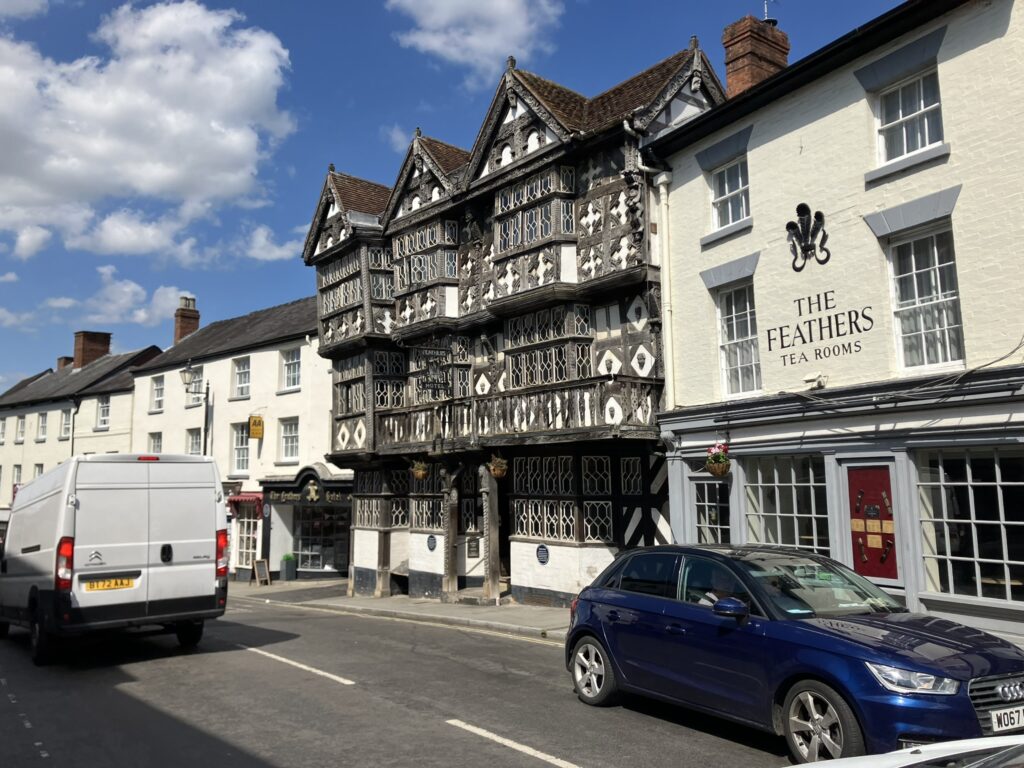
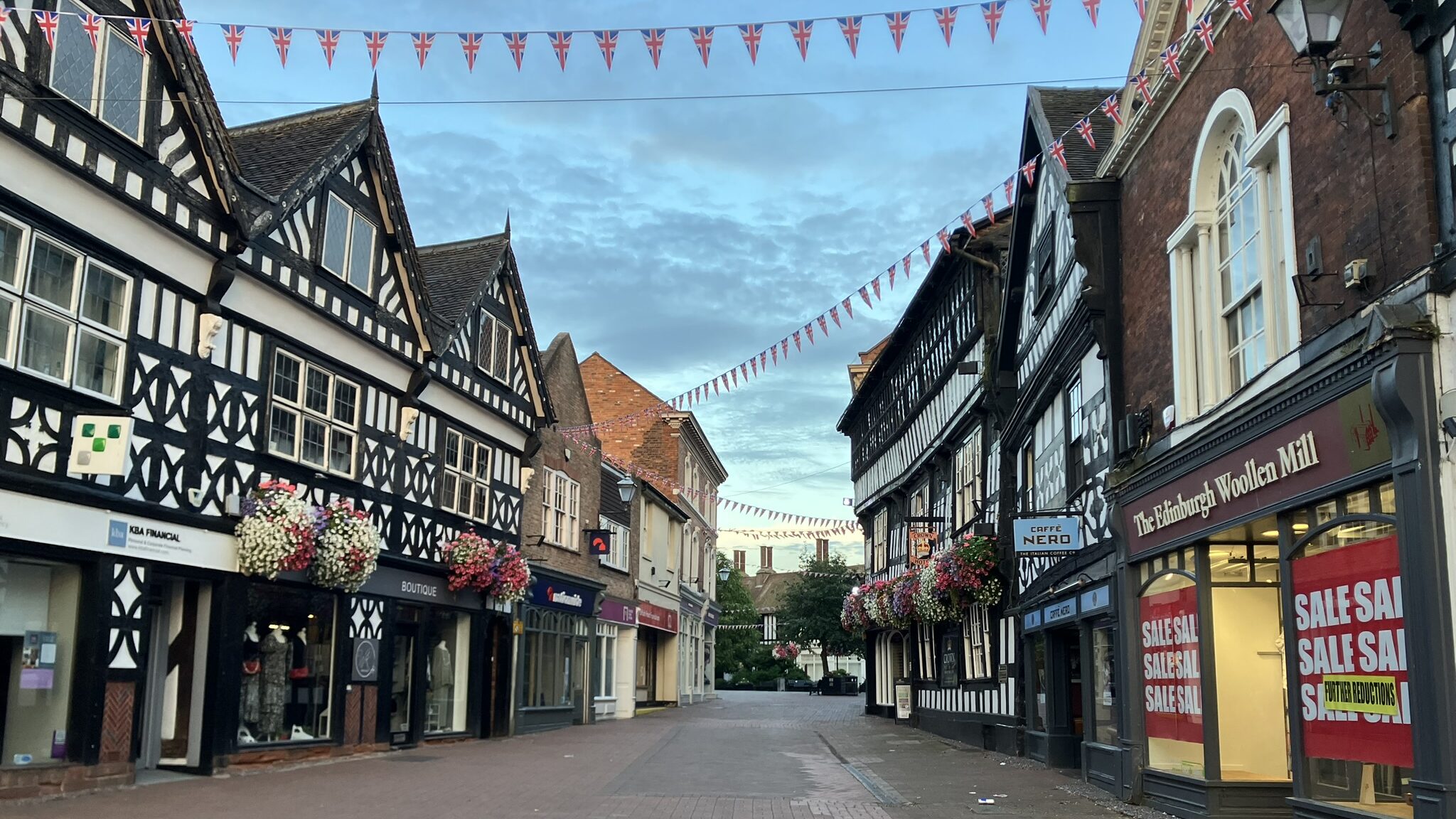
When reaching the market town of Nantwich, I tried to distract myself by appreciating its medieval town center with the iconic black and white timber frame buildings.
Nantwich, Cheshire
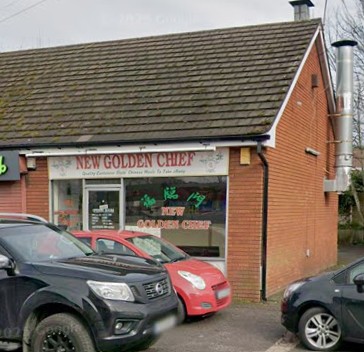
As night’s darkness encroached and overthrew daylight, the physical suffering turned into emotional distress. Passing through the town of Winsford, I spotted New Golden Chief, a Chinese takeaway shop. When I would find myself in these mental and physical ruts, salty and savory food would often be the antidote that revived me.
Harvested from Google Street View
When my order was brought out, I immediately dug into the rice expecting to scarf it down like a ravenous jackal. I was disappointed after the first scoop. The rice was hard and the soup had some flavor other than hot and sour. From disappointment I became distraught. Meanwhile, several bicycles with their glaring red rear lights whizzed past the Chinese takeaway, leaving me to feel left behind.
I mounted my bike and marched on into the pitch-black night through unlit roads and lanes, not to pursue, just to persist. I felt an overwhelming sense of defeat as I fixated on my present condition best described by Shakespeare:
When in disgrace with fortune and men’s eyes
I all alone beweep my outcast state
And trouble deaf heav’n with my bootless cries
And look upon myself and curse my fate.
I made my way to Warrington, a suburb between the two hegemons of the north: Manchester, known for its soccer teams, and Liverpool, where the Beatles were from. I found some solace pedaling through empty city streets unmolested by cars as I navigated through its twists and turns. Counting down the miles to Golborne, the 2nd overnight control, I began crafting my abandonment speech. It wasn’t “fun” anymore with acid reflux and stomach churns now at their peak. With Michael officially out after all our planning and plotting to finish together, the lone endeavor seemed pointless. The wheels on my bike had fallen off.
The original plan was to push all the way to Lancaster another 42 miles further down and stay at the Holiday Inn slightly off the course. Just making it to the control broke me. I had to settle on writing off a non-refundable hotel stay.
At Golborne, a woman with blonde hair, well-maintained complexion and the trim frame of an endurance athlete welcomed me. My prepared speech was no less resounding than Churchill’s or Gladstone’s: I’m abandoning. In a matter-of-fact voice she counter offered: “Why don’t you eat, clean up, and sleep. I’ll stamp your brevet card now and we’ll discuss tomorrow.” She directed me to where the food was, the selection of which was slightly better than at Mark but not much more encouraging. Expat Matt with whom I started the day and Mimo, the other RUSA rando whom I met at the start, were at a table. I joined and continued to “beweep my outcast state” and “curse my fate” of DNFing. I drew a couple of sympathetic wordless nods. It was not that they were deaf but just mute from their exhaustions.
When the control worker walked by me, I intercepted her and pestered her again with my queries about finding a rental car agency in Manchester. Her demeanor became markedly irritated and with an insistent and stern voice in her retort: “Just go sleep and we can make arrangements tomorrow!” I wasn’t going to argue. After collecting my drop bag, I took a nice warm shower and found an empty air mattress, hoping all this would end.
At 4:00AM I rose from bed to begin preparation for the day: a quick shower to help invigorate the consciousness from the outside in followed by a couple cups of coffee from the inside out. Not long Michael and Matt joined for breakfast. LEJOG was not our first rodeo. We’ve all finished PBP and other grand randonnees. We finished breakfast, cleaned up our Airbnb, packed our gear and conducted one final bike inspection. Still inside me I felt that newbie giddiness yearning to cry out like a toddler while experience, the adult in the room, kept that urge muted as I went about my morning business.
Unlike US events with start times that would make even roosters complain, Andy was an enlightened organizer – 7:00AM start. We locked up the Airbnb, mounted our bikes and headed toward Land’s End into the chill morning air under a canopy of a surprisingly clear blue sky. At the Land’s End visitor’s center, we sought out Andy to have our brevet cards stamped.
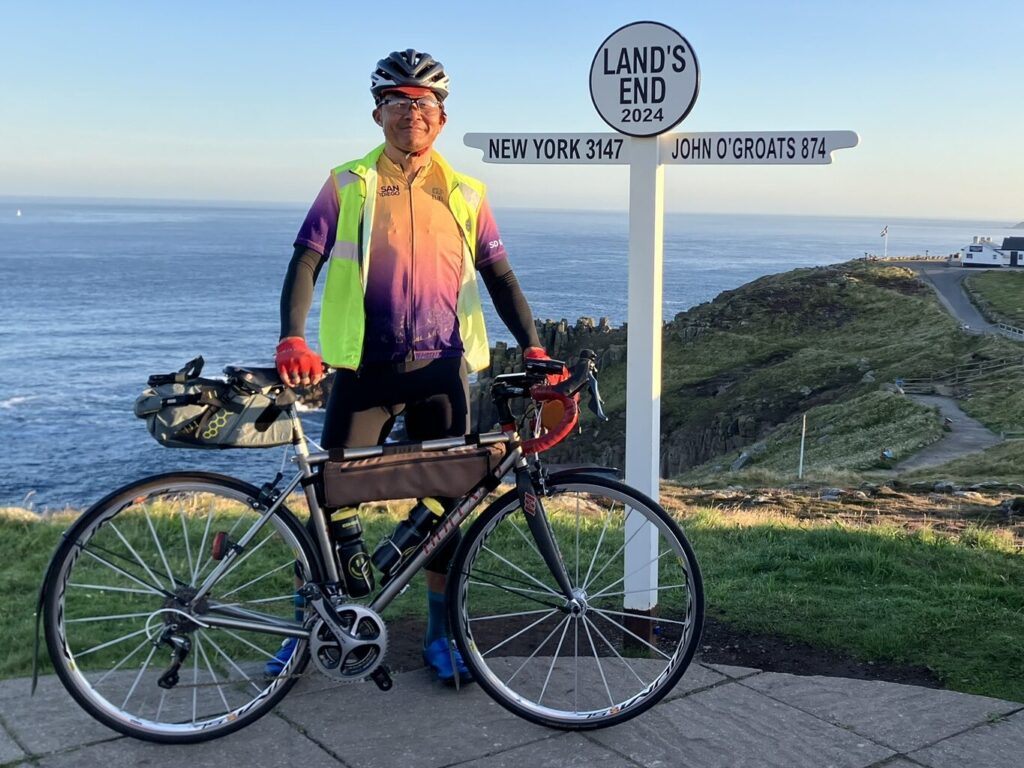
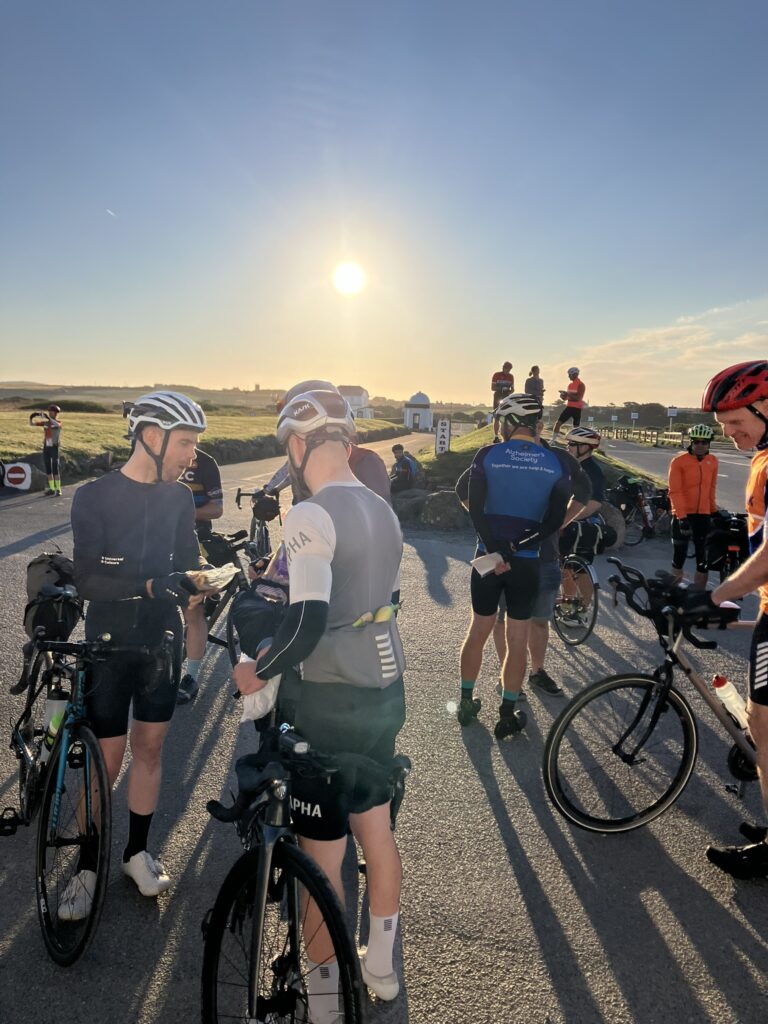
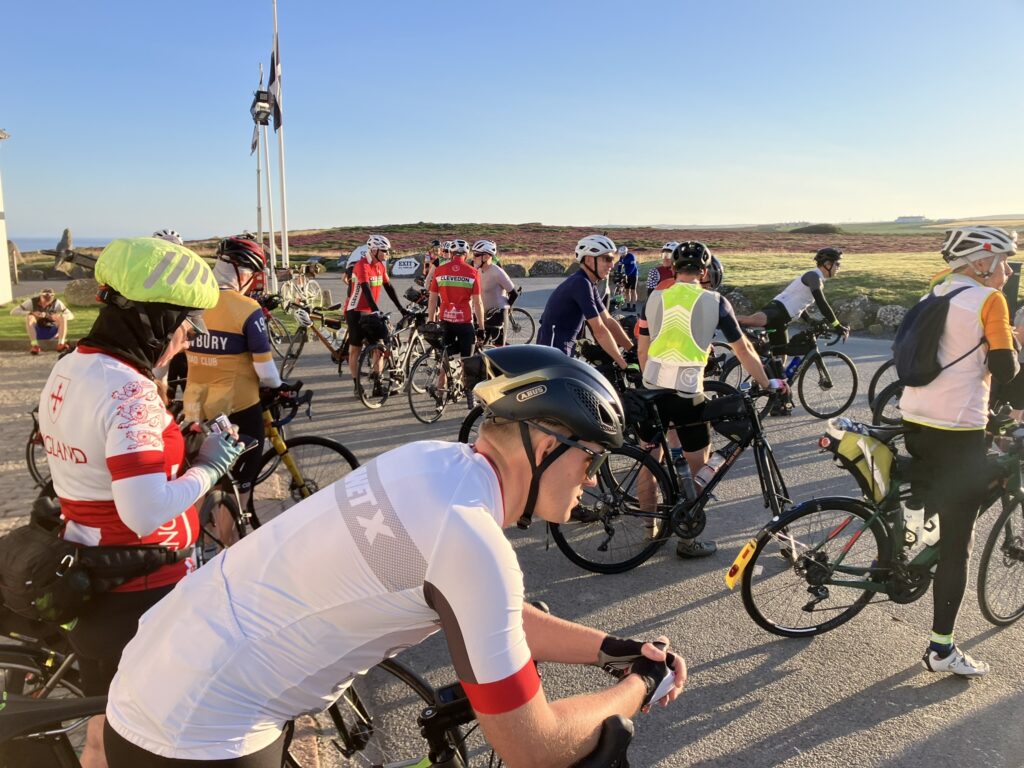
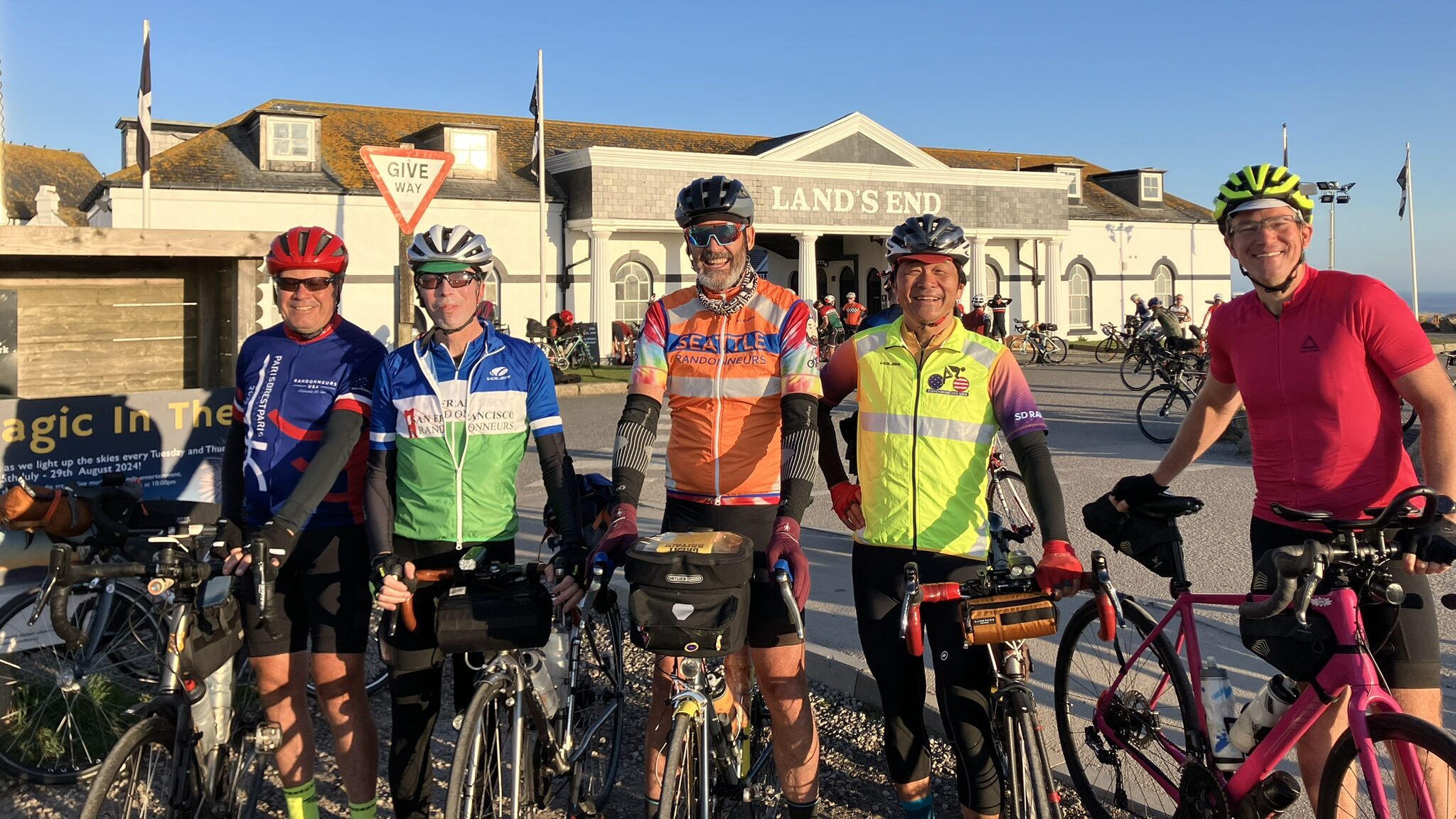
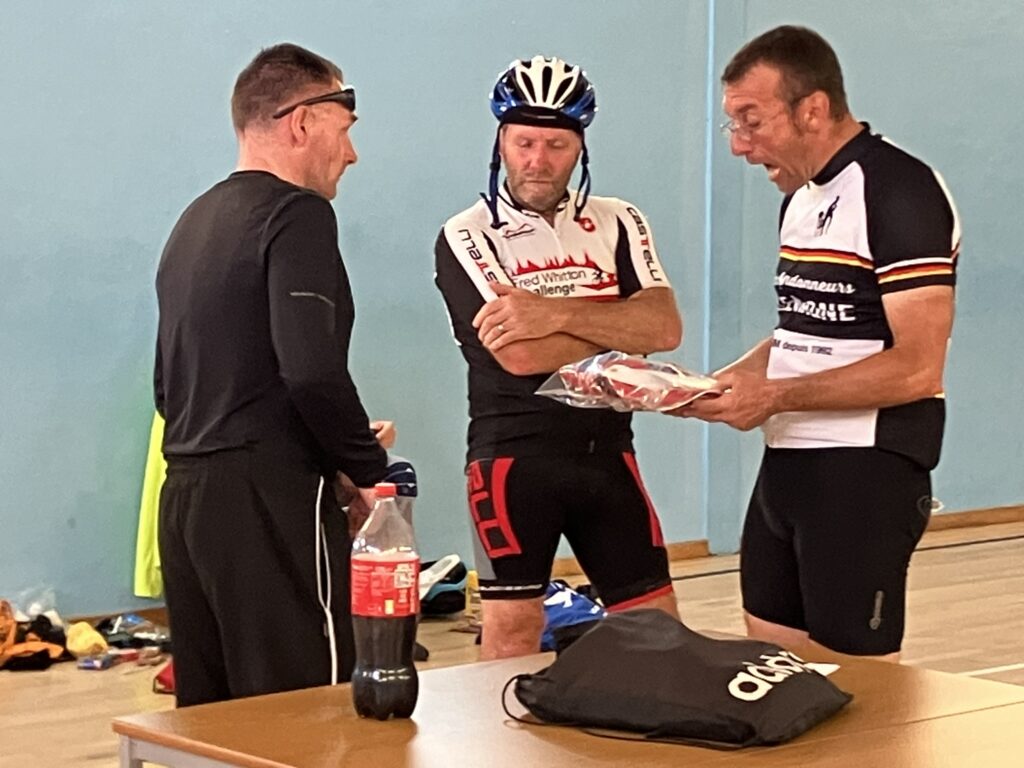
I joined a group of randos to have our photos taken by that iconic white “Land’s End” signpost to document the start of this journey. About 5 minutes before 7:00, 90 randonneurs gathered with the sun now over the horizon splashing its warm glow on our faces. In addition to Michael, Matt and me, we met 2 other RUSA randos, Mimo from DC Randonneurs and Bill from Indiana Randonneurs. We briefly celebrated this occasion with warm greetings and the obligatory start photo.
In the excitement, Andy lost track of time and finally waved us off at 7:05.
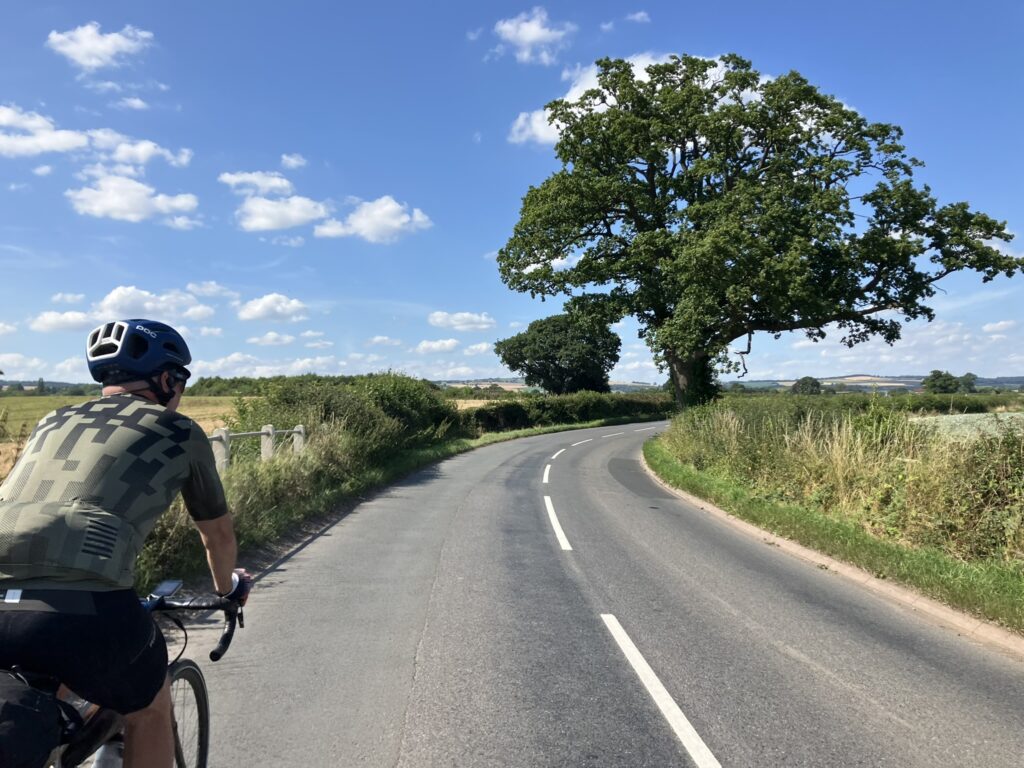
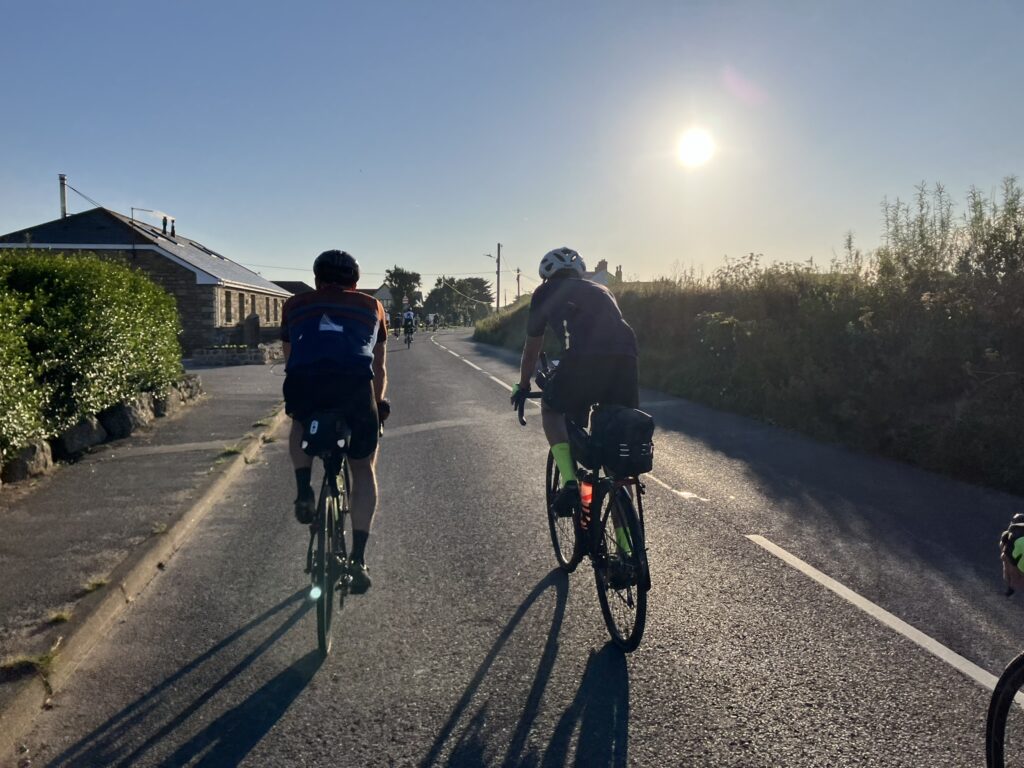
As we doubled backed on a slight climb passing through Sennen, we made a bee line toward Penzance. Rolling green fields on both sides were broken up by Cornish hedges: property boundary markers made of stone-faced earth banks. As the sun progressively climbed higher, the skies remained blue and bright. We hoped it would foretell better weather than was previously experienced in the UK that summer. A month prior to the start, our weather checks, confirmed by local friends, provided a bleak outlook of a cold, wet summer.
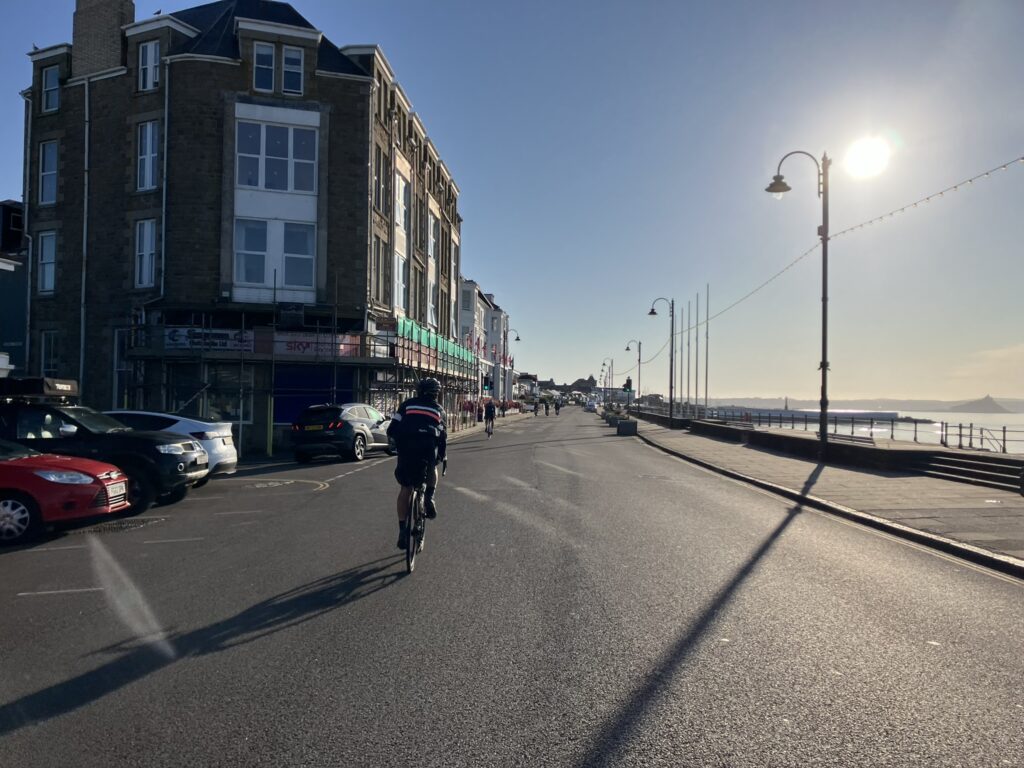
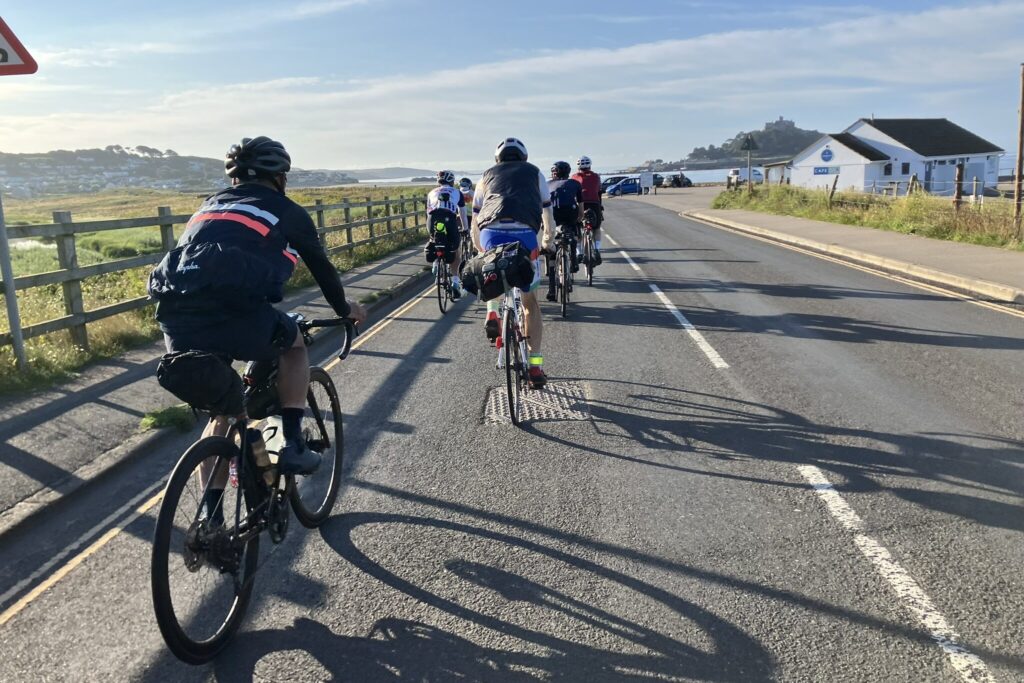
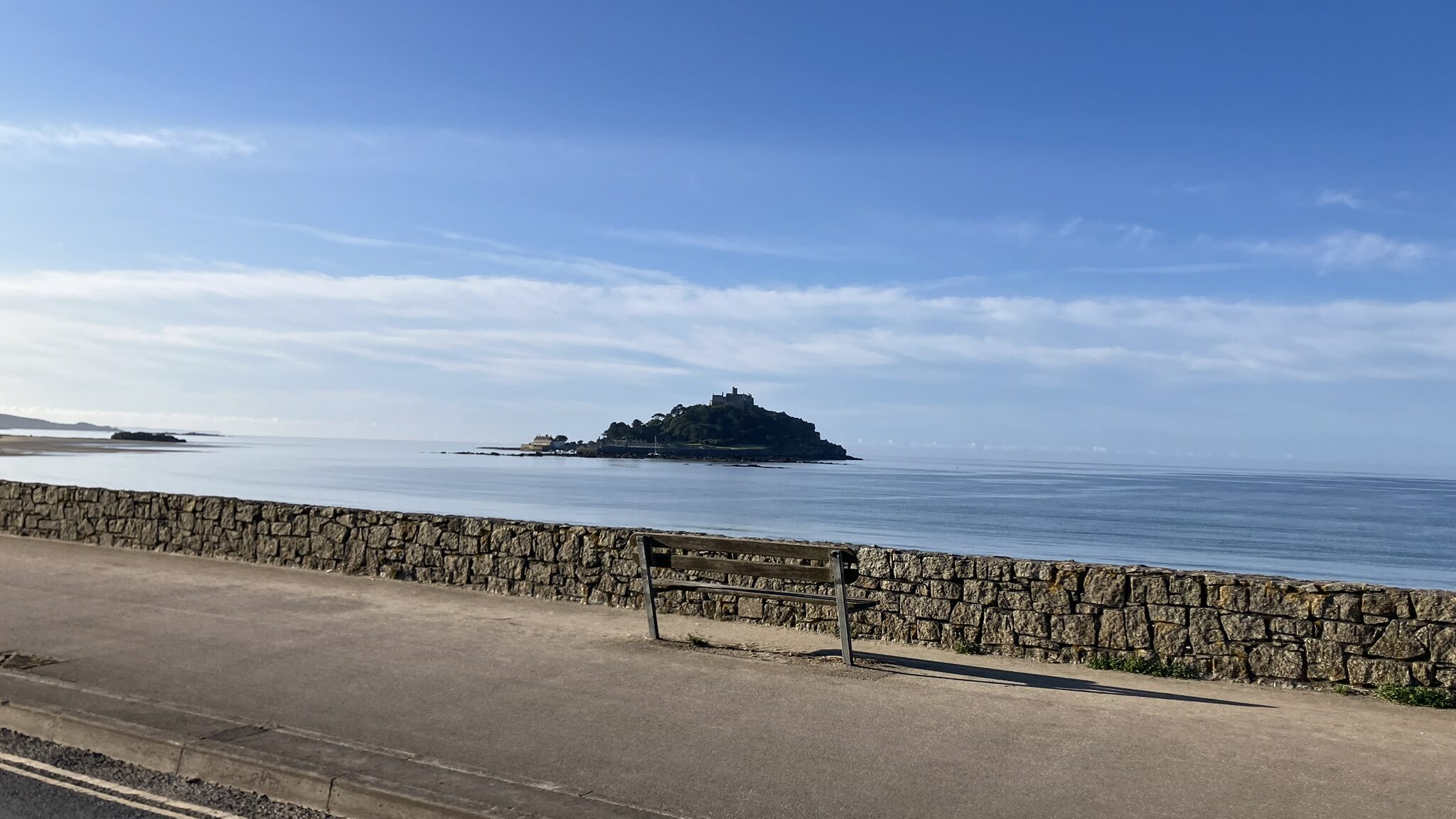
About 75% of the peloton managed to stay together as we dropped into Penzance and followed the Cornish coastline. Being still early on Sunday morning, few cars roamed about as we cut through the urban setting built up to support various beach resorts for British summer holiday makers.
Leaving Marazion, the “fun” began as we turned inland. The dominant feature of the landscape abruptly transitioned from the rolling rises and drops into much more violent peaks that abused both body and psyche. On paper, no climbs exceeded 1,000 ft, yet each upturn on the elevation profile involved a short hustle up a double-digit grade. Michael’s British friend forewarned that the Cornish and Devon climbs would slow a person down and no one could gain any speed when descending. What made for easy hiding places for lawless pirates made the Cornish geography an arduous place for riding for law-abiding randonneurs. This randonnee did not begin as a Gilbert and Sullivan operetta.
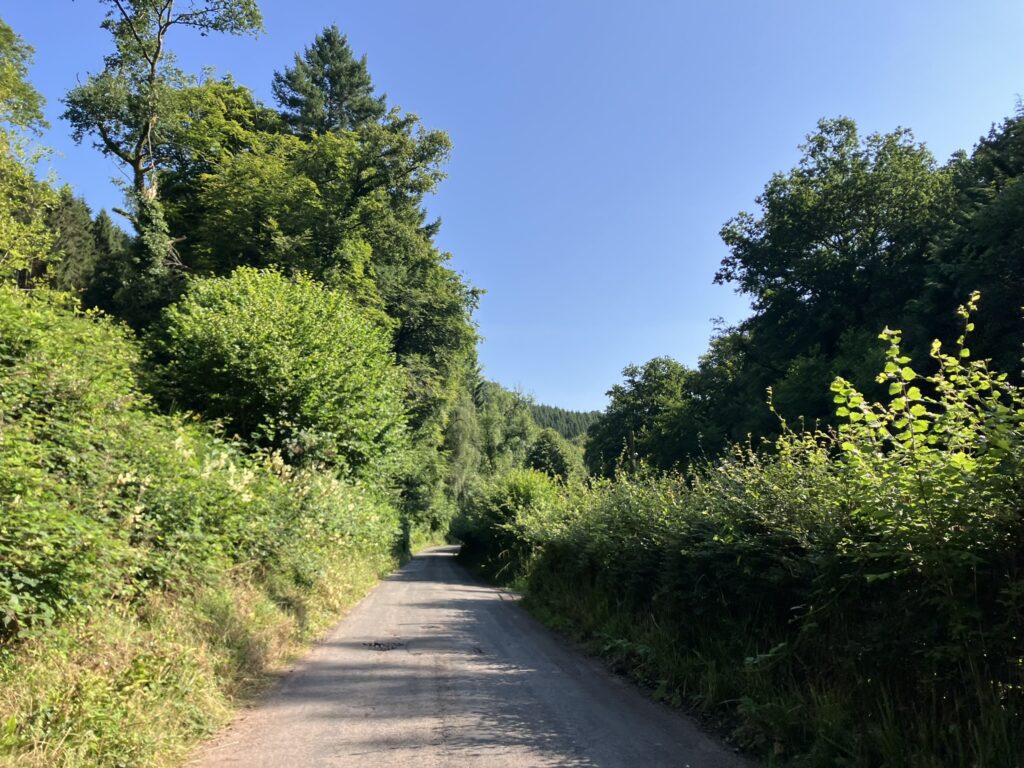
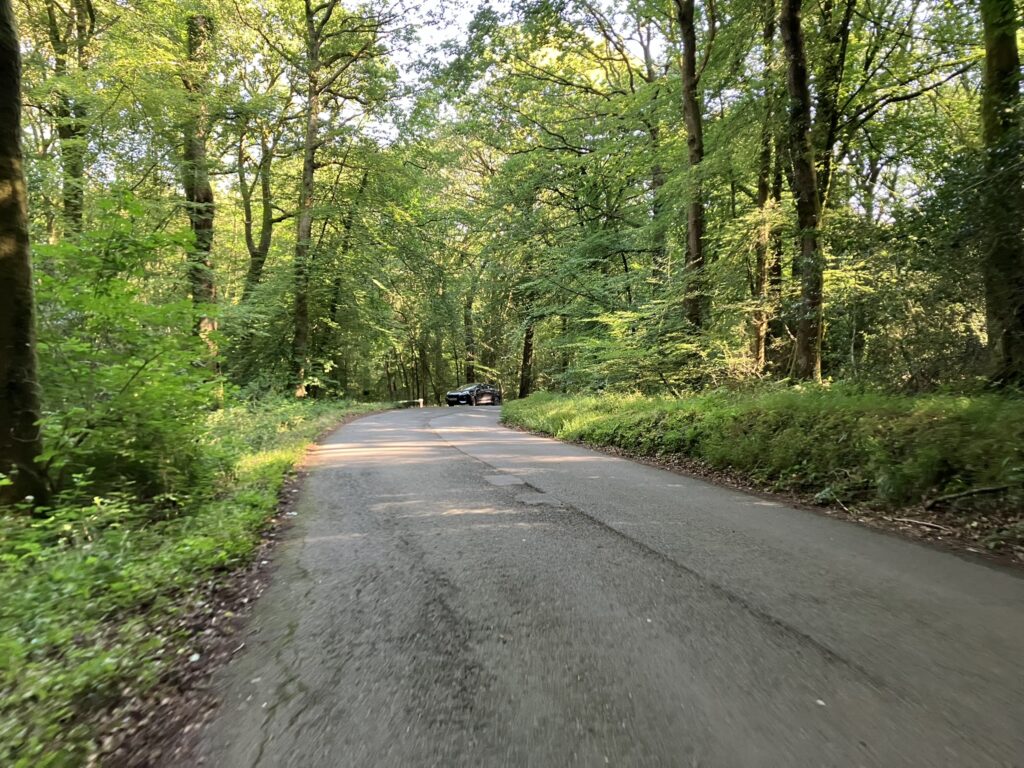
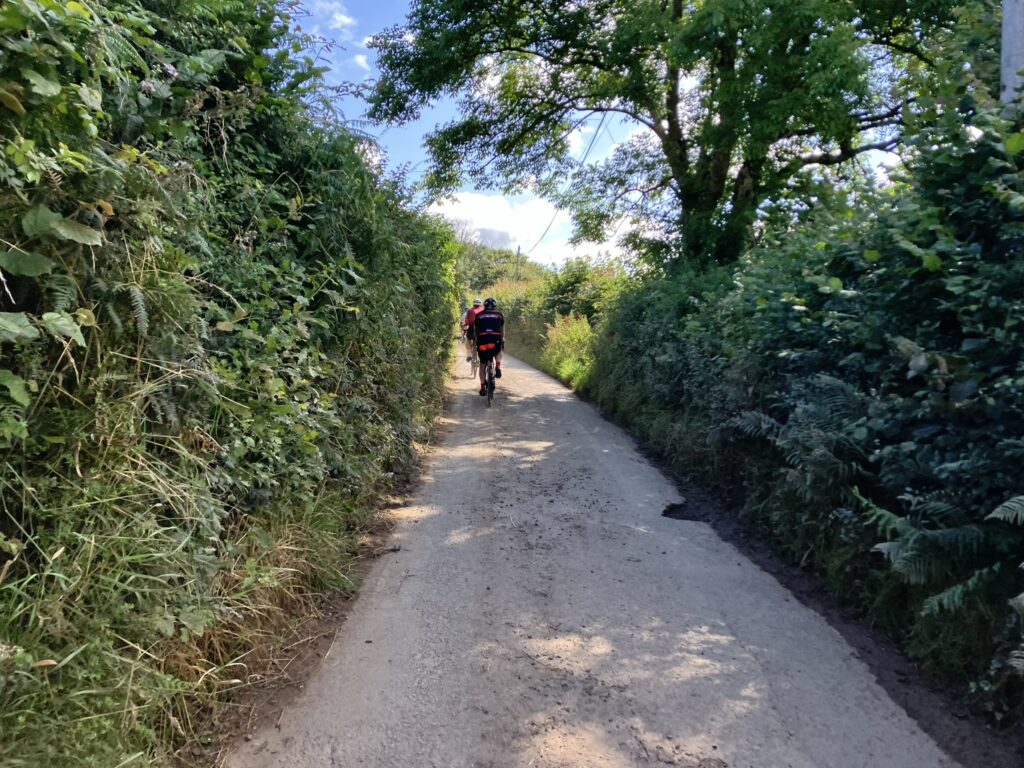
As we approached Truro, Cornwall’s county seat, we entered its surrounding areas lush with vegetation. Along the route tall overhanging hedges in rows formed tunnels. To avoid busy roads, Andy directed us onto country lanes which local farmers would use to move farming equipment from field to field. As such, the paved surfaces were rough at best in most places, some so badly broken that it felt like a gravel trail. On a bright day like that Sunday morning, descending into these dark tunnels and the sudden loss of light blinded me momentarily as my eyes couldn’t adjust in time to the change. I just gritted my teeth and braced for the violent bounces or followed the line that the rando ahead of me took, hoping he or she made the right choices. Later we found out that someone had crashed in one of these sections but were relieved to learn that he was able to continue.
Cornwall pavement
We checked in at St Stephens, the first intermediate control. Andy was there to help the other control workers. I overheard him expressing how lucky the weather turned out. If it were a fortnight ago, the heavy rain would have turned these dusty country lanes into mud traps.
Michael and I next entered County Devon as we continued a more northernly route. Known for Dartmoor and Exmoor, its landscape provided Sir Arthur Conan Doyle the sinister atmosphere created by the grotesquely shaped granite outcroppings and obscuring fog in which Sherlock Holmes and Dr Watson succeeded in solving an equally sinister crime in “The Hounds of the Baskervilles”. While its geography inspired enjoyable storytelling, Michael and I were not enjoying the unrelenting leg-jabbing climbs as we slogged on to Holsworthy, stopping at the Co-op convenience store to buy some provisions and collect that first of many receipts required for our proof of passage. The most hound-like encounters were local villagers walking their dogs.
Two nights before, Michael reported flu-like symptoms. Though it seemed to have subsided at the start, after 95 miles he began to fade. Not too far after the Holsworthy control, he told me to continue without him as he slowed his pace to assess his condition.
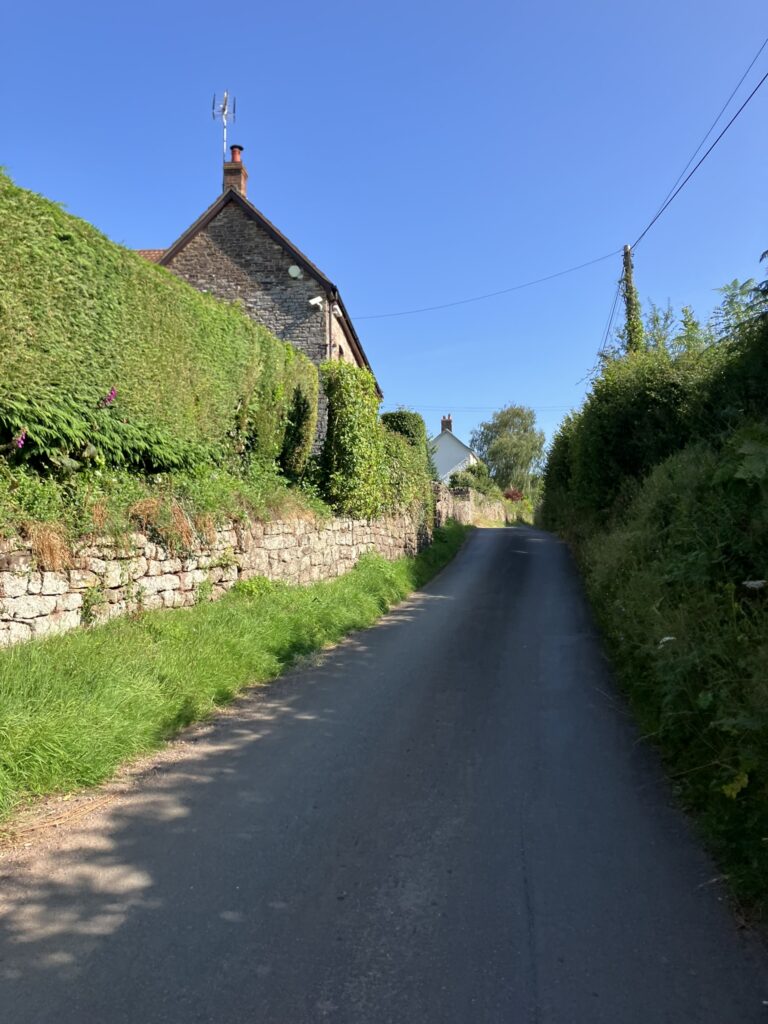
Entering County Somerset, the jagged terrain finally subsided, and I was able to enjoy some flattish stretches. Another LEJOGer caught up to me. He looked like a former time trialist who was set to hammer so I held on to his wheel for motivation and a chance to draft. When I reached the Wiveliscombe control after 151 miles, I opted to rest and wait for Michael. Arriving late in the day, I entered the Co-op with its food section already pillaged and ravaged by randos who passed through before me as if they were Attila the Hun. I managed to scrounge the less desirable leftovers for sustenance. As I forced myself to eat while sitting on a park bench in the square, Michael pulled up. After he refilled his water bottle and food supply, we headed out together.
Somerset summer
The brilliance of midday was being overwhelmed by the amber glow of an impending dusk. We meandered through several trails and country roads before Cothelstone Hill, the last major climb to do battle with before reaching Mark, our first overnight control. Its summit was a mere 850 ft, but it was defended by a section over 13%. It was one of those climbs that could break the spirit after 160 miles and 11,600 feet of elevation gain. When I reached the top, I waited for Michael, who dismounted and walked the final 100 yards. He was physically and mentally spent as the strain of a hard day in the saddle weakened his ardent defenses against the illness’s onslaught. Again, he waved me on to not let his condition dictate my timetable. I was grateful for his magnanimity.
Michael and I first rode together in PBP 2015. We formed a temporary rando alliance somewhere just before Fougere on the outbound leg toward Brest. By the time we reached Carhaix I was too sleepy and exhausted to keep up. The following year we formed another alliance on SFR’s Golden Gate 1000k. Though we briefly rode together during SLO Randos’ Pinnacle Traveler 600k for our 2019 PBP qualification, we met again later at PBP. This time we finished together in 79 hours: he completed the enterprise on a Soma steel frame fixie while I claimed faux glory on a freewheel bike. For some time, we boasted that we would not ride together unless the event was over 1000k. Over the years our friendship was forged in the furnace of stupid decisions to ride long distances in unimaginable conditions. At SFR’s Hopland 400k Centennial Brevet, we goaded each other on in the 110° F heat through Coverdale followed by what felt like freezing through Point Reyes in the dark, all for the sake of cheap trinkets.
I reached the control at Mark in the dark of night. The food offerings were meagre at best. They managed to cook up a batch of rice but nothing to complement. They ran out of the bolognaise sauce for pasta that I could use. When I asked for salt, the control worker replied: “We have no salt, I’m afraid.” There were flats of canned Heinz baked beans, a staple British foodstuff. I figured that any canned food would have sufficient salt as preservative, though British baked beans were masked by a heavy dose of sugar to satisfy the working-class palate. I asked for a couple ladles full of beans to help lubricate the flavorless rice down my gullet.
Not long afterward Michael entered the control, his clammy, pale skin and that 1000-yard stare revealed his point of exhaustion beyond return. His breathing was labored caused by congestion. Knowing his limits, he pulled the cord and declared that he was an abandonneur for LEJOG 2024.
I couldn’t be too comfortable at the Mark control as I had a non-refundable room waiting for me another 14 miles down the road at the Hilton DoubleTree in Congresbury just south of Bristol. Matt, an American expatriot registered as an Audax UK rider, took the offer to stay in Michael’s room. In the dark we pedaled on and about 11:00PM, we reached the hotel. There was no greater relief than to finish a long day with a hot shower and a nice comfortable bed with clean sheets in a quiet room to sleep.
It was a Day of Daze to battle Cornwall and Devon’s treacheries. I relished this moment of recovery to face tomorrow’s challenge. I found solace in the belief that tomorrow would be an “easy” day. Not long after laying my head down on the pillow, my consciousness fluttered off into soft oblivion.
Distance – 194 miles / 312 km
Elevation – 13,224 ft / 4,030 m (highest point – 968 ft)
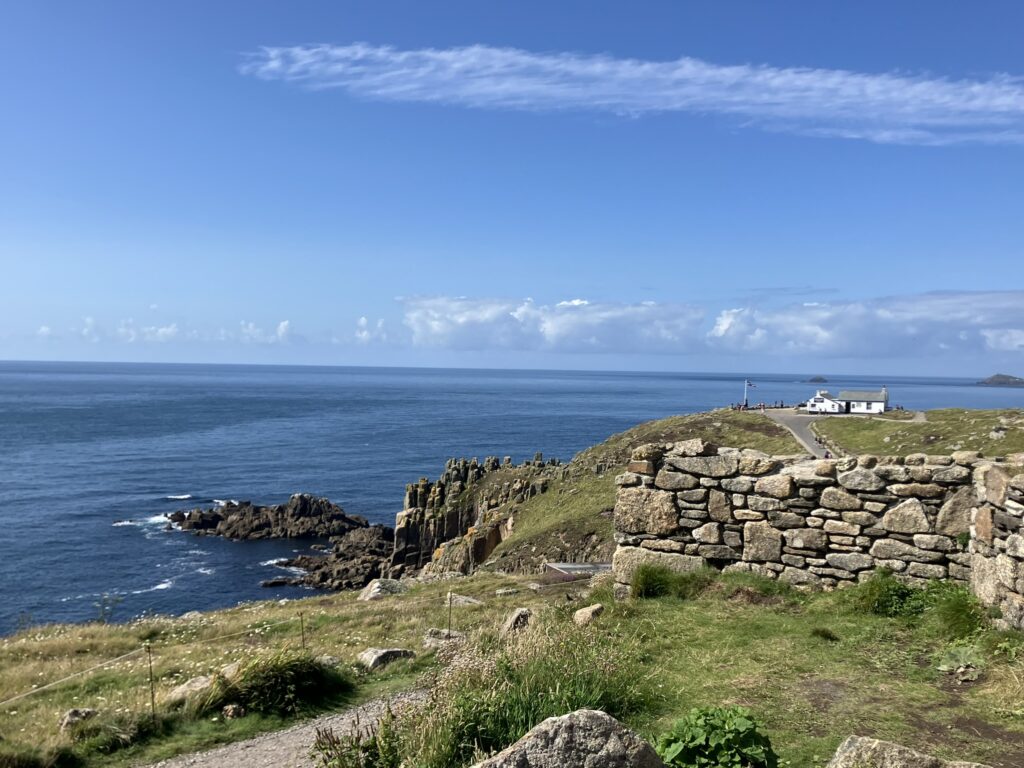
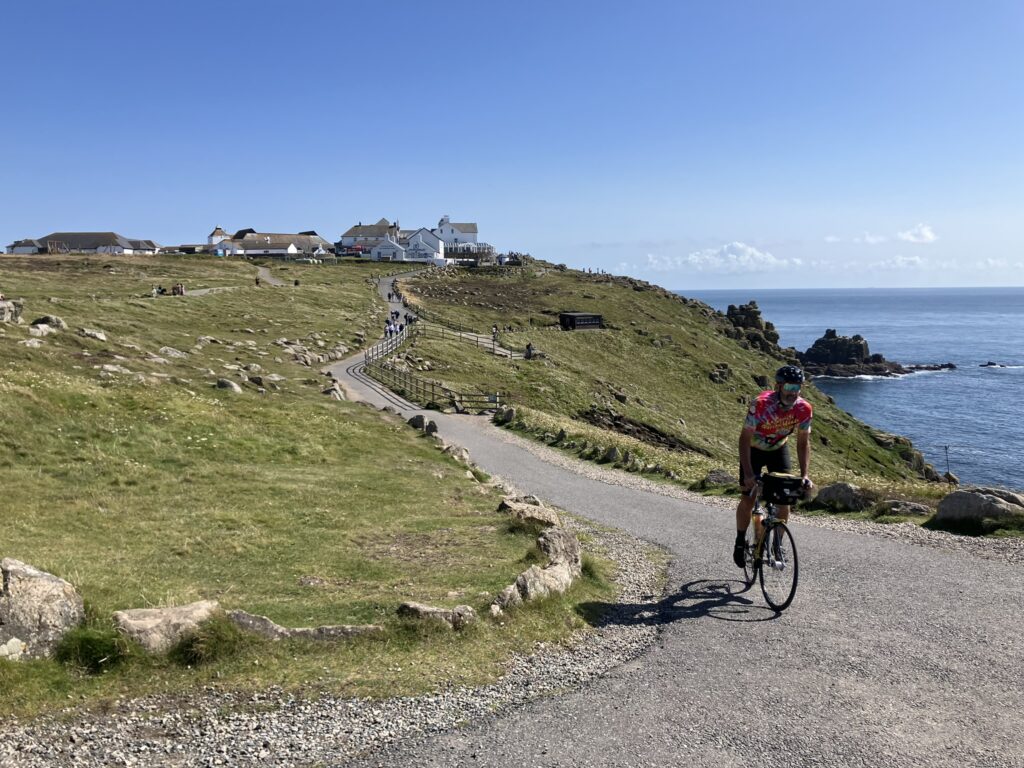
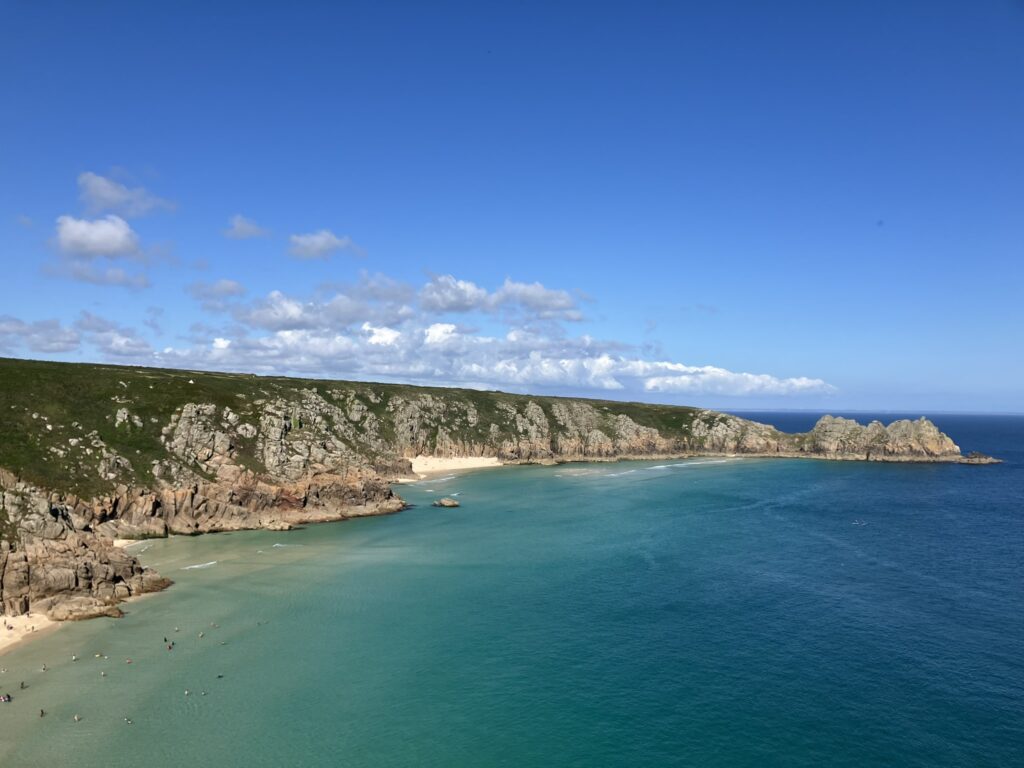
Situated at the most southwestern tip of England in County Cornwall, Land’s End is perched on the cliffs overlooking the rugged Celtic Sea. Surrounded by quaint fishing villages and farmland, its geographic marvels lend itself to an idyllic and picturesque starting point of an epic adventure.
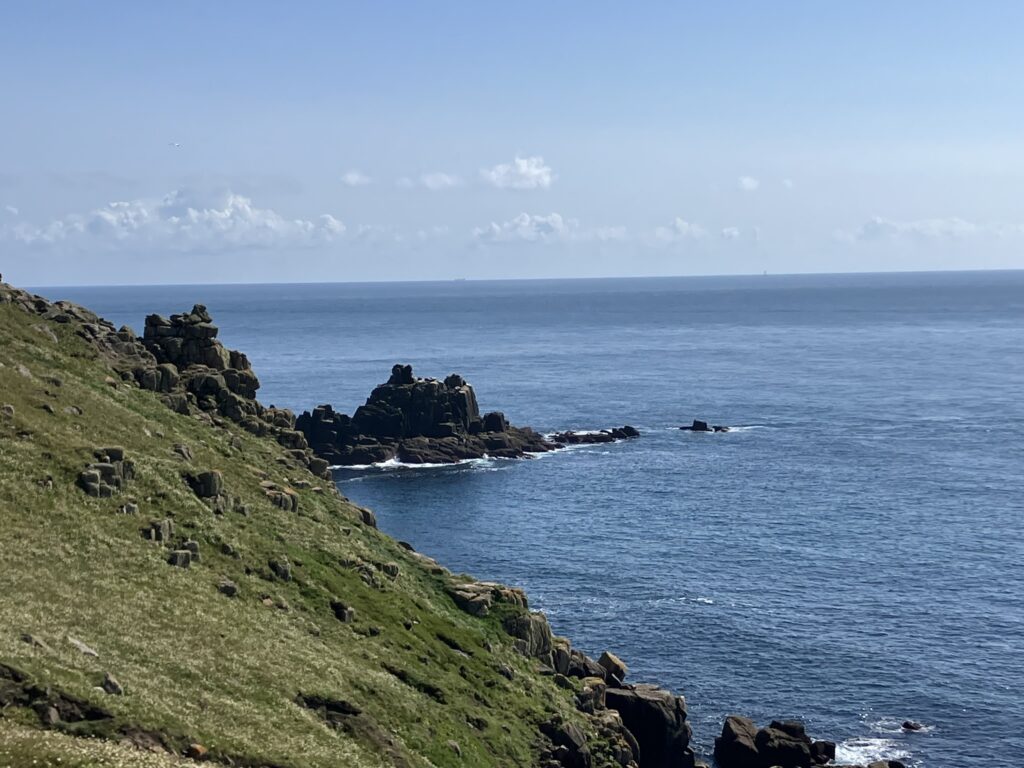
Cornish coastline
Idyllic it was for its setting; ideal it was not for rando logistics. The closest rail station was in the town of Penzance about 10 miles to the east of Land’s End. If traveling to the UK from abroad, one needed to figure out how to store bike box and other belongings plus other logistic challenges before embarking on this grand British adventure
SennenOur AirbnbKitchen
I rented a car upon arrival. After staying in London visiting friends for a couple of days, one of whom offered her home to store my bike box and other stuff, I drove out to Sennen, the village next to Land’s End, to check into the Airbnb. Michael from SF Randos chose to take the train to Penzance where I picked him up at the station. LA Matt from PCH Randos, a dyed-in-the-wool rando, took the train from London then rode from Penzance to the Airbnb fully loaded with his gear. Once the car had served its purpose, I dropped it off at the rental agency in Penzance and rode back to Sennen.
Taking care of businessLA MattOn their way
By a stroke of good fortune, Andy’s choice for the start HQ at the Sennen community center where we could pick up our brevet cards and drop off our 2 bags was about a quarter of a mile from our Airbnb. We walked there. Once relieved of our obligatory administrative chores, we stopped at Shantys Fish Bar for fish and chips to celebrate our start. Michael had a last-minute procurement visit to the SPAR convenience store next to the chip shop.
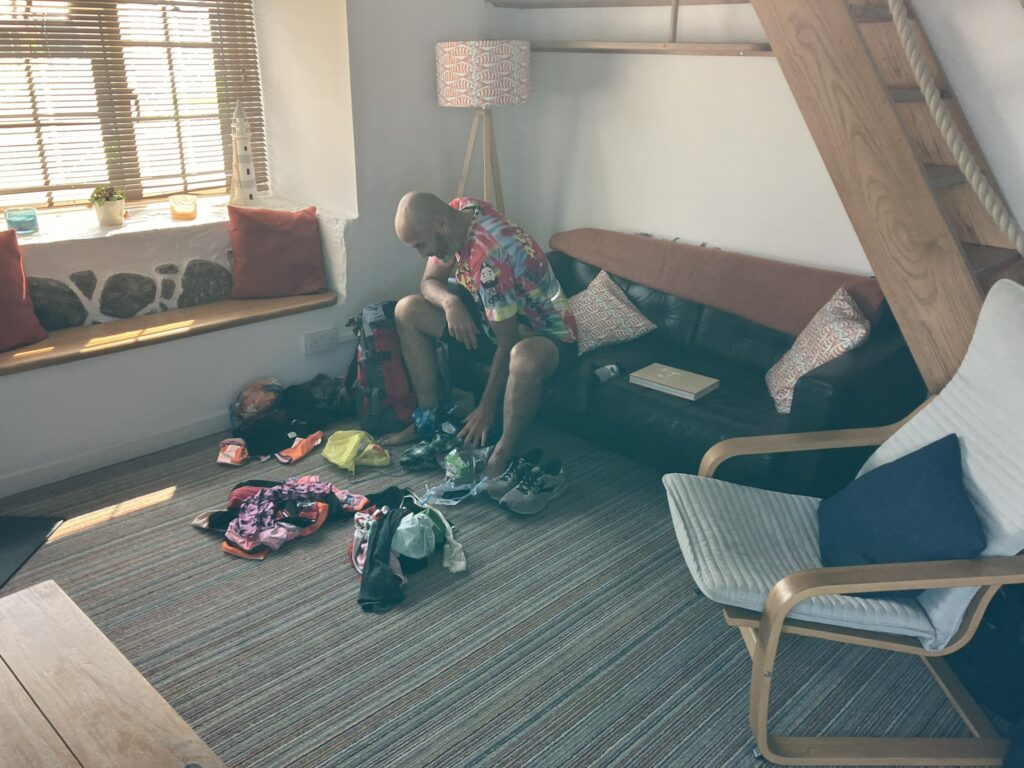
That last minute purchasesPacking up gear
That night before the start, sleep was an endeavor, not a realization. The anticipation of the upcoming adventure inevitably aroused the countless thoughts of uncertainties, fears, doubts, imagined mishaps and remembered failures, becoming a boiling sleeplessness stew mixed and stirred as I tossed and turned.
By 3:02AM, I acquiesced to the fact that it would be another sleep-deprived start in the morning….
Evocation
Thou fairest Muse, true blogger of all ages
I am but scribe who type your words on pages
Homer, Steinbeck, Van Munoz you have blessed
Their stories with your artful words expressed.
Adventures on my bike that must be told
Endeavors foolish masquerade as bold
Of self-inflicted hardships for your laughter
The type 2 fun not while but only after
Rando’s travails are stories to rejoice
Their foolish deeds when fools like me give voice
No greater joy than share with friends the smiles
To read my tale of riding senseless miles.
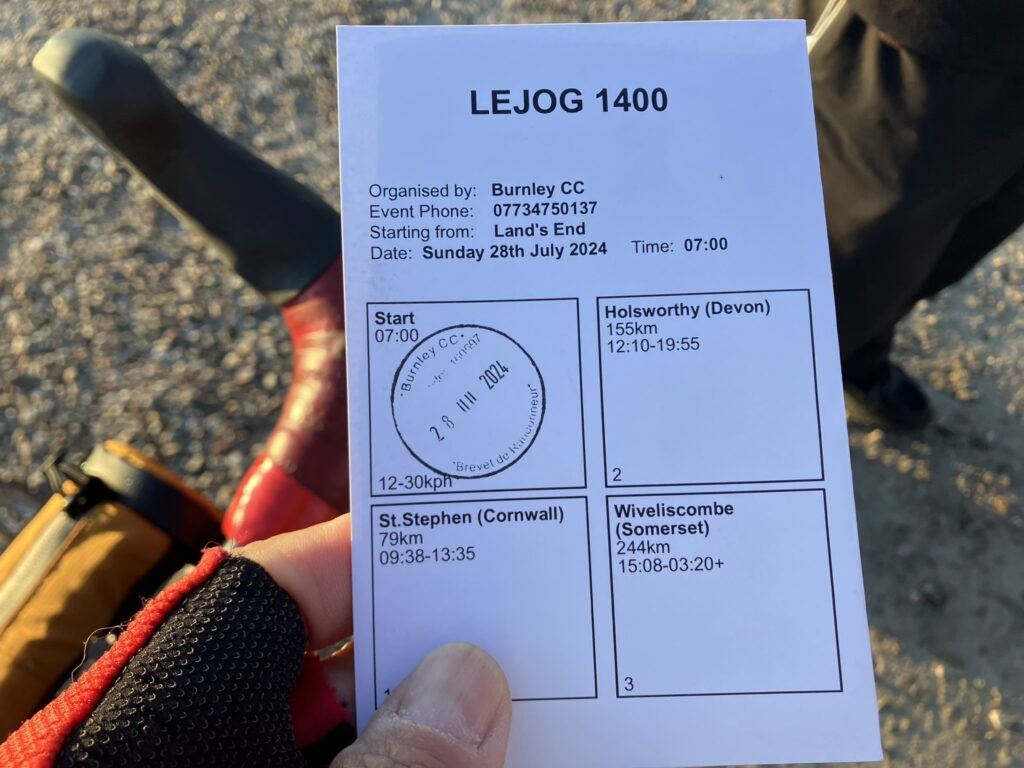
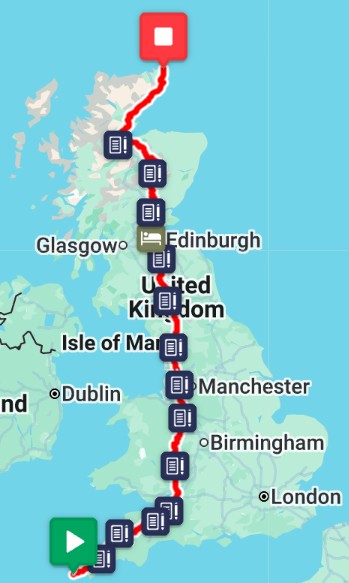
Land’s End to John O’Groats (LEJOG) is a 1400km grand randonnee organized by Audax UK through Burnley CC. While not as well known in the rando world as London-Edinburgh-London (LEL), LEJOG has been in the pantheon of British endurance challenges since 1871 when 2 brothers, John and Robert Naylor, completed their journey.
LEJOG’s home page sums up the journey most succinctly:
… is the traversal of the whole length of the island of Great Britain – a long-standing route from the southwestern tip to the north-eastern tip of the UK; from Cornwall through the Cotswold; Wales; the Scottish Lowlands, and finishing off in the Scottish Highlands – a windswept land of glacial lakes and an economy of trees. A succession of different terrains, architecture, and history.
Unlike other iconic grand randonnées such as PBP and LEL that are out and back courses, LEJOG is an extended point-to-point trek. This unique feature, while giving riders the opportunity to see the whole expanse of the British Isles, also creates logistical challenges, especially for those participants who are coming from abroad.
The lead organizer was Andy Corless of Burnley CC: a stocky man with short, cropped hair and a square jawline. He spoke with a Lancastrian accent broader than his shoulders, on those rare occasions when he did speak. He looked more like a rugby scrum half than a cyclist, which made him an ideal randonneur. His piercing eyes displayed that fierce taciturn tenacity to get shit done, a necessary quality to carry out this endeavor. LEJOG was his baby.
Andy Corless on the left
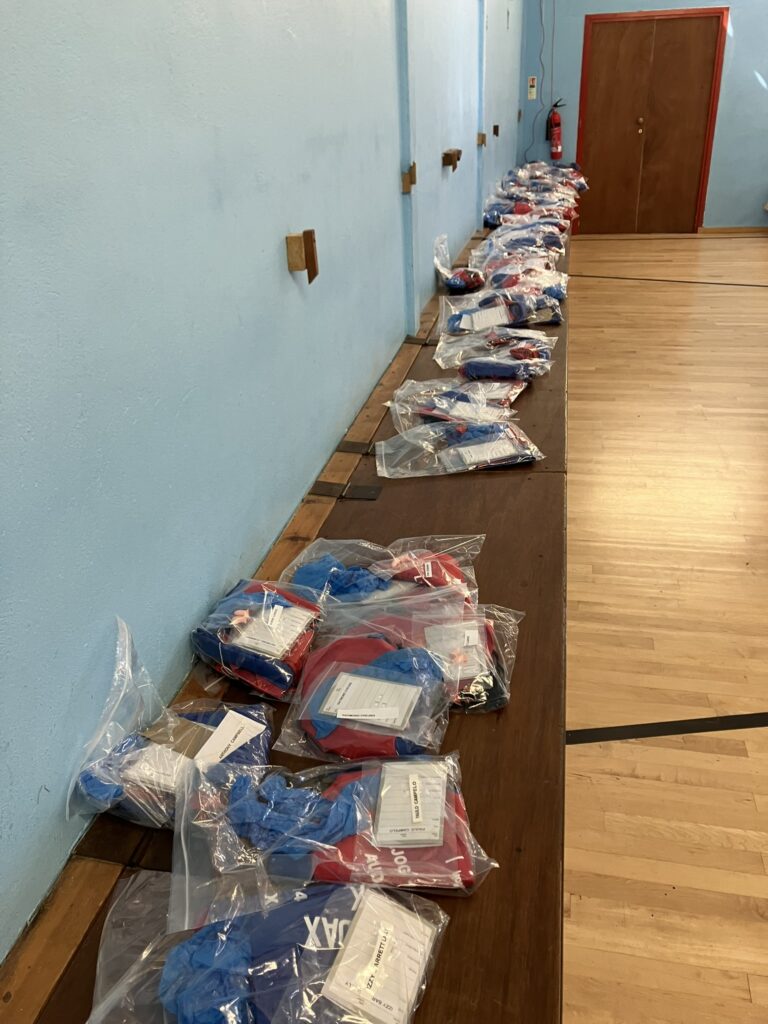
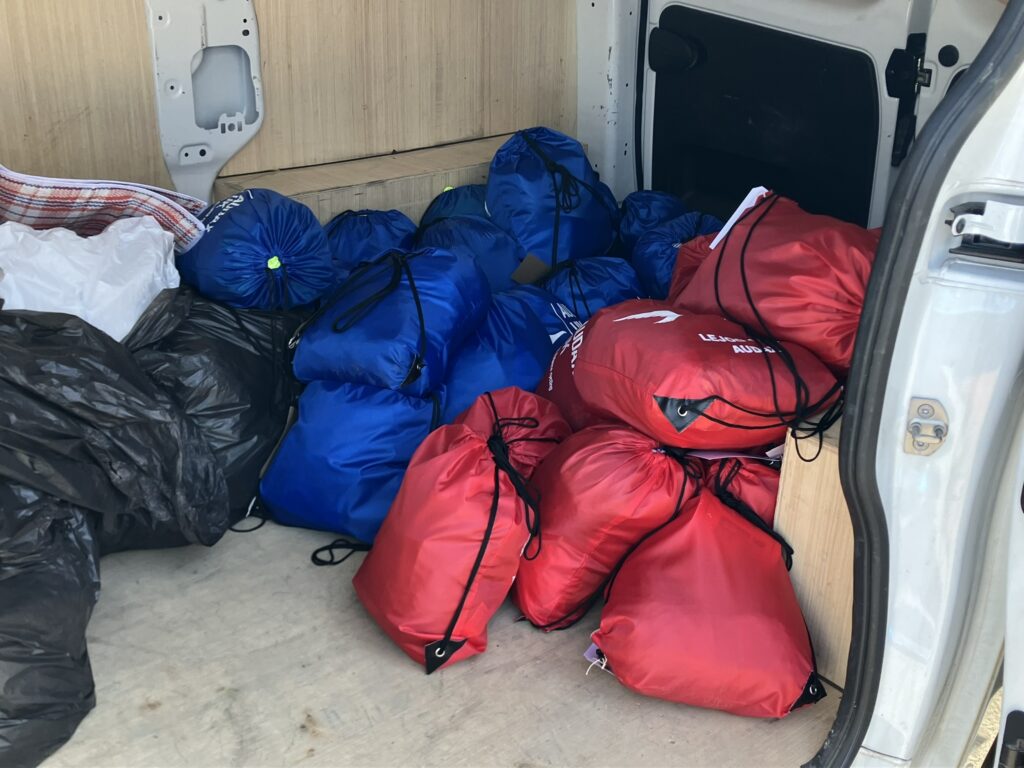
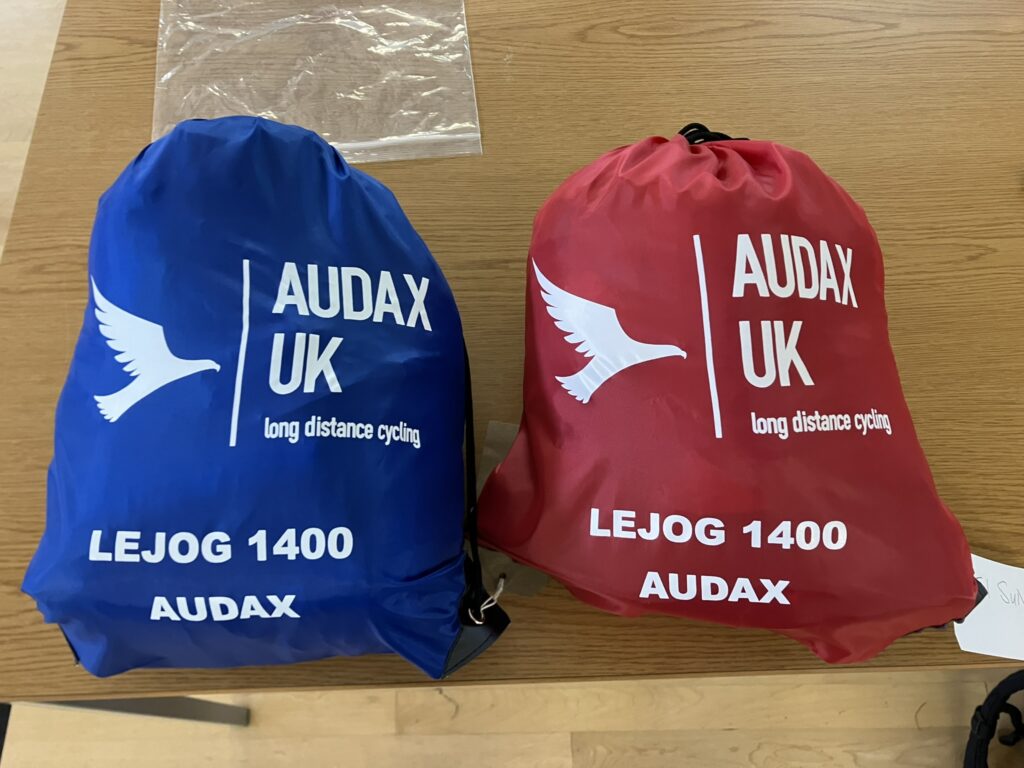
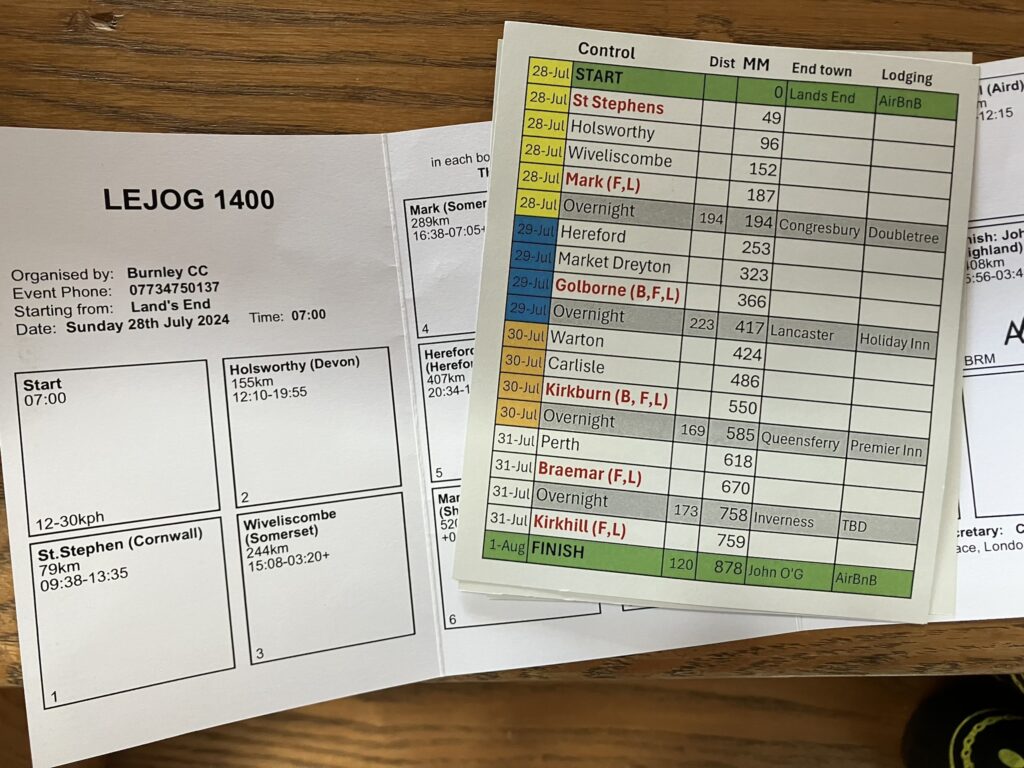
We were allotted 116 hours and 40 minutes to finish. There were 4 overnight controls that provided air mattresses or beds, if available, as well as food, though we were allowed to make our own lodging arrangements. The organizers would support only 2 bag drops (1 bag at the 2nd overnight control in Golborne at mile 366 and the 3rd control in Kirkburn in the Scottish Lowlands at mile 550).
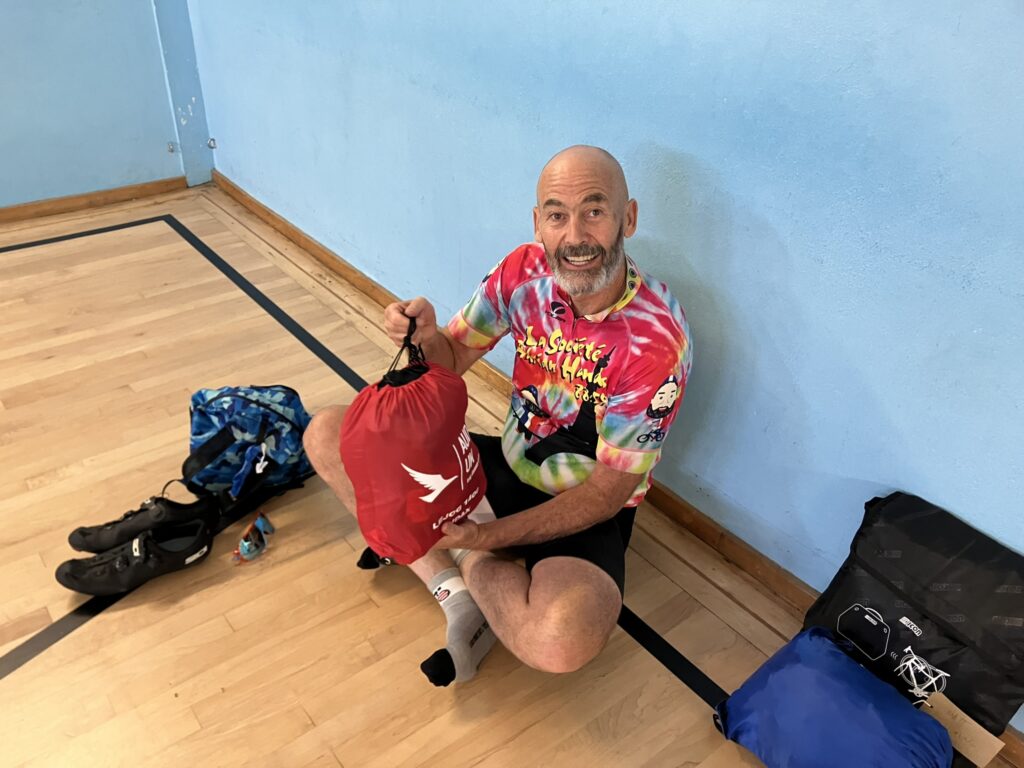
The 2 drop bags
In late 2023 when Michael and I were discussing rando goals for 2024, I mentioned that I registered for LEJOG. Not long after our exchanges, he texted me that he too had registered. It seemed to have that right mix of Homeric adventure sprinkled with good bits of Quixotic ambitions. On paper the decision to take part was just stupid enough to become a great story to recount after completion.
The best laid schemes ….
We began planning in earnest. We worked out our schedule to stay at hotels by pushing further each night than places Andy had arranged for overnight controls. Not knowing how they would be staffed and the quality of food on offer, we settled on quality sleep at the hotels and good food at restaurants along the way as our recipe for success. The goal was to finish in 110 hours: not overly ambitious and leaving enough buffer to account for unforeseen delays. We were really looking forward to notching another grand randonnee on our randonneur to-do list.